Infant Baptism and the Covenant of Grace
The Biblical Place of Believers’ Children in the People of God
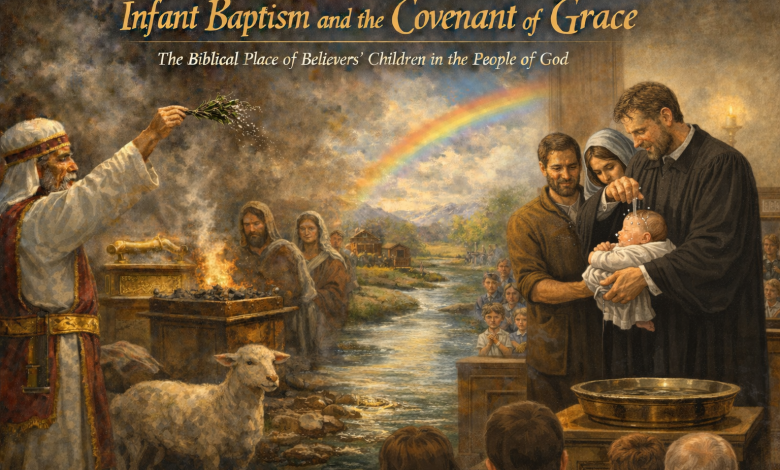
I. Introduction: The Question of Infant Baptism in the Life of God’s People
Among the persistent points of division within Protestant ecclesiology, few have proven as divisive as the theology of baptismal administration—specifically, whether the children of believing parents ought to receive the covenant sign.[1] This question extends beyond mere ecclesiastical custom; it concerns the fundamental architecture of God’s redemptive dealings, the structural unity of the covenant of grace, and the precise boundaries of the visible church. As the Westminster Confession of Faith defines it, the visible church consists not only of those who profess the true religion but also “of their children.”[2] To address infant baptism is to engage the fabric of biblical theology, directly implicating the continuity of God’s saving purposes from the Abrahamic epoch to the messianic age.[3]
The theological implications of this debate are profound. If the paedobaptist paradigm is correct, withholding the sacramental sign from the children of believers deprives them of an ordained covenantal blessing, formally treats them as outsiders to the visible church, and introduces a redemptive-historical discontinuity unwarranted by Scripture. Because covenant children are, as Herman Bavinck argues, “born in the covenant,” they possess a divine right to its initiatory sign.[4] To withhold this sign is to declare to the seed of believers that they remain outside the covenant family until they demonstrate autonomous faith, fundamentally altering the Abrahamic promise that God will be a God “to you and to your offspring after you” (Gen. 17:7). Such a position, if erroneous, carries grave consequences for the spiritual nurture of covenant children and the church’s faithfulness to divine revelation.
Conversely, if the credobaptist position is biblically accurate, administering baptism to infants fundamentally confounds the regenerate nature of the new covenant. From this perspective, paedobaptism administers the sign apart from the reality it signifies, presumes a subjective spiritual state that the New Testament does not authorize, and violates the regulative principle of worship by departing from the apostolic pattern of believer’s baptism.[5] As John L. Dagg classically articulated, baptism as a sign of regeneration must invariably be preceded by a credible profession of faith.[6] To practice otherwise is to confuse the outward administration of the covenant with its inward, saving efficacy.
The debate, therefore, transcends minor ecclesiastical differences; it represents a fundamental inquiry into the life and health of the church. It requires rigorous engagement with the Scriptures, informed by the combined disciplines of biblical theology, systematic dogmatics, and church history. Resolving this tension requires a deep appreciation for the overarching covenantal structure that organizes redemptive history from Genesis to Revelation.[7]
In Reformed sacramental theology, the ordinances are not bare, memorialistic signs but divinely appointed means of grace. As the Westminster Shorter Catechism specifies, through these sensible signs “Christ, and the benefits of the new covenant, are represented, sealed, and applied to believers.”[8] When the church administers baptism, it objectively declares God’s covenantal faithfulness to the household.[9] The practice of infant baptism, therefore, rests upon strict biblical warrant and necessary covenantal deduction rather than sentimentality. The church’s administration must be governed entirely by scriptural command and good and necessary consequence, rather than human tradition.[10]
The present article defends the paedobaptist position as the necessary doctrinal consequence of Scripture, the consistent practice of the historic church prior to the sixteenth-century Radical Reformation, and the proper sacramental administration of the covenant of grace.[11] The thesis argued here is that infant baptism is a biblically warranted, covenantally grounded, and historically attested doctrine. It arises not as an isolated liturgical custom, but as a necessary implication of the overarching unity of the covenant of grace, the historic inclusion of believers’ children in the Old Testament community, and the organic relationship between Old and New Testament sacramental administration.[12]
This thesis rests upon five foundational pillars. First, the covenant of grace is essentially one in substance across all its administrations; therefore, the principles governing covenant membership remain consistent unless explicitly abrogated by Scripture.[13] Second, the Old Testament consistently includes believers’ children in the covenant community, mandating the application of the covenant sign to them (Gen. 17:10–12). Third, the New Testament confirms this principle, expanding the covenant to include all nations while explicitly retaining the promise “for you and for your children” (Acts 2:39). Fourth, the practice of the early church confirms that infant baptism was not a medieval innovation but the historic practice of the Christian communion.[14] Fifth, credobaptist objections fail to account for the full scope of biblical teaching, introducing a severe discontinuity into redemptive history.
To demonstrate this thesis, the present study adopts a strictly redemptive-historical and covenantal methodology. The argument traces the unfolding of God’s covenantal purposes, beginning with the theological foundations of the Abrahamic administration. Subsequent sections will examine the lexical and conceptual framework of the covenant, the structural relationship between circumcision and baptism—where baptism functions as the new covenant counterpart to circumcision[15]—and the New Testament data regarding household solidarity and the apostolic declaration that the children of believers are covenantally “holy” (1 Cor. 7:14).[16]
After clarifying the Reformed distinction between the sacramental sign and the thing signified (res sacramenti)—recognizing, with the Westminster divines, that “grace and salvation are not so inseparably annexed unto it, as that no person can be regenerated or saved without it” [17]—the article will explore the ecclesiastical implications of child membership. A historical survey will establish the continuity of paedobaptist practice from the early church through the magisterial Reformation.[18] This will be followed by a critical engagement with the credobaptist paradigm, evaluating its exegetical and theological claims, before concluding with the confessional formulations that govern the pastoral administration of the sacrament.[19]
Ultimately, the inclusion of children in the covenant community is not a peripheral liturgical debate, but a central feature of how God administers his grace under the lordship of Jesus Christ.[20] The objective of this study is to articulate a constructive vision of the covenant of grace and the place of children within it, grounded in the Word of God and confirmed by the witness of the historic church.
II. The Biblical Foundation: Covenant, Promise, and the People of God
A. Covenant as the Organizing Principle of Redemptive History
Any proper understanding of infant baptism must begin with the biblical concept of covenant (Hebrew berit; Greek διαθήκη). The covenant is not a peripheral motif in Scripture but the central organizing principle by which God relates to his people.[21] From Genesis to Revelation, God’s dealings with humanity are structured covenantally: with Adam (Hos. 6:7; cf. Gen. 2–3), with Noah (Gen. 6–9), with Abraham (Gen. 12, 15, 17), with Israel at Sinai (Exod. 19–24), with David (2 Sam. 7), and finally through the new covenant inaugurated in Christ (Jer. 31:31–34; Luke 22:20; Heb. 8–10).[22] The covenant serves as the indispensable lens for redemptive history, constituting the formal means by which God binds himself to his elect and establishes the terms of their communion.[23]
The Westminster Confession of Faith perfectly captures the theological necessity of this framework: “The distance between God and the creature is so great, that although reasonable creatures do owe obedience unto Him as their Creator, yet they could never have any fruition of Him as their blessedness and reward, but by some voluntary condescension on God’s part, which He hath been pleased to express by way of covenant.”[24] Consequently, the covenant is God’s gracious condescension to his creatures. It is not a negotiated contract between equals but what Herman Bavinck describes as a “sovereign disposition” (foedus monopleuron) by which God unilaterally binds himself to his people while calling them to reciprocal obedience.[25]
The covenant of works, established with Adam prior to the fall, promised life upon the strict condition of perfect and personal obedience (Gen. 2:17; Gal. 3:12; Rom. 10:5).[26] Adam stood not merely as a private individual but as the federal head of humanity, representing all his natural posterity. When Adam violated this probationary command, plunging humanity into sin and death (Rom. 5:12–21), God did not abandon his redemptive purpose to dwell with a people.[27] Rather, he immediately promised a Redeemer and instituted the covenant of grace, wherein salvation is secured not by human merit but through faith in the promised Seed.[28]
This covenant of grace finds its initial administration in the protevangelium (first gospel) of Genesis 3:15, which promises that the seed of the woman will crush the head of the serpent.[29] This foundational covenant is progressively unfolded throughout redemptive history—through the patriarchal, Mosaic, and Davidic epochs, culminating in the new covenant in Christ—yet all administrations share the exact same essential substance: salvation by grace through faith in the promised Mediator (Gal. 3:8; Heb. 4:2).[30] As John Calvin argues, the covenant made with the patriarchs “is so much like ours in substance and reality that the two are actually one and the same,” differing only in the mode of administration.[31] This underlying unity is a non-negotiable premise for understanding the status of children in the visible church. If the covenant of grace is essentially one, the burden of proof rests heavily upon those who postulate a radical discontinuity in the principles of covenant membership.[32]
The theological concept of federal representation is structurally crucial for understanding this continuity. Just as Adam stood as the federal head of humanity in the covenant of works, and Christ stands as the federal head of the elect in the covenant of grace (Rom. 5:18–19), a subordinate principle of covenantal solidarity operates within the family.[33] While parents do not impute righteousness to their offspring for salvation, they do stand as covenantal representatives for their households, bringing their children into the objective sphere of the visible church. As Bavinck rightly observes, “The children of believers are born in the covenant, and as covenant children they have a right to baptism.”[34]
Furthermore, the covenant of grace is not merely a guarantee of future eschatological blessings but a present, objective reality that structures the visible community. The covenant fundamentally consists of both promises and obligations. Because the children of believers are formally included in the covenant, they inherit both its promises and its demands. The Westminster Larger Catechism defines a sacrament as a holy ordinance instituted by Christ to “signify, seal, and exhibit” the benefits of his mediation, while putting the recipients “under a solemn obligation to obedience.”[35] The infant receives the sign of the covenant, which objectively signifies the divine promise, and is simultaneously obligated to appropriate that promise by personal faith as they mature.
The Westminster Confession emphasizes that despite variations in outward administration, “there are not therefore two covenants of grace, differing in substance, but one and the same under various dispensations.”[36] This dogmatic formulation is the hinge upon which the paedobaptist argument turns. If the covenant of grace is one, the principles governing membership must remain consistent across testaments. Under the old economy, God administered the covenant through circumcision and explicitly included the seed of believers. Under the new economy, the covenant is administered through baptism and, barring an explicit divine revocation, must continue to include them. As Calvin forcefully reasons, if the children of Old Testament believers were granted the covenant sign, withholding it from the children of Christians would constitute “a manifest injury to God’s covenant.”[37]
B. The Abrahamic Covenant: Foundational for Understanding Covenant Children
The administration of the covenant of grace with Abraham (Gen. 12:1–3; 15:1–21; 17:1–27) is of paramount importance for this inquiry, for it is here that God explicitly and repeatedly addresses the status of children within the visible church. As John Calvin argues, the Abrahamic covenant serves as the theological foundation for infant baptism, demonstrating that God’s will is to include the seed of believers in his redemptive community.[38] In Genesis 12:1–3, God makes promises to Abraham that encompass both land and offspring, declaring, “in you all the families of the earth shall be blessed.” This promise of universal blessing not only foreshadows the inclusion of the Gentiles in the new covenant, but it establishes the architectural principle that covenantal blessings extend organically beyond the individual to wider households and nations.[39]
Genesis 15 formalizes these promises in a solemn covenant ceremony where God alone passes between the severed pieces (Gen. 15:17). This divine self-maledictory oath signifies that the covenant rests ultimately upon divine faithfulness rather than human performance.[40] God reiterates the promise of offspring, commanding Abram to number the stars, and declaring, “So shall your offspring be” (Gen. 15:5). Abram believed the Lord, and it was counted to him as righteousness (Gen. 15:6)—the foundational text for the apostolic doctrine of justification by faith (Rom. 4:3; Gal. 3:6). This sequential connection is crucial: Abraham received justification by faith, and circumcision was subsequently given as a “sign and seal” of that preexisting righteousness (Rom. 4:11).[41] For Abraham, the sign followed faith; for his infant descendants, however, the sign preceded personal faith, administered strictly on the objective basis of the covenant promise.
Genesis 17 is the pivotal chapter for understanding the ecclesiological status of covenant children.[42] Here God formally institutes the covenant sign of circumcision and explicitly mandates its administration to infants. The chapter opens with God appearing to Abram at ninety-nine years old: “I am God Almighty; walk before me, and be blameless, that I may make my covenant between me and you, and may multiply you greatly” (Gen. 17:1–2). The covenant is established not merely with the patriarch, but organically with his offspring: “And I will establish my covenant between me and you and your offspring after you throughout their generations for an everlasting covenant, to be God to you and to your offspring after you” (Gen. 17:7).
Several features of this administration demand attention. First, the covenant is established simultaneously with Abraham and his descendants. The offspring are not merely indirect beneficiaries of the patriarch’s faith; they are themselves formal parties to the covenant. The Hebrew phrase le-zar‘aka ’achareka (לְזַרְעֲךָ אַחֲרֶיךָ, “to your offspring after you”) structurally secures the children within the covenant relationship.[43]
Second, this covenant is described as “everlasting” (עוֹלָם, ‘olam), extending throughout their generations. In this context, ‘olam denotes an indefinite, perpetual continuance into the future rather than a strictly philosophical eternality.[44] It indicates that the Abrahamic administration is not a temporary historical arrangement but a perpetual paradigm for successive generations. This continuity is foundational to the Westminster Confession’s assertion that there are not two differing covenants of grace, “but one and the same, under various dispensations.”[45]
Third, the substantive content of the covenant promise is that the Lord will be God to Abraham and to his seed. This formula—“I will be your God”—functions as the central, unifying promise of redemptive history, echoing throughout the prophets and finding its ultimate fulfillment in the new covenant (Jer. 31:33; Heb. 8:10).[46] Because this promise of personal, covenantal communion is expressly made to Abraham and his offspring, the children are objectively included in the promise.
The appointed sign of this covenant is circumcision:
“This is my covenant, which you shall keep, between me and you and your offspring after you: Every male among you shall be circumcised…. He who is eight days old among you shall be circumcised. Every male throughout your generations, whether born in your house or bought with your money from any foreigner who is not of your offspring… shall surely be circumcised.” (Gen. 17:10, 12)
Here the biblical text explicitly commands the inclusion of infants in the covenant sign: the eight-day-old male receives the mark of membership. This administration occurs not because the infant can personally profess faith or cognitively grasp the significance of the rite, but purely because the covenant is established with the household.[47] The sign is applied to the offspring strictly on the basis of their covenantal relationship to God through their federal head. Significantly, the sign was also applied to servants “bought with your money from any foreigner” (Gen. 17:12). Entry into the covenant community was determined by incorporation into a covenant household rather than by personal ethnic lineage or an autonomous profession of faith.[48]
The alternative to receiving the sign was severe: the uncircumcised male “shall be cut off from his people; he has broken my covenant” (Gen. 17:14). Withholding the sign was not a neutral act of parental deference; it constituted a fundamental breach of the covenant relationship. The phrase “cut off from his people” (nikretah hanefesh hahi, נִכְרְתָה הַנֶּפֶשׁ הַהִוא) signifies severe excommunication from the visible church and, frequently, divine judgment.[49] The covenant sign was an absolute obligation for membership.
The mandatory nature of this generational inclusion is drastically underscored in Exodus 4:24–26. When Moses failed to administer the covenant sign to his son, the Lord met him and sought to put him to death. This terrifying encounter prompted Zipporah to hastily perform the rite with a flint knife, declaring Moses a “bridegroom of blood.”[50] This narrative demonstrates that withholding the covenant sign from a covenant child is not a matter of Christian liberty but a severe dereliction of covenantal duty that invites divine wrath. The shedding of blood in circumcision was necessary to identify the child with the God of the covenant—a reality that points typologically to the blood of the true Bridegroom, Jesus Christ, who fulfills the covenant demands on behalf of his people.[51]
C. The Principle of Covenant Continuity: Parents and Children
The inclusion of children in the covenant community is not an isolated feature of the Abrahamic administration but reflects a pervasive redemptive-historical pattern.[52] From the earliest chapters of Genesis, God structures his redemptive dealings around households. Following the fall, the promise of salvation is conveyed organically through the seed of the woman (Gen. 3:15). In the days of Noah, God preserves not merely an individual but a family, declaring, “I will establish my covenant with you, and you shall come into the ark, you, your sons, your wife, and your sons’ wives with you” (Gen. 6:18).[53] This household solidarity continues in the exodus. The Passover lamb was applied to households (Exod. 12:3–4), and participation in the meal explicitly required the circumcision of all males (Exod. 12:43–49), reinforcing the corporate boundaries of the covenant sign.[54] At the renewal of the covenant in Moab, the children are explicitly formalized as members. Moses declares: “You are standing today, all of you, before the Lord your God: the heads of your tribes… your little ones, your wives, and the sojourner… so that you may enter into the sworn covenant of the Lord your God” (Deut. 29:10–12). The express inclusion of the “little ones” (ṭaph) demonstrates that the covenant relationship formally encompassed those who were incapable of a conscious profession of faith.[55]
This objective covenantal status forms the basis for biblical instruction. Moses commands the Israelites: “You shall teach them diligently to your children, and shall talk of them when you sit in your house” (Deut. 6:7). As John Calvin rightly argues, this mandate presupposes that the children are already within the covenant community; the church does not evangelize them as outsiders but nurtures them as heirs.[56] The psalmist later celebrates this generational continuity, recounting how God “appointed a law in Israel, which he commanded our fathers to teach to their children, that the next generation might know them… and arise and tell them to their children” (Ps. 78:5–6). This is not mere historical recitation; it is a theological mandate affirming that God’s redemptive actions are given to secure the faithfulness of future generations, so that the children of the covenant “should set their hope in God” (Ps. 78:7).[57] This principle of generational succession is further embedded in the Davidic covenant, which secures God’s eternal faithfulness expressly through David’s offspring (2 Sam. 7:12–16).[58]
As redemptive history progresses, the prophets anticipate the ingathering of the nations without abrogating this generational inclusion. Isaiah prophesies, “I will pour my Spirit upon your offspring, and my blessing on your descendants” (Isa. 44:3), and promises that “all your children shall be taught by the Lord” (Isa. 54:13).[59] Nevertheless, the promise of the new covenant in Jeremiah 31:31–34 is frequently cited against infant inclusion, particularly the promise that “they shall all know me, from the least of them to the greatest” (Jer. 31:34). While credobaptists argue this universal knowledge precludes unregenerate children from the visible administration, Reformed theology has consistently understood this prophecy eschatologically. As Louis Berkhof distinguishes, we must not confuse the “essential nature” of the new covenant with its “external administration.”[60] The presence of the mixed church—the wheat and the tares (Matt. 13:24–30)—continues until the final judgment.[61] Consequently, even under the new covenant, members require the exhortation to “make your calling and election sure” (2 Pet. 1:10) and face the severe warning that some may fall away from the visible assembly (Heb. 6:4–6).
Furthermore, prophets such as Joel and Ezekiel emphatically reiterate that the future messianic age will be marked by the outpouring of the Spirit across generational lines. Joel promises the Spirit will fall upon “your sons and your daughters” (Joel 2:28)—a text the Apostle Peter directly appropriates at Pentecost to validate the inclusion of households in the new economy (Acts 2:17, 39).[62] Similarly, Ezekiel promises a new covenant administration marked by the sprinkling of clean water and the granting of a new heart, with the explicit guarantee that “they and their children and their children’s children shall dwell there forever” (Ezek. 37:25).[63] Far from envisioning a radically individualized community, this prophetic language firmly anchors the new covenant’s cleansing reality within an enduring generational framework.
D. The Unity of the Covenant of Grace Across the Testaments
The apostolic authors consistently present the Abrahamic administration of the covenant of grace as an enduring reality that organically continues in the New Testament church.[64] In his epistle to the Romans, Paul argues that Abraham is the father of all who believe, whether circumcised or uncircumcised:
“For the promise to Abraham and his offspring that he would be heir of the world did not come through the law but through the righteousness of faith. For if it is the adherents of the law who are to be the heirs, faith is null and the promise is void. For the law brings wrath, but where there is no law there is no transgression. That is why it depends on faith, in order that the promise may rest on grace and be guaranteed to all his offspring—not only to the adherent of the law but also to the one who shares the faith of Abraham, who is the father of us all.” (Rom. 4:13–16)
In this context, Paul identifies the true offspring (sperma, σπέρμα) of Abraham as those who share his faith. Yet, as John Murray rightly observes, Paul’s polemic is directed strictly against “the restriction of the promise to the law,” not against the generational structure of the covenant.[65] The apostle is dismantling Jewish ethnic exclusivism to demonstrate that the covenant extends to believing Gentiles. The principle of inclusion is faith rather than strict ethnic descent; however, this redemptive-historical expansion does not mean that the children of believers are suddenly excluded. Rather, they are included on the exact same basis as the children of Abraham were included under the old economy—by virtue of their objective relation to believing parents within the covenant community.[66] Paul’s argument in Romans 4 concerns the inclusion of the nations, not the excommunication of infants.
In Galatians 3, Paul makes this redemptive-historical continuity even more explicit:
“Now the promises were made to Abraham and to his offspring. It does not say, ‘And to offsprings,’ referring to many, but referring to one, ‘And to your offspring,’ who is Christ. This is what I mean: the law, which came 430 years afterward, does not annul a covenant previously ratified by God, so as to make the promise void. For if the inheritance comes by the law, it no longer comes by promise; but God gave it to Abraham by a promise.” (Gal. 3:16–18)
Paul’s theological logic rests on the premise that the ultimate offspring of Abraham is Christ, and consequently, that those who belong to Christ are Abraham’s offspring and heirs according to the promise.[67] He subsequently declares:
“For as many of you as were baptized into Christ have put on Christ. There is neither Jew nor Greek, there is neither slave nor free, there is no male and female, for you are all one in Christ Jesus. And if you are Christ’s, then you are Abraham’s offspring, heirs according to promise.” (Gal. 3:27–29)
Baptism is thus presented as the sacramental sign of incorporation into Christ, functioning as the visible threshold into the Abrahamic covenant community.[68] As the Westminster Confession of Faith declares, baptism was ordained by Christ not only for the solemn admission of the party into the visible church, but also to be “a sign and seal of the covenant of grace.”[69] While Galatians 3 does not explicitly depict the baptism of an infant, it establishes the architectural premise of the paedobaptist argument: the Abrahamic covenant continues uninterrupted in the messianic age, and baptism now serves as its initiatory sign.
John Calvin presses the inescapable logic of this continuity, arguing that “if the covenant still remains firm and steadfast, it applies no less today to the children of Christians than under the Old Testament it pertained to the infants of the Jews.”[70] If the covenant community continues, and if the covenant sign was mandated for the children of believers under the law, the theological burden of proof rests entirely upon those who would seek to exclude them under the gospel.[71]
E. Key New Testament Texts on Covenant Continuity
The New Testament provides several key texts that explicitly and implicitly confirm the structural continuity of the covenant principle encompassing believers’ children.
Acts 2:38–39 stands as the foundational text for paedobaptist theology in the apostolic era. On the day of Pentecost, when the convicted crowd asks how they must respond, Peter declares: “Repent and be baptized every one of you in the name of Jesus Christ for the forgiveness of your sins, and you will receive the gift of the Holy Spirit. For the promise is for you and for your children and for all who are far off, everyone whom the Lord our God calls to himself.”
Three features of this apostolic declaration are crucial. First, Peter addresses the crowd in covenantal categories drawn directly from the Old Testament. The phrase “the promise is for you and for your children” explicitly echoes the generational formula of Genesis 17:7.[72] Second, Peter objectively includes the children of his hearers in the promise. He does not say the promise is exclusively for those who presently repent and believe; rather, the promise of the Holy Spirit and the forgiveness of sins is extended generationally. Third, the promise is also for “all who are far off”—the Gentiles—whom the Lord will call. This redemptive-historical expansion opens the covenant community outward to the nations, but it does not narrow it inward against the children. The structure of Peter’s argument is entirely covenantal: the promise made to Abraham is now fulfilled in Christ, and while its ethnic boundaries have expanded, its generational inclusion remains intact. If the children are formally included in the promise, there is no biblical basis to exclude them from the sign of the promise.
First Corinthians 7:14 is another text of immense theological significance. Addressing a mixed marriage where one spouse is a Christian and the other is not, Paul instructs: “For the unbelieving husband is made holy because of his wife, and the unbelieving wife is made holy because of her husband. Otherwise your children would be unclean, but as it is, they are holy.”
Paul employs the language of holiness (ἁγιάζω, hagiazō) to describe the objective status of the unbelieving spouse and, more directly, the children. The children are “holy” (ἅγιά ἐστιν, hagia estin)—not in the sense of subjective, inward regeneration, but in the objective, covenantal sense of being set apart to God.[73] This is the technical vocabulary of covenant membership. In the Old Testament, Israel was consecrated as a holy people (Exod. 19:6; Deut. 7:6), a status that organically encompassed their offspring. Paul deliberately applies this identical category to the children of new covenant believers.
The contrast Paul draws is sharp: if the children were not holy, they would be “unclean” (ἀκάθαρτα, akatharta)—the language of ritual impurity and exclusion from the cultic community. Because they are holy, they are formally included in the visible church. As John Calvin forcefully argues regarding this verse, the children of believers are “separated from others by a sort of exclusive prerogative,” making it unthinkable to treat them as pagans outside the household of God.[74]
The household baptisms recorded in Acts and 1 Corinthians provide the historical corollary to this theological inclusion. When Paul and Silas minister to the Philippian jailer, they “spoke the word of the Lord to him and to all who were in his house.” Following his conversion, “he was baptized at once, he and all his family” (Acts 16:32–33). Similarly, the Lord opened Lydia’s heart, and she was baptized along with her household (Acts 16:15). Crispus, the ruler of the synagogue, “believed in the Lord, together with all his household,” and was baptized (Acts 18:8). Paul also recalls baptizing “the household of Stephanas” (1 Cor. 1:16).
While these texts do not explicitly inventory the ages of the family members, the first-century concept of the household (οἶκος, oikos) possessed a well-defined corporate solidarity that naturally encompassed infants, children, and servants. As Joachim Jeremias has thoroughly documented, the apostolic use of the oikos formula was “not just a term for a family, but rather for a cultic unit,” which historically and inherently included children of all ages.[75] The consistent apostolic pattern of household baptism—without a single recorded warning that children were now excluded—is most naturally understood as the unbroken continuation of the Old Testament practice of household covenantal entry. Had the apostles intended to abrogate the inclusion of children, such a radical departure from the Abrahamic pattern would require an explicit prohibition, which the New Testament conspicuously lacks.
Finally, Jesus’ reception of little children (Matt. 19:13–15; Mark 10:13–16; Luke 18:15–17) provides a vital Christological insight into kingdom membership. Luke specifies that the people brought infants (βρέφη, brephē) to Jesus so that he might touch them. When the disciples attempted to bar them, Jesus responded with indignation: “Let the children come to me; do not hinder them, for to such belongs the kingdom of God” (Mark 10:14).
Christ’s declaration is striking: he does not say that the children will belong to the kingdom only if they later exhibit adult faith; he declares that the kingdom currently belongs to them. While this highlights the childlike dependence required of all believers, it simultaneously demonstrates Jesus’ objective reception of covenant children and his sharp rebuke of those who would exclude them. As Calvin correctly concludes from this passage, “For if it is right for infants to be brought to Christ, why not also to be received into baptism, the symbol of our communion and fellowship with Christ?”[76] If the kingdom of God belongs to such as these, the church possesses no authority to deny them the visible sign of kingdom entry.
F. The New Testament Does Not Abolish the Inclusion of Children
A crucial methodological point must be established: the New Testament nowhere explicitly revokes the Abrahamic principle of including children in the visible covenant community. Because the Old Testament unequivocally includes the seed of believers and administers the covenant sign to them, any ecclesiology that seeks to exclude them must bear the theological burden of proof.[77] In the context of redemptive-historical continuity, the apostolic silence regarding the excommunication of infants is a silence that speaks volumes.[78]
As John Calvin forcefully argued, the grace of God in the new covenant is not less powerful, nor its administration narrower, than under the law. “If the covenant which God made with Abraham… remains in force,” Calvin reasoned, “the children of Christians are not in a worse condition than the children of the Jews.”[79] To assert otherwise would be to make the advent of Christ a moment of covenantal contraction rather than expansion, suggesting that the promise is less efficacious now than it was for the patriarchs.
Far from abolishing this generational inclusion, the New Testament explicitly confirms it. Peter extends the Pentecost promise directly to the “children” (Acts 2:39), Paul affirms their objective covenantal “holiness” (1 Cor. 7:14), the apostles consistently baptize entire households, and Christ himself declares that the kingdom of God belongs to such as these.[80] Because the New Testament consistently operates upon the established architecture of the covenant of grace, the burden of proof falls entirely upon those who would sever the children of believers from the sacramental sign.[81]
III. The Covenantal Logic of Infant Baptism
A. The Foundation of Covenantal Continuity
Having established the biblical foundation, we must now examine the covenantal logic that governs infant baptism. The Reformed argument does not rest upon isolated prooftexts but upon a series of interconnected covenantal principles that together form a coherent theological architecture.[82]
First, the covenant of grace is essentially one in substance across all its historical administrations. The Westminster Confession of Faith captures this structural unity perfectly. While acknowledging that the covenant was “differently administered in the time of the law, and in the time of the gospel,” the divines insist that under the new economy, the sacraments are “held forth in more fullness, evidence, and spiritual efficacy, to all nations, both Jews and Gentiles.”[83] Because the gospel does not contract the grace of God but expands it, the Confession concludes with the definitive Reformed formulation: “There are not therefore two covenants of grace, differing in substance, but one and the same, under various dispensations.”[84]
If the covenant is substantively one, then the organic principles governing its membership must remain consistent across testaments unless Scripture explicitly commands an abrogation.[85] Under the old economy, God explicitly included the children of believers in the visible community and mandated that they receive the initiatory covenant sign. The New Testament, rather than revoking this generational principle, expands the covenant’s boundaries to encompass all nations while actively retaining the inclusion of the seed of believers.[86]
B. The Burden of Proof and the Principle of Continuity
A sound hermeneutical principle requires that when the Old Testament establishes a pattern of covenant administration, and the New Testament does not explicitly revoke that pattern, we should presume continuity rather than discontinuity.[87] This is particularly important when the pattern is as clear and as repeatedly emphasized as the inclusion of children in the covenant community. This principle is not an arbitrary rule but is grounded in the nature of God’s redemptive revelation, which unfolds progressively but never contradicts itself.[88] The God who declares, “I am the LORD, I do not change” (Malachi 3:6), does not alter the fundamental structure of His covenant dealings arbitrarily.[89]
The Old Testament pattern includes several elements that are woven into the fabric of redemptive history:
- The covenant is made with believers and their offspring. Genesis 17:7 is the foundational text: “I will establish my covenant between me and you and your offspring after you throughout their generations for an everlasting covenant, to be God to you and to your offspring after you.” This formula is repeated throughout Scripture (Deuteronomy 29:10–13; Isaiah 44:3; 59:21; Jeremiah 32:38–40; Ezekiel 37:25–27).[90] The covenant is not merely an individual transaction but a familial and generational reality. The offspring are not accidental to the covenant; they are integral to its administration.
- The covenant sign is applied to infants. Genesis 17:12 commands: “He who is eight days old among you shall be circumcised.” The eighth day was chosen before the child could speak, understand, or exercise faith. The sign was applied on the basis of the covenant promise, not on the basis of the child’s personal response.[91] The same principle is seen in the Passover, which was to be observed by households including children (Exodus 12:3–4, 24–27). The children were included in the covenant sign even before they could understand its meaning.
- The covenant community includes children in its worship, instruction, and discipline. Deuteronomy 6:4–9 commands parents to teach the law diligently to their children. Deuteronomy 29:10–12 explicitly includes the “little ones” (taf, טַף) in the covenant renewal ceremony.[92] Deuteronomy 31:12–13 commands that the law be read before “the men, women, and little ones” so that they may hear and learn to fear the Lord. Psalm 78:1–8 instructs that the works of God be taught to the children, “that the next generation might know them, the children yet unborn, and arise and tell them to their children, so that they should set their hope in God.” Joel 2:16 commands the gathering of “the children, even nursing infants” for solemn assembly. Children were not marginalized; they were central to the covenant community’s life.
- Exclusion from the covenant sign is considered a breach of covenant. Genesis 17:14 states: “Any uncircumcised male who is not circumcised in the flesh of his foreskin shall be cut off from his people; he has broken my covenant.” Withholding the sign was not a neutral act; it was an act of covenant breaking. The sign was not optional but obligatory. This is dramatically illustrated in Exodus 4:24–26, where the Lord sought to kill Moses for failing to circumcise his son.[93] The covenant sign was not a matter of parental discretion; it was a divine command.
The New Testament nowhere explicitly revokes any of these elements. This is a fact of such significance that it cannot be overstated.[94] In the entire New Testament, there is no text that says, “The children of believers are no longer members of the covenant community.” There is no text that says, “The covenant sign is no longer to be administered to infants.” There is no text that says, “The promise is no longer for you and your children.” There is no text that says, “Children are no longer to be included in the worship and instruction of the covenant community.” The silence is deafening—and it is a silence that, in the context of covenant continuity, strongly supports the paedobaptist position.[95]
Instead of revoking these elements, the New Testament confirms them. It extends the promise to children (Acts 2:39). It affirms the holiness of covenant children (1 Corinthians 7:14). It includes households in baptism (Acts 16:15, 33; 18:8; 1 Corinthians 1:16). It records Jesus’ welcome of children into the kingdom and His declaration that the kingdom belongs to such as these (Mark 10:13–16). The New Testament does not introduce a new pattern; it continues the old pattern, now expanded to include all nations.[96]
The credobaptist position, by contrast, requires that the New Testament has implicitly or explicitly abrogated the Old Testament pattern. This is a monumental claim, and it must be supported by clear scriptural evidence. Yet the evidence is not forthcoming.[97] The credobaptist must argue that the Old Testament pattern, so clearly established, has been silently set aside. But such a silent abrogation is inconsistent with the character of biblical revelation. When God makes a fundamental change in His covenant administration, He announces it clearly. The change from circumcision to baptism is announced (Colossians 2:11–12). The change from the Levitical priesthood to the priesthood of Christ is announced (Hebrews 7). The change from the Old Covenant to the New Covenant is announced (Hebrews 8). But the change in the subjects of the covenant sign—from including children to excluding them—is never announced. This silence is not accidental; it is because no such change occurred.[98]
Some theologies, such as 1689 Federalism, attempt to circumvent this silence by arguing that the Covenant of Grace was only revealed progressively as a promise throughout the Old Testament but was not formally established or concluded until the New Covenant.[99] This permits them to claim that the Old Covenant (including the Abrahamic covenant) was merely an administration of carnal and temporal promises distinct from the Covenant of Grace, thereby severing the continuity that mandates infant inclusion. But this hermeneutic faces insurmountable difficulties.
First, it directly contradicts Paul’s argument in Galatians 3. Paul states that the covenant made with Abraham was “previously ratified by God” and that the law, which came 430 years later, “does not annul a covenant previously ratified by God, so as to make the promise void” (Galatians 3:17). The covenant with Abraham was not merely a promise of future grace; it was a ratified covenant.[100] Paul also states that “the Scripture, foreseeing that God would justify the Gentiles by faith, preached the gospel beforehand to Abraham, saying, ‘In you shall all the nations be blessed’” (Galatians 3:8). The gospel was preached to Abraham. The covenant with Abraham was not a subservient, earthly administration distinct from the covenant of grace; it was the covenant of grace in its Old Testament administration.[101]
Second, Paul explicitly calls circumcision a “seal of the righteousness that he had by faith” (Romans 4:11). A seal confirms the reality to which it is attached. If circumcision was a seal of the righteousness of faith, then it was a seal of the covenant of grace. To argue that the Abrahamic covenant was merely a physical, national, typological covenant is to misunderstand Paul’s teaching. Abraham’s covenant was the covenant of grace, and circumcision was its sign and seal.[102]
Third, this hermeneutic undermines the unity of the people of God. If the Old Testament saints were not members of the covenant of grace in the same way as New Testament saints, then there is a fundamental discontinuity in the history of redemption that Scripture does not teach. The Westminster Confession rightly affirms that there are not two covenants of grace differing in substance, but one and the same covenant under various dispensations.[103] The Old Testament saints were saved by the same grace, through the same faith, in the same Christ as New Testament saints (Hebrews 4:2; 11:39–40). To separate the Abrahamic covenant from the covenant of grace is to introduce a discontinuity that Scripture does not warrant.[104]
Fourth, the 1689 Federalist reading of Jeremiah 31 and Hebrews 8 as establishing a purely regenerate New Covenant membership fails to account for the mixed character of the New Testament church. As we have already seen, the New Testament warns of apostasy from the New Covenant (Hebrews 6:4–6; 10:26–29). These warnings would be meaningless if all members of the New Covenant were infallibly regenerated.[105] The New Covenant community, in its visible administration, is mixed. The children of believers are part of that visible administration.[106]
The burden of proof, therefore, rests squarely on the credobaptist. The Old Testament pattern is clear: children are included in the covenant community and receive the covenant sign. The New Testament does not revoke this pattern. Therefore, the church must continue to include children in the covenant community and administer the covenant sign to them. Any theology that excludes them must produce explicit scriptural warrant. No such warrant exists.[107]
The Westminster Confession captures this principle: “Not only those that do actually profess faith in and obedience unto Christ, but also the infants of one or both believing parents, are to be baptized.” This is not a novel innovation; it is the faithful application of the principle of covenant continuity. The Larger Catechism (Q. 166) explains: “Infants descending from parents, either both, or but one of them, professing faith in Christ and obedience to him, are in that respect within the covenant, and to be baptized.”[108] The children are “within the covenant” because the covenant has always included believers and their offspring.
The principle of continuity is not a matter of mere tradition; it is a matter of biblical hermeneutics. The God of the Bible is faithful to His covenant promises. He does not revoke His promises silently. He does not change the principles of covenant membership without announcement. The inclusion of children in the covenant community was not a temporary accommodation to Old Testament culture; it was a revelation of God’s covenant character.[109] The God who is God to believers and their children does not cease to be such. The New Covenant, being the fulfillment of the Old, does not narrow the covenant; it expands it. And in that expansion, children are not excluded; they are confirmed in their place as heirs of the promise.[110]
The silence of the New Testament on the exclusion of children is not a weakness of the paedobaptist position; it is a strength. It demonstrates that the apostles did not conceive of the New Covenant as a departure from the Old in this respect. They continued to include children in the covenant community, to baptize households, to address children as members of the church, and to affirm their holiness. The burden of proof lies on those who would overturn this pattern. And that burden has not been met.[111]
C. The Visible/Invisible Church Distinction
A crucial distinction that helps clarify the nature of covenant membership is the distinction between the visible and invisible church. This distinction is not a modern invention but is grounded in Scripture and has been central to Reformed theology since the Reformation.[112] It is essential for understanding how children can be members of the covenant community without presuming their regeneration.[113]
The Westminster Confession of Faith defines the boundaries of this distinction:
“The catholic or universal church, which is invisible, consists of the whole number of the elect, that have been, are, or shall be gathered into one, under Christ the Head thereof; and is the spouse, the body, the fullness of Him that filleth all in all. The visible church, which is also catholic or universal under the gospel (not confined to one nation, as before under the law), consists of all those throughout the world that profess the true religion; and of their children: and is the kingdom of the Lord Jesus Christ, the house and family of God, out of which there is no ordinary possibility of salvation.”[114]
This distinction is vital for understanding infant baptism. The invisible church consists of the elect alone—those who are truly regenerated and united to Christ by faith. The visible church, however, consists of all who profess the true religion together with their children. Membership in the visible church does not guarantee membership in the invisible church, nor does baptism guarantee regeneration. The visible church is a mixed body, containing both wheat and tares (Matt. 13:24–30), both true believers and hypocrites (Matt. 7:21–23), both those who will persevere and those who will fall away (Heb. 6:4–6).[115]
The covenant of grace has both an outward administration and an inward efficacy. The outward administration includes the preaching of the Word, the administration of the sacraments, and the exercise of discipline. The inward efficacy consists of the work of the Holy Spirit applying Christ’s benefits to the elect. The sign of baptism belongs to the outward administration; it signifies the inward blessings of regeneration and union with Christ, but it does not automatically confer them.[116]
This distinction is not a way to diminish the significance of baptism; it is a way to understand it accurately. Baptism is a means of grace, but it is not magic. It works not by the mere performance of the act (ex opere operato) but by the Spirit’s work through the act.[117] The Westminster Confession states:
“Although it be a great sin to contemn or neglect this ordinance, yet grace and salvation are not so inseparably annexed unto it, as that no person can be regenerated or saved without it, or that all that are baptized are undoubtedly regenerated. The efficacy of Baptism is not tied to that moment of time wherein it is administered; yet, notwithstanding, by the right use of this ordinance, the grace promised is not only offered, but really exhibited and conferred by the Holy Ghost, to such (whether of age or infants) as that grace belongeth unto, according to the counsel of God’s own will, in His appointed time.”[118]
This means that the administration of baptism to infants does not presume their regeneration but rather administers to them the sign and seal of the covenant promises, which they are called to appropriate by faith as they grow.[119] The covenant is not merely a promise to be claimed but also a responsibility to be fulfilled. Baptized children are under obligation to repent and believe, and they are to be raised in the nurture and admonition of the Lord (Eph. 6:4) with the expectation that the Spirit will work in them the reality signified by the sacrament.[120]
The visible/invisible church distinction also guards against the error of presuming that all baptized children are saved. The children of believers are members of the visible church, but they are not necessarily members of the invisible church. They must be called to personal faith and warned against the danger of apostasy. The warnings of Scripture (Heb. 6:4–6; 10:26–29) apply to those who have been baptized and have participated in the life of the church.[121] The church must not presume upon the grace of God but must call all its members—including covenant children—to diligence in the faith.
At the same time, this distinction gives parents and the church confidence that the covenant promises are for their children. The children are not outsiders; they are within the covenant. They are to be raised in the expectation that God will fulfill His promises to them. The visible church is the ordinary means through which God saves His elect, and covenant children are placed within that means. They are not guaranteed salvation, but they are given the means of salvation. The church prays for them, instructs them, and disciplines them, trusting that the Spirit will work through these means.[122]
The credobaptist position, by blurring the distinction between the visible and invisible church, tends to equate the two. It assumes that the visible church should consist only of those who give evidence of regeneration. But this is to demand a purity that is not attainable in this life and that Scripture does not require.[123] The visible church will always be a mixed body until the final judgment. The attempt to create a pure church by restricting baptism to professing believers does not succeed in creating a regenerate church; it only shifts the locus of uncertainty. Professions can be false, and the church cannot read the heart.
The visible/invisible church distinction, therefore, is not a weakness of the paedobaptist position but a strength.[124] It allows the church to administer the covenant sign to those to whom the promise belongs, while recognizing that the inward reality of the covenant depends on the Spirit’s work. It gives covenant children a secure identity as members of the visible church, while calling them to personal faith. It provides a framework for Christian nurture that is both hopeful and realistic. And it is faithful to the biblical teaching that the covenant community has always been a mixed body, containing both those who are truly God’s people and those who are only outwardly so.
D. The Relation Between Promise, Sign, and Covenant Membership
The relation between promise, sign, and covenant membership is central to understanding infant baptism. The covenant promise is unconditional in its ultimate fulfillment—God will be God to His people—but conditional in its application to individuals.[125] The promises are “for you and for your children” (Acts 2:39), but they are received through faith. The sign signifies the promise and marks one as belonging to the covenant community, but it does not guarantee that the individual will ultimately receive the inward blessings of the covenant.[126]
The sign is administered on the basis of the promise, not on the basis of the individual’s demonstrated faith.[127] In the Old Testament, infants received circumcision not because they could demonstrate faith but because the promise was to them and to their offspring. The same logic applies in the New Testament. The promise is to believers and their children; therefore the sign of the promise is appropriately administered to believers and their children.[128]
This does not mean that the sign is administered without any condition. The condition is that at least one parent be a member of the visible church in good standing. Baptism is not administered to the children of unbelievers because the promise is not for them in the same way.[129] But for the children of believers, the promise is given, and the sign is therefore appropriate.
The Westminster Confession (28.4) captures this balance: “Not only those that do actually profess faith in and obedience unto Christ, but also the infants of one or both believing parents, are to be baptized.”[130] The condition is the faith of the parent, not the faith of the child. The child is baptized because the parent is a believer and the promise is to the parent and the child.
This raises an important question: How can the child be included in the covenant on the basis of the parent’s faith? The answer is found in the covenantal principle of representation. Just as Adam’s sin is imputed to his posterity (Romans 5:12–21), so the covenant standing of the parent extends to the child.[131] This is not a matter of mechanical transfer but of covenantal solidarity. The child is born into the covenant community, just as they are born into a family. They are members from the beginning, not because they have made a decision, but because God has placed them in the covenant community.[132]
This principle is not unique to the New Covenant; it is the pattern throughout Scripture. God deals with families. Noah’s household was saved because of his righteousness (Genesis 6:18; 7:1). The Passover lamb was applied to households (Exodus 12:3–4). The covenant at Sinai included the “little ones” (Deuteronomy 29:10–12). The promise of the New Covenant includes the promise that God will pour out His Spirit on “your offspring” (Isaiah 44:3). The principle of family solidarity is woven into the fabric of redemptive history.[133]
The credobaptist position, by contrast, tends to treat the covenant as strictly individual.[134] Each person must make their own decision; the faith of the parent does not benefit the child. But this individualistic approach is foreign to Scripture. The Bible consistently presents the covenant as operating through families. This is not to say that children are saved automatically; they must appropriate the covenant for themselves. But they are placed in the covenant community, given the sign, and raised in the faith. Their status is not that of outsiders who must be evangelized; it is that of covenant members who must be nurtured.[135]
The relation between promise, sign, and covenant membership, therefore, is not one of automatic conferral but of gracious inclusion. The promise is given, the sign is administered, and the child is called to respond. The sign is not a reward for faith but a means of grace that points to faith and calls for faith.[136] The child who receives baptism is given a gift that they are to appropriate by faith. The church that baptizes infants is not presuming on the child’s salvation; it is administering God’s ordinance to those to whom the promise belongs.[137]
E. The Principle of Family Solidarity in Covenant History
Throughout redemptive history, God’s dealings with families follow a covenantal pattern.[138] This principle is not an occasional phenomenon but a consistent arrangement. From the early chapters of Genesis to the final pages of Revelation, God works through families, making promises to believers and their offspring, and including children within the covenant community.
- Noah and his household. In Genesis 6:18, God declares to Noah, “But I will establish my covenant with you, and you shall come into the ark, you, your sons, your wife, and your sons’ wives with you.” The covenant is made with Noah and his household. The deliverance from the flood is not merely an individual salvation but a household salvation.[139] Noah’s righteousness benefits his family, establishing a pattern in which the faith of the head of the household extends covenantal privileges to the household.[140]
- Abraham and his offspring. The foundational text is Genesis 17:7: “And I will establish my covenant between me and you and your offspring after you throughout their generations for an everlasting covenant, to be God to you and to your offspring after you.” The covenant is explicitly generational. The promise is directed not only to Abraham but to his offspring.[141] The sign of circumcision is administered to male offspring on the eighth day (Gen. 17:12), and the household is circumcised together (Gen. 17:23–27). This inclusion is not merely a national or ethnic principle but a covenantal one: the inclusion of the offspring is integral to the covenant itself.[142]
- The Passover and the household. In Exodus 12, the Passover lamb is selected according to households (Exod. 12:3–4). The instructions for the celebration specifically include the children, who are to be taught the meaning of the event (Exod. 12:26–27). The household functions as the unit of participation.[143] Children are not excluded but are included in both the celebration and the accompanying instruction.
- The covenant at Sinai and the little ones. In Deuteronomy 29:10–12, the covenant is made with “the heads of your tribes, your elders, and your officers, all the men of Israel, your little ones, your wives, and the sojourner who is in your camp.” The “little ones” (ṭaph) are explicitly included.[144] They are not merely present as spectators but are participants in the covenant. The covenant is made with the whole community, including the children.
- The command to teach children. Deuteronomy 6:4–9 commands parents to teach the law diligently to their children.[145] This command presupposes that children belong to the covenant community and are to be raised in the faith. The instruction is not directed toward evangelizing outsiders but toward forming covenant members.[146] Children are already within the covenant; they require instruction in what it means to live as covenant members.
- The Psalms and generational instruction. Psalm 78:1–8 instructs that the works of God be taught to the children, “that the next generation might know them, the children yet unborn, and arise and tell them to their children, so that they should set their hope in God.” The covenant is generational.[147] Each generation bears responsibility to teach the next. Children are not outside the covenant; they are recipients of covenant promises and objects of covenant instruction.[148]
- The prophetic promise of the New Covenant. The prophets anticipate that the New Covenant will continue the pattern of generational inclusion. Isaiah 44:3 promises, “I will pour my Spirit upon your offspring, and my blessing on your descendants.” Isaiah 59:21 declares, “My Spirit that is upon you, and my words that I have put in your mouth, shall not depart out of your mouth, or out of the mouth of your offspring, or out of the mouth of your children’s offspring.” Similarly, Ezekiel 37:25 states, “They and their children and their children’s children shall dwell there forever.” The New Covenant does not abolish the inclusion of children but confirms it.[149]
- The New Testament and the household principle. The New Testament continues this pattern. The promise of the Spirit is for believers and their children (Acts 2:39). Households are baptized (Acts 16:15, 33; 18:8; 1 Cor. 1:16).[150] Children are addressed as members of the church (Eph. 6:1; Col. 3:20). Jesus welcomes children and declares that the kingdom belongs to them (Mark 10:13–16).[151] The principle of family solidarity is not abolished in the new covenant but is confirmed and expanded.[152]
This principle of family solidarity is not absolute. It does not imply that children are saved automatically or that their salvation is guaranteed.[153] It does, however, mean that children are born into a covenant environment, are set apart as holy (1 Cor. 7:14), and are to be raised as members of the covenant community. They are not to be treated as outsiders until they make a personal profession of faith. Rather, they are to be nurtured in the faith, instructed in the Scriptures, and called to embrace for themselves what they have received as their birthright in the covenant.[154]
This principle carries profound pastoral implications. The church bears responsibility for covenant children, parents bear responsibility to raise them in the faith, and the children themselves bear an obligation to respond to the covenant promises. Moreover, the church is not merely a gathering of individuals who have made a personal decision for Christ but a community that spans generations—a family in which children are members from their earliest days.[155]
The credobaptist position, by breaking the principle of family solidarity, introduces a discontinuity that is not warranted by Scripture. It treats the covenant individualistically, requiring each person to make their own decision before being included in the covenant community.[156] Scripture, however, consistently presents the covenant as operating through families. The faith of the parent does not substitute for the faith of the child, but it does place the child in a covenantal relationship with God. The child is not an outsider but a member of the covenant community, and as a member, is entitled to the sign of the covenant.[157]
The Westminster Confession of Faith reflects this principle when it defines the visible church as consisting of “all those throughout the world that profess the true religion; and of their children.”[158] Children are not an afterthought; they are integral to the definition. The church is not merely a gathering of professing individuals but a community of believers and their children. This is the biblical pattern, and it must be preserved.
F. The Expansion of the Covenant to the Nations Does Not Narrow It Against Children
One of the great redemptive-historical shifts from the Old to the New Testament is the expansion of the covenant community from the nation of Israel to all nations.[159] The Great Commission explicitly commands the apostles to “make disciples of all nations, baptizing them in the name of the Father and of the Son and of the Holy Spirit” (Matt. 28:19). This universal expansion constitutes a central architectural theme of New Testament ecclesiology (Acts 1:8; Rom. 9–11; Eph. 2:11–22).
However, this outward expansion to the nations does not result in a narrowing of the covenant against children. The credobaptist paradigm frequently argues that because the new covenant is spiritual rather than strictly national or physical, the inclusion of children—which they view as based entirely on physical descent—is abrogated.[160] This argument, however, fundamentally misapprehends both the nature of the old covenant and the specific character of its new covenant expansion.
First, the old covenant community was never merely a physical or national entity; it possessed an inherently spiritual character. The prophets consistently distinguished between outward, physical administration and inward, spiritual reality, demonstrating that circumcision of the heart was always the prescribed theological goal (Deut. 10:16; 30:6; Jer. 4:4).[161] The inclusion of children in antiquity was not grounded in sheer physical descent, but in the divine covenant promise. Children were included because God promised to be God to believers and to their offspring—a promise that was profoundly spiritual in its orientation.
Second, the inclusion of the Gentiles does not represent a movement from the physical to the spiritual; rather, it is a movement from the particular to the universal. The visible covenant community was once largely restricted to a single nation, but in the messianic age, it is opened to all nations. Yet the underlying organic principle of household inclusion remains unaltered. If the children of Jewish believers were included under the law, the children of Gentile believers are included under the gospel on the identical covenantal basis.[162] The geographic and ethnic expansion of the covenant does not necessitate its generational contraction.
Third, Paul’s olive tree metaphor in Romans 11:17–24 illustrates this continuity. The apostle describes the visible church as an olive tree, comprising both natural branches (Jews) and wild branches (Gentiles) grafted in. The tree represents the unified covenant community that spans both testaments.[163] The Gentiles are grafted in among the natural branches to partake of the same nourishing root. Because the children of the natural branches were structurally included in this tree, the children of the wild branches are included on the exact same basis. To exclude the children of Gentile believers would be to treat them fundamentally differently from the children of Jewish believers, which fractures the organic unity of the tree.
Fourth, the New Testament explicitly confirms the continued inclusion of children within the covenant community. At Pentecost, Peter declares that the promise is “for you and for your children” (Acts 2:39). The apostle Paul formally classifies the children of believers as “holy” (hagia), utilizing the standard septuagintal category for covenantal consecration (1 Cor. 7:14).[164] Furthermore, the apostolic pattern of household baptisms (Acts 16:15, 33; 18:8; 1 Cor. 1:16)[165] and Christ’s own declaration that to children “belongs the kingdom of God” (Mark 10:14) demonstrates that the New Testament does not treat paedobaptism as an obsolete relic of the old economy, but as a continuing reality in the new.
The credobaptist position ultimately argues that the new covenant is narrower than the old in that it deliberately excludes infants. Yet the author of Hebrews describes the new covenant as “better” (Heb. 7:22; 8:6), established on better promises and mediated by a superior high priest. It introduces a severe theological anomaly to suggest that a “better” covenant would be more restrictive. The old covenant formally included children; to argue that the new covenant deliberately excludes them is to posit that the administration of the gospel is less gracious, less inclusive, and less generous than the administration of the law.[166]
The expansion of the covenant to the nations does not abrogate the rights of covenant children. Rather, it confirms their inclusion, extending that privilege globally. The children of believing Gentiles are included in the covenant community just as the children of believing Jews were. The promise belongs to them, they are entitled to the sign of the promise, and the visible church encompasses them.
The Westminster Confession of Faith captures this dynamic of expansion without subtraction: “Under the gospel, when Christ, the substance, was exhibited, the ordinances in which this covenant is dispensed are the preaching of the Word, and the administration of the sacraments of Baptism and the Lord’s Supper: which, though fewer in number, and administered with more simplicity, and less outward glory, yet, in them, it is held forth in more fullness, evidence, and spiritual efficacy, to all nations, both Jews and Gentiles.”[167] The expansion to all nations is accompanied by greater fullness and evidence. The inclusion of the seed of believers is integral to that fullness.
The burden of proof rests on those who argue that the new covenant church is generationally narrower than the old covenant assembly.[168] The New Testament consistently presents the visible church as broader—incorporating Gentiles, tearing down ethnic dividing walls, and extending to the ends of the earth—and nowhere issues a command to excise children from its ranks. The principle of covenant succession is not abolished; it is vindicated and globalized.
IV. Hebrew and Greek Word Study Section
A proper understanding of infant baptism requires careful attention to the key Hebrew and Greek terms that shape the biblical teaching on covenant, sign, and membership. This word study is not intended to settle the question by lexical means alone, but to clarify the conceptual framework within which the biblical authors operated. Language is not merely a vehicle for ideas; it is the medium through which divine revelation communicates the nature of God’s covenantal dealings with His people. Therefore, careful attention to the semantic range, usage, and theological context of key terms is essential for understanding the biblical teaching on the place of children in the covenant community.
A. Hebrew Terms
1. בְּרִית (berit) — Covenant
The Hebrew noun berit occurs over 280 times in the Old Testament and serves as the foundational architectural concept for understanding God’s relationship with his people.[169] While the term can denote a parity treaty between human parties (Gen. 21:27; 26:28), it primarily designates God’s sworn commitments to his elect. The etymology of berit remains a subject of scholarly debate. Many philologists trace the root to the Akkadian biritu, meaning “fetter” or “bond,” which conceptually highlights the imposition of a binding obligation.[170] Others connect it to the Hebrew root barah (to cut), linking the noun to the maledictory ritual of severing animals during covenant ratification (Gen. 15:9–21). Ultimately, the term conveys a structurally binding agreement—often inaugurated by the solemn act of “cutting” (karat)—that establishes formal promises, obligations, and signs.[171]
The Abrahamic covenant is explicitly identified as an everlasting covenant (berit ‘olam) (Gen. 15:18; 17:2, 4, 7, 9–10, 13–14, 19, 21), indicating its enduring validity across successive generations. The repetition of berit ‘olam throughout Genesis 17 emphasizes that this administration of grace is neither historically temporary nor ultimately suspended upon human performance; rather, it is anchored in God’s immutable purpose.[172] This theological reality carries profound ecclesiological implications for the status of children: if the structural principles of the Abrahamic covenant are legally everlasting, its parameters of membership do not organically dissolve across redemptive-historical epochs.[173] Because the seed of believers were objectively included under the Abrahamic administration, they retain that identical covenantal standing under its new covenant administration.
Consequently, the biblical covenant is not a mere bilateral contract negotiated between parity parties with mutual conditions; it is a sovereign disposition of God.[174] In the Abrahamic administration, God unilaterally binds himself to the patriarch and his offspring. While subsequent covenantal obedience is demanded as the proper condition of continuing in its blessings, the foundation of the covenant itself rests entirely on divine faithfulness rather than human merit.[175] This sovereign monergism is precisely why the covenant can be designated as everlasting—it relies upon the unchangeable character of God.
This unilateral dynamic is further confirmed by the Septuagint and New Testament translation of berit using the Greek noun diathēkē.[176] In Greco-Roman legal taxonomy, a diathēkē was not a mutually negotiated treaty (synthēkē) but a unilateral disposition—frequently functioning as a last will and testament—that distributed an inheritance entirely according to the testator’s unalterable will.[177] By adopting this specific vocabulary, the biblical writers linguistically safeguard the truth that God’s covenant is a gracious, sovereign administration that legally secures an inheritance for his people.[178]
2. אוֹת (‘ot) — Sign
The biblical theology of the sacraments is fundamentally grounded in the Hebrew concept of the ‘ot (אוֹת)—a distinguishing mark, pledge, or symbol.[179] In Genesis 17:11, God expressly designates circumcision as an ‘ot of the Abrahamic administration. Crucially, the sign does not create the covenant; rather, it signifies it, serving as a visible, objective guarantee of divine promises and obligations. This sacramental pattern permeates redemptive history, from the rainbow given to Noah (Gen. 9:12–13) to the Sabbath ordained for Israel (Exod. 31:13, 17). In every epoch, God condescends to human weakness by attaching physical signs to his word, thereby marking out his covenant people and establishing a perpetual memorial of his faithfulness.[180]
The inherent function of such a sign is to point beyond its material substance to the redemptive reality it signifies. The rainbow points to God’s eschatological promise not to destroy the earth; the Sabbath points to divine sanctification and the consummation of rest; circumcision points to the gracious promises made to Abraham and his spiritual seed. While the sign must never be confused with the reality itself, Reformed theology recognizes a “sacramental union” between the two.[181] Because of this inseparable connection, to despise the sign is to despise the covenant itself—a reality severely demonstrated when the Lord threatened to cut off the uncircumcised from the community (Gen. 17:14). Conversely, to receive the sign is to be formally and visibly marked as belonging to the household of faith.
In the New Testament, baptism functions as the initiatory sacrament in precisely the same theological manner. It stands as the visible mark of admission into the visible church. Just as circumcision was the sign of the Abrahamic covenant, baptism is the sign of the new covenant. As John Calvin argues regarding the continuity of these rites, “Whatever circumcision did for the Jewish people, baptism does for us.”[182] This sacramental administration does not mechanically guarantee the inward reality, for grace and salvation are not “so inseparably annexed unto it, as that no person can be regenerated or saved without it.”[183] Nevertheless, the sign is objectively given to those to whom the promise belongs. Because the children of believers received the sign of initiation under the Abrahamic administration, they rightfully receive the sign of baptism under the new covenant.
The apostolic literature, however, elevates this sacramental theology further by designating the sign also as a “seal” (σφραγίς, sphragis). In Romans 4:11, Paul identifies circumcision as a seal of the righteousness that Abraham already possessed by faith.[184] In Greco-Roman antiquity, a seal authenticated a document, legally guaranteeing the integrity of its contents. In the same way, baptism seals the promises of the covenant of grace to the believer. For covenant children, baptism does not presume inward regeneration; rather, it serves as an objective seal of the divine promise—”I will be your God”—and places them under the solemn obligation to appropriate that promise by personal faith as they mature.[185]
3. זֶרַע (zera’) — Seed / Offspring
The Hebrew noun זֶרַע (zeraʿ) functions flexibly in the Old Testament, denoting both literal agricultural seed planted in the earth (Gen. 1:11–12) and human offspring (Gen. 4:25; 12:7). Within the architecture of the covenant, however, the term assumes profound theological weight, designating the formal heirs of the divine promise. Genesis 17:7–8 emphasizes that God establishes His covenant with Abraham and his zeraʿ “throughout their generations.” Philologically, zeraʿ operates as a collective singular; while grammatically singular in form, it can denote either a vast multiplicity of descendants (a collective lineage) or one specific individual (a particular heir).[186]
The Apostle Paul seizes upon this precise grammatical feature when employing the Greek equivalent, σπέρμα (sperma). In Galatians 3:16, Paul famously exploits the singular morphology of the noun to demonstrate its ultimate christological fulfillment: “It does not say, ‘And to offsprings,’ referring to many, but referring to one, ‘And to your offspring,’ who is Christ.”[187] While Christ is the singular, eschatological Seed of Abraham in whom all promises terminate, Paul does not thereby obliterate the collective meaning of the term. Just a few verses later, he writes, “And if you are Christ’s, then you are Abraham’s offspring, heirs according to promise” (Gal. 3:29). The biblical concept operates according to the principle of corporate solidarity—the “one and the many.”[188] By virtue of union with Christ, the singular realization of the seed organically encompasses the collective body of believers. The term simultaneously bears an individual and a collective sense, both of which are indispensable for a proper biblical theology of the covenant.
The inclusion of children within the visible church rests firmly upon this collective and organic nature of the zeraʿ. The divine promise was never issued to isolated individuals as autonomous subjects, but to Abraham and his offspring collectively—a corporate reality that structurally and necessarily included infants (Gen. 17:10–12). The advent of the new covenant does not abolish this generational administration; rather, it expands its ethnic boundaries to encompass all nations while retaining its fundamental household structure.[189] Because the children of believers are objectively included in the collective seed of Abraham, they remain formal heirs of the covenant promise, and consequently, are fully entitled to its visible sacramental sign.[190]
4. מוּל / מִילָה (mul / milah) — Circumcise / Circumcision
Circumcision is the covenant sign given to Abraham and his descendants. The verb mul (מוּל) means to cut off the foreskin, and the noun milah (מִילָה) refers to the act or the state of being circumcised.[191] The sign was to be applied on the eighth day (Gen. 17:12), indicating that it was to be administered to infants before they could make any personal decision. This timing is significant: the child receives the sign before he can speak, before he can understand, and before he can exercise saving faith. As John Calvin observes, this explicit eighth-day mandate demonstrates unequivocally that sacramental inclusion depends “upon the promise, not upon the capacity of age.”[192] The sign is administered entirely on the basis of the objective covenant promise, not on the basis of the child’s subjective personal response.
The uncircumcised male was to be “cut off” from his people (Gen. 17:14). The Hebrew phrase we-nikretah ha-nefesh ha-hi’ (וְנִכְרְתָה הַנֶּפֶשׁ הַהִוא, “that soul shall be cut off”) indicates severe exclusion from the covenant community, and in some contexts, direct divine judgment.[193] This indicates that the sign was not an optional custom but an absolute obligation for covenant membership. To withhold the sign was to break the covenant itself.[194]
The theological logic of this eighth-day timing is particularly significant in light of the New Testament. In the Old Testament economy, the infant received the sign on the eighth day, prior to any exercise of faith. In the New Testament, the child receives baptism whenever the believing parents present him, but the underlying redemptive-historical principle remains identical: the sacramental sign is administered strictly on the basis of the generational covenant promise, not on the basis of the child’s personal, cognitive response.[195]
Circumcision also carried with it the theological realities of purification and consecration. In the Old Testament, circumcision served as a strict prerequisite for participation in the Passover meal (Exod. 12:48). It was the visible boundary marker that distinguished the holy covenant community from the surrounding pagan nations. In Reformed ecclesiology, baptism serves the exact same initiatory function: it marks the boundaries of the visible covenant community, it consecrates the recipient to God, and it stands as the necessary prerequisite for participation in the Lord’s Supper.[196]
The structural connection between circumcision and baptism is made explicit by the apostle Paul in Colossians 2:11–12.[197] Paul speaks of believers being “circumcised with a circumcision made without hands” and immediately connects this spiritual reality to the sacrament of baptism. This apostolic pairing does not mean that baptism is materially identical to circumcision in every historical respect, but it does definitively establish that baptism serves the exact same covenantal function as circumcision. Both are initiatory signs of the covenant of grace; both mark objective entry into the visible church; and both signify the inward necessity of heart transformation. Consequently, as Herman Bavinck concludes, “Baptism came in the place of circumcision and, therefore, has the same meaning and significance.”[198]
5. טָהֵר (taher) — Cleanse / Purify
The Hebrew root taher (טָהֵר) is used extensively in the Levitical laws for ritual purification (Lev. 11–15).[199] It is also employed metaphorically for spiritual cleansing (Ps. 51:7; Ezek. 36:25). The prophets explicitly speak of God cleansing his people in the new covenant (Ezek. 36:25–27). This conceptual framework is directly related to apostolic baptismal theology, where the sacrament is described as the “washing of regeneration” (Titus 3:5) and as an appeal to God for a “good conscience” (1 Pet. 3:21).[200]
The theological trajectory connecting taher to baptism is highly significant. In Ezekiel 36:25, God promises, “I will sprinkle clean water on you, and you shall be clean from all your uncleannesses.” This prophetic language is deliberately drawn from Levitical purification rituals, where sprinkling constituted the prescribed mode of cleansing.[201] The author of Hebrews consciously appropriates this imagery: “let us draw near with a true heart in full assurance of faith, with our hearts sprinkled clean from an evil conscience and our bodies washed with pure water” (Heb. 10:22). As John Calvin argues, the “washing with pure water” refers directly to baptism, which functions as the new covenant fulfillment of these Old Testament cleansing rituals.[202]
Furthermore, the eschatological promise in Ezekiel remains explicitly generational: “they and their children and their children’s children shall dwell there forever” (Ezek. 37:25).[203] The sovereign cleansing that God promises is not restricted to the present generation but organically encompasses their offspring. This prophetic expectation reinforces the foundational covenantal principle that the objective blessings and administration of the new covenant extend securely to the children of believers.[204]
6. בֵּן (ben) — Son / Child
The Hebrew noun ben (plural banim, “son” or “child”) appears pervasively throughout the Old Testament. Within the redemptive-historical context of the covenant, this lexical category confirms that the offspring of believers are formally included in the visible community from birth.[205] The Passover instructions, for example, explicitly mandate that the sacrificial lamb be taken according to households (Exod. 12:3–4), ensuring that the children are organically included in both the cultic celebration and its accompanying theological instruction (Exod. 12:26–27).[206] Furthermore, the term ben is employed corporately to designate the members of the covenant community itself, as Moses declares to Israel, “You are the sons [banim] of the LORD your God” (Deut. 14:1).[207]
This language of divine sonship is architecturally significant for understanding the objective status of children within the covenant of grace. In the Old Testament, Israel as a corporate entity is identified as God’s firstborn son (Exod. 4:22–23; Hos. 11:1).[208] This sonship is not merely an aggregate of individual redemptive experiences; rather, the nation functions corporately as the family of God. While the New Testament deepens this concept by emphasizing the inward reality of adoption for individual believers (John 1:12; Rom. 8:14–17), this spiritualized language of sonship accentuates the familial bond between God and his people without abolishing the objective, generational structure of the visible household.[209]
This generational solidarity is powerfully reinforced in apostolic preaching. In Acts 3:25, Peter translates this underlying Hebrew idiom into Greek (huioi, υἱοί), addressing his Jewish hearers as “the sons of the prophets and of the covenant that God made with your fathers.”[210] As John Calvin observes regarding this text, this apostolic designation demonstrates that the children of believers are objectively “heirs of the covenant” by birthright.[211] The administration of the covenant, therefore, is never restricted merely to the present professing generation; it legally and securely encompasses their children as well.
7. טָף (taf) — Little Ones / Children
The Hebrew noun ṭaph (טַף) refers specifically to young children, often denoting those who take short steps, are carried, or are otherwise too young to walk or to understand.[212] In Deuteronomy 29:10–12, the ṭaph are explicitly included in the covenant ratification ceremony at Moab. This demonstrates that the visible covenant community was understood to include even the youngest children in its corporate accountability and blessing. As J. G. McConville observes regarding this assembly, the ṭaph are not merely present as passive spectators; they are formal participants in the covenant.[213] They are explicitly included in the corporate “you” who stand before the Lord to enter into the sworn oath.
The inclusion of the ṭaph is particularly significant because these are children who cannot possibly understand the liturgical proceedings. They are not being asked to make a cognitive decision or to profess autonomous faith; they are simply being included in the covenant community because God has sovereignly chosen to include them.[214] This establishes the foundational biblical pattern: children are included in the covenant not because of their understanding or subjective faith, but because of God’s objective promise and the representative standing of their parents.[215]
In the New Testament, the Old Testament ṭaph correspond directly to the brephē (βρέφη, infants) whom Jesus blesses. Luke 18:15 deliberately uses the term brephē to describe the children brought to Jesus—a lexical choice specifically designating nursing babies or infants too young to comprehend what is happening.[216] Yet Jesus actively receives them, blesses them, and declares that the kingdom of God belongs to such as these. As John Calvin famously argues from this text, if Christ embraces infants and declares them heirs of the heavenly kingdom, it is unthinkable that the church on earth should deny them the visible sign of that kingdom.[217] The ancient pattern of including infants in the covenant community continues uninterrupted.
8. קָהָל (qahal) — Assembly / Congregation
The Hebrew noun qahal (קָהָל) designates the assembled congregation of Israel, the covenant community formally gathered for worship and instruction.[218] Crucially, the Septuagint routinely translates qahal with ekklēsia (ἐκκλησία)—the exact lexical equivalent adopted by the New Testament writers for the Christian church.[219] As Geerhardus Vos observes, this linguistic continuity demonstrates that the New Testament church is not a novel institution, but the eschatological continuation of the “congregation of the Lord.”[220] Because both testaments describe the identical covenantal assembly, the explicit inclusion of children in the Old Testament gatherings (Deut. 29:10–12; 31:12) establishes a binding pattern for Christian worship.
The qahal comprised the entirety of the covenant community, organically encompassing men, women, and children. When Israel assembled before the Lord, children were not segregated or dismissed; they were structurally integrated into the liturgical life of the nation. This same theological principle governs the ekklēsia of the New Testament. When the apostolic church gathered for worship and the public reading of the Epistles, children were present in the congregation, as evidenced by the apostle Paul directly addressing them in his letters (Eph. 6:1; Col. 3:20).[221] Covenant children are not to be marginalized as outsiders; rather, they are to be present, learning, and maturing within the corporate worship of the Triune God.[222]
This inclusion of children in the qahal was never a matter of mere pragmatic accommodation; it was a strict covenantal mandate. The law explicitly required the presence of children during the public reading of Scripture: “Assemble the people, men, women, and little ones, and the sojourner within your towns, that they may hear and learn to fear the LORD your God, and be careful to do all the words of this law” (Deut. 31:12).[223] The pedagogical architecture of the covenant demands that children be present in the gathered assembly, precisely because public worship is the divinely ordained context where the next generation learns to fear the Lord.[224]
B. Greek Terms
1. βαπτίζω (baptizō) — Baptize
The verb baptizō means to dip, immerse, or wash. In classical Greek, it frequently carried the nuance of being whelmed or submerged, such as a ship sinking or a person drowning.[225] In the Septuagint and the New Testament, however, its semantic range expanded to denote ceremonial ablution and purification. For instance, Mark 7:4 and Luke 11:38 employ baptizō to describe the ceremonial washing of hands and vessels—situations where pouring or sprinkling were the standard Jewish modes of purification.[226] The insistence that baptizō can strictly and exclusively mean total bodily immersion ignores this broader lexical usage, where the theological focus rests on the cleansing effect rather than the specific mode.[227]
The Septuagint utilizes baptizō to translate Hebrew terms for ceremonial washing, such as ṭabal (to dip) and raḥats (to wash). In 2 Kings 5:14, when Naaman “dipped” (ṭabal) himself in the Jordan, the Septuagint renders the action with baptizō. Ultimately, the mode of baptism in the New Testament is determined not by bare etymology alone, but by the context and theological significance of the rite. The Didache, an early Christian manual of discipline, explicitly allows for pouring water over the head if immersion in living water is not possible.[228] Following this trajectory, the Reformed tradition has consistently held that “dipping of the person into the water is not necessary; but Baptism is rightly administered by pouring, or sprinkling water upon the person,” a mode that accurately signifies the descending, cleansing work of the Holy Spirit.[229]
Theologically, baptism functions as the covenant sign of entry into the new covenant community, analogous to the purifying intent of circumcision in the old economy (Col. 2:11–12). The mode is secondary to the meaning. What matters is that the recipient is washed with water in the name of the Triune God, objectively signifying the cleansing of sin and the gift of the Spirit.
2. βάπτισμα (baptisma) — Baptism
This noun refers to the formal rite or ordinance of baptism. It is used of John’s baptism (Matt. 3:7), of Christian baptism (Rom. 6:4), and metaphorically of Jesus’ own impending suffering (Mark 10:38–39). The term inherently carries the theological idea of identification and union; baptism into Christ is baptism into his death and resurrection (Rom. 6:3–4).[230]
The use of baptisma in the New Testament emphasizes the objective nature of the sacrament. It is not merely a human ceremony but a divine ordinance. When one is baptized, one is baptized “into Christ” (Gal. 3:27) and “into his death” (Rom. 6:3). This Pauline language indicates that baptism is not a bare symbol, but a divinely appointed means of union with Christ.[231] For covenant children, baptism into Christ means they are visibly united to Christ and are solemnly called to appropriate that union by faith.
The concept of being “baptized into Christ” is particularly important for understanding infant baptism. Infants are baptized into Christ, meaning they are placed within the visible covenant community, united to Christ in a covenantal sense, and obligated to grow into the reality that their baptism signifies.[232] While this administration does not guarantee infallible, inward salvation, it grants them an objective covenantal identity and binds them to a covenantal obligation.
3. ῥαντίζω (rhantizō) — Sprinkle
This verb means to sprinkle, and it is used in the New Testament to describe the sprinkling of blood in the old covenant cultus (Heb. 9:13, 19, 21; 10:22; 12:24). The theological connection between sprinkling and baptism is vital because the old covenant inauguration involved the sprinkling of blood (Exod. 24:8), and the new covenant is inaugurated with the sprinkling of the blood of Christ (Heb. 12:24).[233] This covenantal concept of sprinkling is integral to the new covenant administration, echoing the prophetic promise in Ezekiel 36:25 to sprinkle clean water upon God’s people.
The use of rhantizō in the New Testament is highly significant for understanding the mode of baptism. The early church recognized a direct typological connection between the sprinkling of blood in the old economy and the sprinkling of water in Christian baptism.[234] This organic connection is reflected in the practice of pouring or sprinkling water, which has been the predominant sacramental practice in the Western church for most of its history. The scriptural emphasis rests not on the sheer quantity of water, but on the efficacious cleansing signified.
The promise in Ezekiel 36:25 is particularly relevant: “I will sprinkle clean water on you, and you shall be clean from all your uncleannesses.” This eschatological promise is fulfilled in the new covenant, and baptism serves as the visible sign of that fulfillment. The sprinkling of water signifies the cleansing work of the Spirit, the removal of the guilt of sin, and the granting of a new heart.
4. λουτρόν (loutron) — Washing
This term is utilized in Titus 3:5 for the “washing of regeneration” (loutron palingenesias). Here, baptism is described as a washing that signifies the regenerative work of the Holy Spirit.[235] The term loutron can refer either to the bath itself or to the act of washing. Conceptually, this connects the Christian sacrament directly to the Old Testament Levitical purification rituals and to the prophetic promises of spiritual washing.
The phrase “washing of regeneration” is theologically critical. Regeneration is the sovereign work of the Spirit, and baptism is the sign and seal of that inward renewal. For adult converts, baptism normally follows regeneration and signifies it retroactively. For infants, however, baptism is administered prior to conscious regeneration, and the child is raised in the faith with the expectation that the Spirit will work regeneration in due time.[236] The washing objectively signifies what the Spirit will do, not necessarily what the child has already subjectively experienced.
The connection between baptism and regeneration is not automatic or mechanical, but sacramental. The Spirit works through the ordained means of grace. For covenant children, baptism is a real means of grace through which the Spirit operates to create and sustain faith. This does not mean that all baptized children are infallibly regenerated at the precise moment of administration, but it affirms that baptism is an efficacious ordinance used by the Spirit to accomplish his sovereign purposes.[237]
5. διαθήκη (diathēkē) — Covenant
The term diathēkē was deliberately chosen by the translators of the Septuagint to render the Hebrew berit, a decision carrying profound theological weight. In Greco-Roman legal taxonomy, a diathēkē was not a mutually negotiated treaty (synthēkē) but a unilateral disposition, frequently functioning as a last will and testament that distributed an inheritance entirely according to the testator’s unalterable wishes.[238] This specific vocabulary masterfully underscores the wholly gracious, sovereign, and unilateral character of God’s covenantal promises.[239]
In the New Testament, diathēkē is used for the Sinaitic covenant (Gal. 4:24), the Abrahamic covenant (Acts 3:25), and the new covenant in Christ’s blood (Matt. 26:28; Heb. 8:8–13). The apostolic use of diathēkē emphasizes that God’s covenant is not a bilateral contract negotiated between equals, but a sovereign gift. The covenant is unilaterally established, ratified, and secured by God. While human response is strictly required, it is a subsequent response to grace, not a meritorious condition for grace.
The unilateral character of the covenant is crucial for understanding infant baptism. The establishment of the covenant does not depend upon the child’s cognitive understanding or active faith; it depends entirely upon God’s objective promise. The child is included in the covenant because God has promised to be a God to believers and their seed. Consequently, the sign of the covenant is administered on the objective basis of the promise, not on the subjective basis of the child’s response.
6. σπέρμα (sperma) — Seed / Offspring
This term is the Greek equivalent of the Hebrew zeraʿ. It is used in the New Testament to designate both physical offspring (Rom. 4:13) and spiritual offspring (Rom. 4:16; Gal. 3:29). Paul’s famous use of the singular in Galatians 3:16 highlights that Christ is the ultimate, eschatological seed of Abraham, and that all who are united to Christ—along with their designated households—are incorporated into Abraham’s seed (Gal. 3:29).[240]
The collective sense of sperma is indispensable for understanding the inclusion of children. When Paul asserts that believers are Abraham’s offspring, he does not mean that each individual believer constitutes Abraham’s offspring in strict isolation from their children. Rather, the church as a corporate entity is the offspring of Abraham, and the children of believers are structurally included in that lineage.[241] The household principle continues uninterrupted: the children are an integral part of the seed of Abraham.
The theological connection between sperma and baptism is explicitly forged in Galatians 3:27–29. Those who are baptized into Christ are Abraham’s offspring. Baptism functions as the sign of incorporation into Christ and, consequently, into the Abrahamic seed. Because the children of believers are part of the household, they are included in this collective seed and are fully entitled to its visible sign.
7. περιτομή (peritomē) — Circumcision
This term refers to the ancient rite of circumcision. It is used in the New Testament to denote the physical rite itself (John 7:22; Acts 7:8) and metaphorically for the spiritual reality of a cleansed heart (Rom. 2:28–29; Phil. 3:3). In Colossians 2:11–12, Paul explicitly connects circumcision and baptism, arguing that Christian baptism is the “circumcision of Christ.”[242]
The connection between circumcision and baptism is not merely verbal, but architecturally theological. Both are initiatory signs of the covenant of grace; both mark objective entry into the visible covenant community; both signify the absolute necessity of heart transformation. The primary difference is redemptive-historical: circumcision was a bloody rite pointing forward to Christ’s impending sacrifice, while baptism is a bloodless rite pointing back to Christ’s finished, substitutionary work. Yet their covenantal function remains identical.[243]
The fact that circumcision was mandated for infants is decisive for understanding baptism. If circumcision served as the sign of the covenant under the old economy and was explicitly administered to infants, and if baptism serves as the exact corresponding sign of the covenant under the new economy, then baptism must also be administered to infants unless there is an explicit apostolic command to the contrary. In the context of redemptive-historical continuity, the burden of proof rests entirely upon those who would seek to change the subjects of the covenant sign.[244]
8. οἶκος (oikos) — House / Household
This term refers to a house or household, encompassing the immediate family and servants living together under one head. The oikos formula is deeply rooted in the Old Testament, where the household served as the standard structural unit of covenant administration.[245] In the New Testament, several accounts explicitly describe the baptism of entire households (Acts 16:15, 33; 18:8; 1 Cor. 1:16). These household baptisms reflect the enduring continuity of God dealing with families as unified covenantal entities.
The oikos formula in the apostolic literature is not an incidental historical detail; it reflects a deliberate continuation of the Old Testament pattern. When a family head believed, the natural theological assumption was that their household would be baptized alongside them. This is precisely why the Philippian jailer is promised, “Believe in the Lord Jesus, and you will be saved, you and your household” (Acts 16:31). The covenantal promise is extended to the household organically.
While the household baptism narratives do not explicitly list the ages of those baptized, they conspicuously fail to exclude infants. In the context of the established Old Testament household pattern, the only natural reading is that the oikos included children, and that they received the sign alongside their parents.[246] Again, the burden of proof lies heavily upon those who would argue that infants were suddenly and silently excluded from the cultic unit.
9. τέκνα (tekna) — Children
This term is used for children of various ages. It is prominently employed in Acts 2:39, where Peter declares that the promise is for “your children” (ta tekna hymōn). The term does not specify an age threshold; it encompasses children entirely. In the immediate context of Acts 2, Peter’s Jewish hearers would have instantly recognized this phrasing as a direct invocation of the Abrahamic generational promise (Gen. 17:7).[247] The promise of the Spirit is not only for the adult converts but for their children, mirroring the ancient covenant established with Abraham and his offspring.
The theological use of tekna in Acts 2:39 is perfectly parallel to the use of zeraʿ in Genesis 17. The promise belongs to believers and their children. This is the architectural covenantal pattern that runs from Genesis to Revelation. The children are not excluded from the promise; they are explicitly included in it. And because they are included in the objective promise, they are undeniably entitled to the visible sign of that promise.
10. βρέφη (brephē) — Infants
This specific term refers to infants, spanning from unborn children (Luke 1:41, 44) to nursing or newborn babies (Luke 2:12, 16). In Luke 18:15, the text notes that people were bringing even brephē to Jesus for his blessing. The fact that Luke selects this precise term emphasizes that even the youngest, non-cognitive infants were brought to Christ and were graciously included in his blessing and in the kingdom of God.[248]
The use of brephē in Luke 18:15 carries profound theological weight because it demonstrates that Jesus did not require infants to possess cognitive understanding or articulated faith before he received them. He simply received them, blessed them, and declared that the kingdom belongs to such as these. This serves as a powerful argument for infant baptism. As Calvin rightly concluded from this passage, if Christ received infants and declared them heirs of the kingdom, the church commits a grave error if it excludes them from the visible sign of kingdom entry.[249]
11. ἅγιος / ἁγιάζω (hagios / hagiazō) — Holy / Sanctify
These terms refer to that which is formally set apart for God. In 1 Corinthians 7:14, Paul declares that the children of believers are “holy” (hagia). This does not mean they possess an internal, subjective regeneration by default, but rather an objective, covenantal holiness.[250] Just as Israel was deemed a holy nation separated from the profane world for God’s redemptive purposes (Exod. 19:6; 1 Pet. 2:9), the children of believers are covenantally holy and therefore possess a divine right to the ordinances of the visible church.
The concept of covenantal holiness is crucial for understanding the status of infants. The children are not “unclean” (akatharta)—pagans existing outside the covenant boundaries—but “holy”—members existing within the covenant. They are set apart for God, and as such, they are entitled to the sacramental sign of that consecration. To withhold baptism from them would be to effectively treat them as though they were unclean, a practice that directly contradicts Paul’s apostolic ruling.
This covenantal holiness is not merely a passive status; it carries weighty obligations. The children are to be raised in the nurture and admonition of the Lord (Eph. 6:4). They are to be rigorously instructed in the faith. They are to be persistently called to personal faith and repentance. But their objective covenantal status remains a gift of God’s grace, not a reward they earn by their own faith.
12. ἐπαγγελία (epangelia) — Promise
This term refers to the sovereign covenant promises of God. In Acts 2:39, Peter declares that “the promise is for you and for your children.” This specific promise includes the forgiveness of sins and the gift of the Holy Spirit (Acts 2:38). Because this fundamental redemptive promise is extended to the children of believers, they possess the divine right to receive the sacrament that seals that very promise.[251]
The promise is not initially conditional upon the children’s response; it is extended to them freely by divine prerogative. This does not mean that all covenant children will automatically or infallibly be saved, but it does mean that the objective promise is given to them, and that they are to be raised in the faithful expectation that God will fulfill it.[252] The church is commanded to pray for them, to instruct them, and to summon them to faith, trusting entirely that the God who made the promise remains faithful to keep it.
C. Implications of the Lexical Evidence
This lexical investigation yields several profound implications that are indispensable for formulating a rigorously biblical theology of infant baptism. While isolated word studies cannot unilaterally resolve complex systematic debates, tracing the vocabulary of the covenant across the canon exposes the foundational conceptual framework within which the biblical authors operated.
The initial implication to emerge from this data is the absolute consistency with which the Old Testament encompasses children within the visible boundaries of the covenant community. The deliberate deployment of terms such as berit (covenant), zeraʿ (seed), ben (child), ṭaph (little ones), and qahal (assembly) collectively demonstrates that the offspring of believers were never marginalized as mere spectators to redemptive history. Rather, they were structurally integral to the covenant’s administration.[253] They received the initiatory sign of circumcision on the eighth day not because they possessed the cognitive capacity to exercise saving faith, but strictly because the objective covenant had been sovereignly established with them and their parents. This household pattern is not an occasional cultural phenomenon, but a consistently sustained architectural feature of the old economy.
This Old Testament architecture finds its exact counterpart in the New Testament, which appropriates these identical covenantal categories and applies them seamlessly to the Christian church. By adopting the Greek vocabulary of the Septuagint—terms such as diathēkē (covenant), sperma (seed), tekna (children), brephē (infants), and ekklēsia (church)—the apostolic writers deliberately signaled redemptive-historical continuity rather than rupture.[254] The apostles did not invent a novel, highly individualized ecclesiology; they baptized the existing covenantal vocabulary into Christ. Consequently, the Apostle Paul classifies the children of believers as objectively “holy” (hagia) in 1 Corinthians 7:14, utilizing the standard Old Testament lexicon for covenantal consecration.[255] When Peter declares that the promise is “for you and for your children” (Acts 2:39), or when the author of Acts records the baptism of entire households (oikos) as indivisible units (Acts 16:15, 33; 18:8), they are operating instinctively within this inherited generational paradigm.[256] Furthermore, Christ’s own reception of non-cognitive infants (brephē), accompanied by his declaration that the kingdom of God belongs to such as these (Luke 18:15–17), perfectly fulfills this established pattern of grace.
Furthermore, the lexical overlap between circumcision and baptism establishes a profound covenantal continuity regarding the sacrament of initiation. The Greek term peritomē (circumcision) is explicitly tethered to the Christian sacrament in Colossians 2:11–12, where Paul identifies baptism as the “circumcision made without hands.”[257] This apostolic pairing does not suggest that the two rites are materially or historically identical in every respect—one is a bloody rite anticipating the cross, the other a bloodless rite reflecting upon it—but it definitively establishes that they serve the exact same theological and covenantal function. As John Calvin forcefully reasoned, “Whatever circumcision did for the Jewish people, baptism does for us.”[258] If the sign of initiation was mandated for infants under the shadow of the law, and if baptism serves as the eschatological counterpart to that sign under the gospel, the theological logic demanding the baptism of infants is inescapable.
Equally vital is the vocabulary of purification. The lexical trajectory moving from the Hebrew taher (to cleanse) to the Greek terms baptizō, rhantizō (to sprinkle), and loutron (washing) inextricably links Christian baptism to the Old Testament purification rituals and prophetic promises. In Ezekiel 36:25, God promises to sprinkle clean water upon his people to cleanse them from their idolatries. The New Testament consciously appropriates this specific language, portraying baptism as the “washing of regeneration” (Titus 3:5) and exhorting believers to draw near with bodies “washed with pure water” (Heb. 10:22).[259] Crucially, Ezekiel’s promise of cleansing explicitly encompasses successive generations (Ezek. 37:25). The sprinkling of water in Christian baptism visibly signifies this exact cleansing work of the Spirit, administered to believers and their seed as an enduring pledge of God’s covenantal faithfulness.[260]
Ultimately, the unifying lexical thread of this theology is the term epangelia (promise). The biblical covenant is not a bilateral negotiation but a unilateral promise of grace. As Peter announced at Pentecost, this sovereign promise is expressly extended to believers and their children. In Reformed sacramental theology, the visible sign is always administered on the objective basis of the spoken promise.[261] Because the children of believers are formally included in the epangelia, they possess a divine right to the sacrament that seals it. To exclude them from the sign is to suggest, entirely without scriptural warrant, that the promise has been inexplicably withdrawn from them.
Lexical analysis alone cannot resolve every nuance of systematic theology, but it undeniably establishes the conceptual boundaries within which the biblical authors reasoned. The New Testament writers understood themselves to be extending the precise covenantal pattern that God had inaugurated with Abraham, employing a vocabulary heavily saturated with generational continuity. Consequently, the theological burden of proof rests entirely upon those who would argue for a radical, silent discontinuity regarding the subjects of the covenant sign.[262] When synthesized in its full redemptive-historical context, the lexical evidence provides a formidable, virtually insurmountable foundation for the paedobaptist position.
D. Conclusion of the Word Study
The preceding lexical investigation demonstrates that the biblical categories governing covenant membership remain remarkably consistent across the Old and New Testaments. From the earliest epoch of redemptive history, the offspring of believers were structurally incorporated into the covenant community, and the canon contains absolutely no indication that this generational architecture was ever dismantled by Christ or his apostles. The precise terms utilized by the biblical authors to describe the covenant bond, its initiatory signs, and its lawful members all point in a single theological direction: the unbroken continuity of God’s gracious dealings with believers and their children.[263]
Christian baptism, functioning as the new covenant sign of initiation, is therefore appropriately and necessarily administered to the infants of believing parents. They are baptized not because the church presumes their infallible, inward regeneration, but because they are objectively included in the covenant, they are declared covenantally holy, and the divine promise formally belongs to them. The Westminster Confession of Faith captures the culmination of this biblical trajectory with supreme exactness, declaring that “not only those that do actually profess faith in and obedience unto Christ, but also the infants of one, or both, believing parents, are to be baptized.”[264] When the biblical lexicon is understood within its native covenantal habitat, it overwhelmingly confirms that the children of the faithful are not outsiders to the household of God, but rightful heirs who must receive the mark of his grace.
V. The Relation Between Circumcision and Baptism
A. The Challenge of Relating Circumcision and Baptism
One of the most fiercely contested battlegrounds in the debate over infant baptism is the redemptive-historical relationship between circumcision and baptism. While both paedobaptists and credobaptists acknowledge a biblical correlation between the two rites, they diverge sharply on the precise nature of that relationship. Historic Reformed theology argues that circumcision and baptism function as the initiatory covenant signs of the exact same covenant of grace, merely administered at different stages in redemptive history.[265] Conversely, the credobaptist paradigm—particularly in its 1689 Federalist articulation—contends that circumcision was merely the fleshly sign of the Abrahamic covenant, which they restrict to a largely physical, national, and typological arrangement.[266] In this Baptist framework, the Abrahamic administration has been entirely superseded by the new covenant, and baptism now serves as the sign of an eschatological community defined strictly by individual, regenerate membership.[267]
The key to resolving this ecclesiological impasse is to recognize the careful calibration of continuity and discontinuity between the two sacraments. They are not historically identical in every respect, but they serve structurally analogous functions as the visible boundary markers of the one overarching covenant of grace. The Westminster Confession of Faith provides the definitive theological architecture for this understanding, affirming that “there are not therefore two covenants of grace, differing in substance, but one and the same, under various dispensations.”[268] Because the covenant remains materially one, the sacramental sign—though it transitions in outward form from a bloody, anticipatory rite to an unbloody, retrospective washing—retains its essential spiritual function: to visibly demarcate the people of God and to objectively seal the promises of the covenant.[269]
Ultimately, the debate over circumcision and baptism is not a mere dispute over historical trivia; it touches upon the very ontology of the covenant and the identity of the people of God. As Meredith Kline has demonstrated, these sacraments function as “oath-signs” that formally constitute the visible community.[270] If circumcision and baptism are fundamentally different in their subjects and theological significance, then the people of God under the gospel are constituted on a radically different basis than they were under the law. But if the two rites share the exact same covenantal function—signifying justification by faith and the cleansing of the heart—then the new covenant people of God necessarily continues to include believers and their children, just as the old economy did.[271]
In light of this organic redemptive-historical structure, the theological burden of proof rests squarely upon those who argue for a radical discontinuity. The Old Testament witness is indisputable: circumcision was instituted as the initiatory sign of the covenant of grace, and God explicitly commanded its administration to infants on the eighth day (Gen. 17:12). The New Testament literature nowhere explicitly revokes or repeals this foundational household principle. As John Murray famously framed the hermeneutical challenge, unless the New Testament provides an explicit, undeniable apostolic decree that the subjects of the covenant sign have been restricted, the church is bound to presume continuity.[272] To arbitrarily sever the children of believers from the sacramental sign is to impose a theological rupture upon the biblical text that the apostles themselves never envisioned.
B. Continuities Between Circumcision and Baptism
Several points of theological continuity definitively establish that circumcision and baptism serve the exact same covenantal function within redemptive history.
1. Both Are Covenant Signs
The architectural foundation linking circumcision and baptism lies in their shared identity as visible signs of the covenant of grace. In the patriarchal administration, circumcision was explicitly ordained as a sign (Hebrew, ‘ot, אוֹת) of the covenant established with Abraham (Gen. 17:11). Within the biblical lexicon, an ‘ot functions as an objective marker that authenticates a divine relationship and guarantees a corresponding promise.[273] The physical act of cutting the flesh did not bring the covenant into existence ex nihilo; rather, it visibly signified the reality of a gracious arrangement that God had already sovereignly imposed by his word.
This ancient rite served as a perpetual, intergenerational memorial. It bound Yahweh to his chosen people, ensuring that the promises of redemption were physically stamped upon the lineage of the faithful.
Christian baptism occupies this exact sacramental space under the new covenant economy. The Westminster Confession of Faith captures this representative function perfectly, defining sacraments as “holy signs and seals of the covenant of grace.”[274] As an outward washing with water, baptism visibly represents Christ and his saving benefits. Because both rites serve to visibly distinguish the household of faith from the surrounding world, the transition from circumcision to baptism represents a change in outward administration, not a rupture in covenantal ontology.[275] As circumcision was the formal sign of the covenant under the law, baptism is the formal sign under the gospel.
2. Both Mark Entrance into the Visible Covenant Community
Circumcision functioned as the absolute threshold for formal inclusion in the Old Testament visible church. It marked the male offspring as a recognized member of the covenant community, possessing a legal right to the assembly and its privileges. The severity of this boundary marker is underscored in Genesis 17:14: the uncircumcised male was to be abruptly “cut off from his people.” This penalty, known as the karat (כָּרַת), was not a minor civic penalty but a devastating exclusion from the covenant community, frequently carrying the threat of direct divine judgment.[276] To lack the initiatory sign was to exist outside the formal boundaries of God’s redemptive household.
Baptism likewise functions as the visible boundary marker that formally separates the church from the world. It marks the recipient as a member of the visible church, the corporate body of Christ. The Westminster Confession articulates this parallel explicitly, stating that baptism was ordained for “the solemn admission of the party baptized into the visible Church.”[277] Just as no Israelite could partake of the Passover without first submitting to the rite of circumcision (Exod. 12:48), no one may ordinarily be admitted to the Lord’s Table without first passing through the waters of baptism.[278] The structural parallel is exact.
3. Both Point Beyond Themselves to the Spiritual Reality of Heart Circumcision
The prophets of the Old Testament engaged in a relentless polemic against the assumption that the bare, external rite of circumcision guaranteed divine favor. They continually warned the Israelites that physical circumcision of the flesh was utterly insufficient without the corresponding spiritual reality: the circumcision of the heart. Moses commanded the people, “Circumcise therefore the foreskin of your heart, and be no longer stubborn” (Deut. 10:16).
Later, Moses promised that the Lord himself would perform this radical inward surgery so that they might love him (Deut. 30:6). The prophet Jeremiah issued the same stark demand (Jer. 4:4). These passages demonstrate that the outward sign was never intended to be an end in itself; it was a physical pointer to the necessity of a heart radically transformed by sovereign grace.[279]
The New Testament demands the exact same spiritual reality from the sacrament of baptism—namely, repentance, faith, and the inward mortification of sin. The apostle Paul directly binds the spiritual realities of both sacraments together in Colossians 2:11–12, arguing that in Christ, believers have received a “circumcision made without hands” precisely through being “buried with him in baptism.”[280] The physical washing of water points beyond itself to the eschatological cleansing of the Spirit. As Paul argues in Romans 6:4, “We were buried therefore with him by baptism into death, in order that… we too might walk in newness of life.” Neither rite is magical; both serve as physical signposts demanding and signifying the inward spiritual transformation of the recipient.
4. Both Are Administered by Divine Institution
The validity of a sacrament rests entirely upon the positive command of God. Circumcision was not a human invention, a cultural accommodation borrowed lightly from surrounding Near Eastern tribes, or an ecclesiastical tradition; it was a strict divine ordinance sovereignly imposed upon Abraham (Gen. 17:10–14). God alone possesses the authority to attach visible signs to his invisible grace, and he bound the patriarch’s household to this specific rite upon pain of excommunication.[281] Christian baptism derives its authority from this same principle of divine prerogative, explicitly commanded by the resurrected Christ in his Great Commission (Matt. 28:19). The Westminster Confession defends the regulative purity of this practice by emphasizing that true sacraments must be “immediately instituted by God.”[282] This principle of divine institution establishes the absolute validity of both rites and binds the church in every age to administer them strictly according to God’s revealed will.
5. Both Belong within the Administration of the Covenant of Grace
A persistent error in credobaptist theology is the assumption that circumcision was merely a carnal, national, or ethnic marker belonging to a physical covenant, entirely distinct from the spiritual realities of the gospel.
The apostle Paul decisively dismantles this dualism in Romans 4:9–12. By observing that Abraham was justified by faith before he was circumcised, Paul proves that circumcision was added as a “seal of the righteousness that he had by faith” (Rom. 4:11).[283]
Circumcision did not create Abraham’s righteous standing, nor did it merely secure a plot of Middle Eastern real estate; it sealed the core spiritual reality of the gospel. It was, from its inception, a sacrament of the covenant of grace.
Baptism serves this identical redemptive-historical function under the new economy. Because the covenant of grace is substantively one across all epochs of human history, its signs serve a unified theological purpose. The Westminster Confession rightly affirms that “there are not therefore two covenants of grace, differing in substance, but one and the same, under various dispensations.”[284] Though the outward form of the sacrament has transitioned from shedding blood to washing with water, the rites belong entirely to the same gracious administration, sealing the same spiritual promises to believers and their seed.
6. Both Are Administered to Covenant Members by Virtue of Their Relation to Believers
In the Old Testament administration, the initiatory sign was not restricted to those who could articulate a conscious profession of faith. Infants received circumcision strictly because they were the children of covenant members. Because the covenant was formally established with Abraham “and his offspring after him” (Gen. 17:7), the infant was commanded to receive the sign on the eighth day.[285] The child was not baptized into the covenant based on his subjective, cognitive capacity to exercise faith, but based on his objective, representative inclusion in the household of faith.
New Testament ecclesiology preserves this household solidarity intact. The recurring apostolic pattern of household baptisms—wherein the faith of the head of the household organically extends covenantal privileges to the entire family (Acts 16:15, 33; 18:8)—demonstrates that the fundamental principle of generational inclusion has not been abrogated.[286] Rather than introducing a radically individualized requirement for the covenant sign, the apostles continued the ancient pattern. The Westminster Confession faithfully systematizes this biblical continuity by affirming that “not only those that do actually profess faith in and obedience unto Christ, but also the infants of one, or both, believing parents, are to be baptized.”[287]
7. Both Are Called a “Seal” of the Covenant
Beyond serving as a visible sign, the biblical text explicitly designates the initiatory sacrament as a “seal” (Greek, sphragis, σφραγίς). Paul applies this exact terminology to circumcision in Romans 4:11. In the ancient world, a seal was affixed to a legal document by a sovereign or a notary to guarantee its authenticity and to legally secure the promises contained within it.[288] Circumcision functioned as God’s objective, visible seal upon his own covenant promises, authenticating his word to Abraham and his descendants regardless of the immediate subjective state of the recipient.
Baptism operates as the corresponding seal of the new covenant.[289] Just as circumcision authenticated the promises of God under the law, baptism seals the promises of the gospel. The Westminster Larger Catechism describes baptism as “a sign and seal of our ingrafting into Christ, of remission of sins by his blood, and regeneration by his Spirit.”[290] The theological continuity here is precise: both circumcision and baptism are objective divine seals, affixed to the exact same covenant promises, and graciously applied to the exact same covenant people.
8. Both Are Administered Only Once
Finally, the initiatory nature of both sacraments dictates their unrepeatability. Circumcision was administered only once in a man’s lifetime; the physical permanence of the alteration meant that the circumcised male remained a formal member of the covenant community for life. The rite of initiation was never repeated, because the objective entry into the covenant framework was a singular historical event. Christian baptism shares this exact unrepeatable character. Unlike the Lord’s Supper, which functions as the sacrament of ongoing spiritual nutrition and is therefore received continually, baptism is the sacrament of initiation and insertion.[291] The Westminster Confession clearly mandates, “The sacrament of Baptism is but once to be administered unto any person.”[292] This once-for-all nature of the sign directly reflects the once-for-all nature of justification and adoption.
C. Discontinuities Between Circumcision and Baptism
While demonstrating the underlying unity of the covenant of grace is foundational for a biblical theology of the sacraments, a rigorous ecclesiology must simultaneously account for the genuine discontinuities between circumcision and baptism. These points of divergence are not theological contradictions; rather, they reflect the profound redemptive-historical progression from typological shadow to eschatological substance in Jesus Christ. To ignore these shifts is to flatten biblical revelation, stripping the new covenant of its superior glory. When the Word became flesh and accomplished redemption, the outward administration of the covenant was necessarily transformed to reflect the fullness of that finished work.
1. The Expansion of the Sign to Both Male and Female
The most immediately visible discontinuity between the two rites concerns the specific subjects who receive the sign. Under the patriarchal and Mosaic administrations, the initiatory sacrament was administered exclusively to males. This restriction was not a denial of female participation in the grace of God, but a reflection of the principle of federal headship that governed the typological era. Under the law, females were objectively incorporated into the covenant community through their organic, representative relationship to their circumcised fathers and husbands.[293] The covenantal standing of the woman was mediated through the male head of the household.
With the inauguration of the new covenant, however, the sacramental sign is administered directly to both male and female believers and their children. This profound expansion physically manifests the apostolic declaration that in Christ Jesus, “there is no male and female, for you are all one” (Gal. 3:28).[294] The outpouring of the Holy Spirit at Pentecost deliberately encompassed “sons and daughters” (Acts 2:17), signaling that the new economy possesses a greater clarity, directness, and fullness of grace. The administration of the covenant sign is consequently broadened to reflect this democratized reception of the Spirit, ensuring that daughters of the covenant receive the visible seal of grace as directly as the sons.
2. The Abrogation of Ceremonial Timing
The physical timing of the initiatory rite also underwent a deliberate transformation to reflect the arrival of the Messiah. Under the old economy, the law rigidly prescribed that the sign be administered precisely on the eighth day (Gen. 17:12). This strict chronology was not arbitrary; it was deeply entwined with the Levitical purification laws (Lev. 12:3) and the typological significance of the eighth day as the dawn of new creation.[295] The administration of the sacrament was therefore legally bound to the rhythmic calendar of the Mosaic cultus.
Because the entire ceremonial law—including its strict calendar of holy days and purification rites—has been definitively fulfilled and retired in the cross of Christ (Col. 2:16–17), the new covenant imposes no fixed chronological mandate for the administration of baptism. The underlying theological principle remains perfectly intact: the child receives the sign prior to the exercise of conscious faith, strictly on the objective basis of the covenant promise. Yet the church is now completely free from the ceremonial calendar. Baptism may be lawfully administered at any orderly time after birth, as the believing parents present the child to the congregation.[296]
3. The Transition from Blood to Water
The transition from circumcision to baptism represents a profound shift from a bloody rite to a bloodless one. Circumcision involved the painful shedding of blood, functioning legally as a maledictory oath-sign. As Meredith Kline has demonstrated, the cutting of the flesh symbolized the “cutting off” (the karat penalty) that the vassal would suffer if he broke the covenant.[297] It pointed forward, with escalating prophetic tension, to the ultimate shedding of blood required to expiate the sins of God’s people.
That anticipatory tension was permanently resolved at Golgotha. Christ endured the ultimate “cutting off” on the cross, shedding his blood once for all to secure eternal redemption (Heb. 9:12–14). Because the bloody reality has been accomplished, bloody sacraments are entirely obsolete in the Christian church. As John Calvin argues forcefully, to retain any bloody rites after the crucifixion is to implicitly deny that Christ’s sacrifice was sufficient.[298] Baptism is consequently a bloodless rite of washing, pointing backward to the blood already shed and signifying the purifying application of that work by the Holy Spirit. As the Westminster Confession of Faith notes, the mode of this new sign requires no rigid physical extremity: “Dipping of the person into the water is not necessary; but Baptism is rightly administered by pouring, or sprinkling water upon the person.”[299] The theological focus has shifted entirely from the curse of the law to the cleansing of the Spirit.
4. The Universalization of the Covenant Boundaries
This demographic expansion is inextricably linked to a vast ethnic expansion. Circumcision historically functioned as a severe boundary marker, separating the holy nation of ethnic Israel from the surrounding pagan nations. While Gentiles could technically be incorporated into the commonwealth of Israel through proselyte circumcision (Gen. 17:12–13), the primary locus of the old covenant was a specific, geo-political lineage descended from Abraham.
Baptism, by contrast, is the sacrament of global inclusion. In the Great Commission, Christ explicitly untethered the covenant sign from ethnic Israel, commanding his apostles to “make disciples of all nations, baptizing them” (Matt. 28:19). The dividing wall of hostility has been legally demolished in the flesh of Christ (Eph. 2:14).[300] Therefore, baptism marks the people of God not as a culturally isolated nation, but as an eschatological assembly gathered from every tribe, tongue, and people. This ethnic universalization does not contract the covenant to exclude children; rather, it exponentially expands the household principle to the ends of the earth.
5. The Deepening of Sacramental Meaning
Because baptism operates in the blazing light of Christ’s finished work, its theological meaning is vastly richer and more explicitly developed than that of circumcision. While the old sign pointed toward a future, somewhat veiled redemption, baptism explicitly signifies an accomplished union with Christ in his historical death and resurrection. The apostle Paul draws this connection definitively: “We were buried therefore with him by baptism into death, in order that, just as Christ was raised from the dead by the glory of the Father, we too might walk in newness of life” (Rom. 6:4).[301]
The New Testament revelation grants the church a staggering clarity regarding what the sacrament achieves. It objectively seals our ingrafting into the incarnate Son. This eschatological fulfillment does not alter the subjects of the covenant—believers and their seed—but it elevates their standing, granting them a sacrament that radiates with the full, unfiltered light of the resurrected Christ. Where circumcision pointed forward to the cutting off of Christ for the sins of his people, baptism serves as a retrospective seal that the work is definitively finished.
6. The Shift from Earthly Land to Cosmic Creation
The transition from circumcision to baptism also involves a massive expansion of the eschatological horizon. While the Abrahamic sacrament fundamentally sealed the righteousness of faith, it was simultaneously tethered to specific typological promises, particularly the inheritance of the physical land of Canaan. Circumcision marked the people who were destined to conquer and inhabit the localized holy land of the ancient Near East.
In the New Testament, however, the localized promise of Canaan gives way to its true eschatological antitype: the inheritance of the cosmos. As Paul argues, the promise to Abraham was ultimately that “he would be heir of the world” (Rom. 4:13).[302] The patriarchs themselves understood that the physical land was merely a shadow, for they sought a better country, a “heavenly one” whose designer and builder is God (Heb. 11:10, 16). Baptism visibly aligns the believer with this cosmic inheritance. It points directly to the bodily resurrection and the inauguration of the new heavens and new earth.
7. The Movement from Protective Separation to Missional Inclusion
Finally, the function of the covenant sign shifts from protective isolation to missional ingathering. Under the Old Covenant, circumcision operated on a principle of quarantine. It marked Israel as distinct and separate from the Gentiles, safeguarding the Messianic seed line from being assimilated into the idolatrous practices of the surrounding nations. The severity of the law served as a protective custodian until Christ arrived (Gal. 3:24).
Under the New Covenant, the centrifugal force of the gospel replaces the centripetal focus of the law. Baptism marks the people of God as a people actively gathered from all nations. This is not a contradiction of the old economy, but its glorious development. The temporary separation of Israel was always intended for the ultimate purpose of bringing blessing to all families of the earth (Gen. 12:3).[303] Now that the promised blessing has arrived in the person of Christ, the sacramental sign no longer guards an isolated nation; it joyfully marks the globally ingathered people of God.
D. The Key Text: Colossians 2:11–12
The exegetical apex for establishing the redemptive-historical relationship between circumcision and baptism is Colossians 2:11–12. In his polemic against the syncretistic false teachers at Colossae, the apostle Paul explicitly binds the two covenantal signs together, declaring to the Gentile church: “In him also you were circumcised with a circumcision made without hands, by putting off the body of the flesh, by the circumcision of Christ, having been buried with him in baptism, in which you were also raised with him through faith in the powerful working of God, who raised him from the dead.” By structuring his argument in this manner, Paul definitively establishes that Christian baptism functions as the new covenant counterpart to patriarchal circumcision, acting as the visible sign that now seals the exact spiritual reality its predecessor signified.
The phrase “circumcision of Christ” (περιτομῇ τοῦ Χριστοῦ) in verse 11 is theologically dense and essential to the apostle’s logic. While some commentators interpret this strictly as the inward, spiritual circumcision of the believer’s heart, the surrounding context and the genitive construction strongly suggest a direct reference to Christ’s historical crucifixion—his ultimate “cutting off” for the sins of his people.[304] The physical act of Old Testament circumcision pointed relentlessly to the necessity of the flesh being cut away under the judgment of God. Paul argues that this typological judgment was definitively realized in the historical death of the incarnate Son.
The grammatical structure of the Greek text intimately links this eschatological “circumcision of Christ” to the Christian sacrament. The aorist participle syntaphentes (“having been buried”) in verse 12 directly modifies the preceding clause, establishing an epexegetical or instrumental relationship between the two actions.[305] Paul is demonstrating that the spiritual reality of Christ’s circumcision—the putting off of the body of the flesh—is objectively communicated and experientially sealed through the waters of baptism. Baptism is the ordained sacramental means by which believers are formally united to Christ in his death and resurrection, which is precisely the redemptive reality that old covenant circumcision anticipated.
Because Paul so explicitly connects this spiritual circumcision to the waters of baptism, the Reformed tradition has historically recognized a functional sacramental equivalence between the two rites. The believer is circumcised with the circumcision of Christ, and the objective seal of that reality is realized in baptism. Therefore, baptism legally and covenantally replaces circumcision as the sacrament of initiation. John Calvin classically synthesized the force of this text, arguing that Paul “explains that baptism is the same thing to Christians that circumcision was to the Jews.”[306] To deny the ecclesiological continuity between the two rites is to fracture the very logic Paul employs to assure the Colossians of their completeness in Christ.
This sacramental continuity, however, does not mean that baptism replaces circumcision in a simplistic, one-to-one manner that ignores their distinct redemptive-historical epochs. The apostle connects them functionally, not materially. Both are divinely instituted signs of the covenant; both signify the mortification of the flesh; both mark the recipient’s objective identification with the federal head of the covenant. The difference lies in the transition from shadow to substance. Physical circumcision was a bloody, maledictory type pointing forward to the curse-bearing death of Christ on the cross.[307] Baptism, conversely, is the bloodless sign of the new covenant that retrospectively applies the reality of Christ’s finished, vindicating work.
The immediate polemical context of the Colossian epistle brings this covenantal transition into sharp relief. Paul is actively addressing a church being seduced by false teachers who demanded submission to Jewish ceremonial laws—including physical circumcision—as a prerequisite for spiritual fullness.[308] The apostle dismantles this Judaizing heresy not by dismissing the necessity of circumcision entirely, but by declaring that believers have already received the ultimate circumcision in Christ, a reality that has been visibly and objectively sealed for them in baptism. There is no need for physical circumcision precisely because the eschatological reality it pointed toward has arrived. The covenant sign has not been arbitrarily abolished; rather, it has been gloriously transformed. Baptism now serves the exact initiatory function that circumcision served, effectively closing the door to the shadows of the law while opening the door to the multi-ethnic household of faith.
E. Romans 4 and Galatians 3: Abraham as the Father of All Who Believe
The theological bedrock for covenantal continuity is firmly established in the apostle Paul’s profound treatment of Abraham in Romans 4 and Galatians 3. For Paul, the patriarch is not merely a historical exemplar of personal piety; he is the federal head of a continuing, trans-historical covenant community. In his epistle to the Romans, the apostle constructs a meticulous chronological argument to demonstrate that Abraham was justified by faith long before he was circumcised (Rom. 4:9–10). Physical circumcision, therefore, was never the meritorious basis of his righteous standing before God; rather, it functioned strictly as the visible sign and objective seal of a preexisting spiritual reality. As Paul explains, “He received the sign of circumcision as a seal of the righteousness that he had by faith while he was still uncircumcised” (Rom. 4:11). The deliberate apostolic purpose in highlighting this chronology is to prove that Abraham is the father of all who believe—both the uncircumcised Gentile and the circumcised Jew.[309] By functioning as a divine seal upon the righteousness of faith, the patriarchal sacrament served an inherently evangelical purpose.
Because circumcision functioned as an objective seal of the righteousness of faith, the theological trajectory from the old economy to the new becomes remarkably clear. The exact spiritual function formerly served by circumcision is now fulfilled by Christian baptism, which operates as the corresponding sign and seal of the covenant of grace. The visible church today is not a replacement of the Abrahamic family, but its organic, eschatological continuation, and baptism stands as the authorized rite of entry into that unified household. This transition illuminates a critical structural relationship between the sacramental sign and the exercise of saving faith. In the patriarchal narrative, Abraham exercised conscious faith before he received the covenant sign. His infant son Isaac, however, received that exact same seal of the righteousness of faith precisely before he possessed the cognitive capacity to believe.[310] The sign was administered to the infant strictly on the objective basis of the divine covenant promise, not on the subjective basis of the child’s demonstrated faith.
This redemptive-historical paradigm applies with identical force under the administration of the new covenant. When adult converts who are outside the visible church are evangelized, they—like Abraham—receive the sacrament of baptism only after a credible profession of faith. Yet the children born to those believers—like Isaac—receive the initiatory sign before they can consciously exercise faith. The underlying architectural principle remains entirely undisturbed: the sacrament is administered upon the warrant of God’s gracious promise to the household, not upon the recipient’s immediate, subjective apprehension of that promise. As the Westminster Confession of Faith rightly synthesizes this biblical logic, “Not only those that do actually profess faith in and obedience unto Christ, but also the infants of one, or both, believing parents, are to be baptized.”[311] To require a cognitive profession of faith before administering the sign to a covenant child is to impose a restriction upon the new covenant that God himself explicitly rejected in the old.
The apostle Paul reinforces this organic continuity with striking clarity in his epistle to the Galatians. Addressing a Gentile congregation tempted by Judaizing heresies, Paul inextricably links baptism, union with Christ, and the Abrahamic inheritance. He declares, “For as many of you as were baptized into Christ have put on Christ,” and subsequently concludes, “And if you are Christ’s, then you are Abraham’s offspring, heirs according to promise” (Gal. 3:27, 29). The divine promise originally issued to Abraham finds its singular, historical fulfillment in Jesus Christ. Consequently, those who are visibly incorporated into Christ through the sacrament of baptism are formally constituted as Abraham’s seed.[312] Baptism, therefore, functions undeniably as the eschatological sign of entry into the Abrahamic covenant as it is fulfilled and finalized in the Messiah.
The broader polemical argument of Galatians 3 is particularly decisive for defending the continuing validity of infant inclusion. Paul argues emphatically that the Sinaitic law, which was introduced four hundred and thirty years after the patriarchal promise, “does not annul a covenant previously ratified by God, so as to make the promise void” (Gal. 3:17). The Abrahamic administration remains legally and theologically in force; it was not a temporary scaffolding meant to be dismantled by the coming of Christ.[313] Far from annulling the Abrahamic covenant, the inauguration of the new covenant gloriously fulfills and universalizes it. Therefore, the foundational structural principles of that ratified covenant—including the express inclusion of children in its visible administration—remain legally binding unless explicitly revoked by the divine Testator.[314] Because the New Testament issues no such decree of abrogation, the children of believers remain secure in their covenantal birthright.
F. Why the Shift from National Israel to International Church Does Not Eliminate Covenant Children
A frequent credobaptist objection to the practice of infant baptism rests on the assumption that the redemptive-historical shift from national Israel to the international church logically eliminates the principle of generational inclusion. Proponents of this view typically argue that because the old economy was a physical, national entity, whereas the new economy is a purely spiritual and regenerate community, the physical descent of children no longer secures covenantal status.[315] This physical-spiritual dichotomy, however, severely misapprehends the theology of the Hebrew Scriptures. The Old Testament covenant community was never merely a national or carnal entity; it possessed an inherently spiritual character that demanded inward reality. The prophets consistently distinguished between outward administration and inward faith, excoriating Israel for possessing the physical sign while remaining uncircumcised in heart (Isa. 29:13; Jer. 9:25–26; Ezek. 33:31–32).[316] The inclusion of children in antiquity, therefore, was not grounded in sheer biological descent or national identity, but in the gracious, objective reality of the divine covenant promise—a promise that was profoundly spiritual in its orientation.
Rather than abolishing the household structure of this promise, the New Testament church actively assumes and extends it. The transition from the old covenant to the new does not render the church less inclusive than Israel; it renders it exponentially more inclusive. The apostolic mission breaks down historical barriers, expanding the visible boundaries of the covenant to encompass all nations (Matt. 28:19), all socioeconomic classes, and both males and females (Gal. 3:28).[317] Because the covenant is expanding outward to the ends of the earth, it introduces a severe theological anomaly to suggest that it simultaneously contracts inward by suddenly expelling the infants of believers. The apostolic pattern of household baptisms (Acts 16:15, 33; 18:8) reflects the enduring validity of this familial solidarity.[318] Furthermore, Peter’s explicit Pentecost declaration that the promise of the Spirit is “for you and for your children” (Acts 2:39) confirms that the generational parameters of the Abrahamic administration remain fundamentally undisturbed.
The organic unity of this redemptive-historical progression is brilliantly illustrated by the apostle Paul’s olive tree metaphor in Romans 11:17–24. Paul describes the visible church as a single, cultivated olive tree, comprising both natural branches (ethnic Jews) and wild branches (believing Gentiles) grafted in among them. The tree represents the unified, unbroken covenant community that stretches across both testaments.[319] The wild olive shoots are grafted in specifically to partake of the exact same nourishing root and fatness of the original tree. Because the children of the natural branches were structurally included in the very architecture of this tree, the children of the wild branches must be included on the identical covenantal basis. To arbitrarily exclude the children of Gentile believers would be to treat them fundamentally differently from the children of Jewish believers, an exclusion that would fracture the organic, theological unity of the tree.[320]
This continuity is further demanded by the biblical insistence that the new covenant is formally “better” than the old (Heb. 8:6). The author of Hebrews argues that the new economy is established on better promises, mediated by a superior high priest, and accompanied by greater spiritual efficacy. Yet, if the credobaptist paradigm is correct, this “better” covenant deliberately strips away one of the greatest privileges of the old economy: the inclusion of the believer’s seed. John Calvin exposes the theological absurdity of this position, arguing forcefully that if the advent of Christ resulted in the excommunication of infants, the grace of God would be more restricted and less manifest under the gospel than it was under the law.[321] The expansion to the nations is simply not accompanied by a contraction away from children. As the Westminster Confession of Faith rightly concludes, the new covenant administration is dispensed with “more fullness, evidence, and spiritual efficacy, to all nations, both Jews and Gentiles.”[322] The inclusion of the seed of believers is integral to that fullness.
Consequently, the theological burden of proof rests entirely upon those who argue that the new covenant church is generationally narrower than the old covenant assembly.[323] The New Testament consistently presents the visible church as broader, deeper, and more universally expansive, tearing down ethnic dividing walls and extending the grace of God to the farthest corners of the globe. In the midst of this breathtaking expansion, the apostolic authors never once suggest that the church has been narrowed by the exclusion of children. The ancient principle of covenant succession is not abrogated by the coming of Christ; it is gloriously vindicated and globally expanded.
G. Theological Synthesis: Circumcision and Baptism in the Westminster Standards
The Westminster Standards represent the high-water mark of post-Reformation federal theology, offering a remarkably precise and mature synthesis of the relationship between circumcision and baptism. The foundational architecture for this sacramental theology is the strict, substantial unity of the covenant of grace. As the Westminster Confession of Faith articulates in its seventh chapter, the historic Reformed tradition vehemently rejects the notion of two materially distinct covenants of grace. Instead, it posits “one and the same” covenant administered under varying redemptive-historical dispensations.[324] This unbroken continuity provides the indispensable dogmatic framework for understanding why the initiatory sign transitions in outward form while retaining its essential subjects and theological function.[325]
The Confession explicitly charts this redemptive-historical transition. Under the law, the covenant was dispensed through “promises, prophecies, sacrifices, circumcision, the paschal lamb,” all of which functioned as typological ordinances “fore-signifying Christ to come.” With the advent of the gospel, the outward administration necessarily shifted because “Christ, the substance, was exhibited.”[326] The new economy is now dispensed through the preaching of the Word and the administration of the unbloody sacraments of baptism and the Lord’s Supper. Yet, because the underlying redemptive substance of the covenant remains completely identical across both epochs, the theological function of the initiatory sign remains identical. Circumcision and baptism are the corresponding boundary markers in their respective administrations, objectively sealing the exact same redemptive reality to the people of God.
Because the covenant’s substance and generational architecture remain undisturbed, the Westminster divines formally mandated the continuation of infant inclusion. The Confession unequivocally directs that “not only those that do actually profess faith in and obedience unto Christ, but also the infants of one, or both, believing parents, are to be baptized.”[327] This sacramental mandate is not a sentimental ecclesiastical tradition; it is grounded strictly in objective covenantal law. As the Westminster Larger Catechism carefully delineates, infants descending from even one professing parent “are in that respect within the covenant, and to be baptized.”[328] The divines did not require the church to presume the infallible, subjective regeneration of the infant prior to baptism. Rather, the sacrament is administered entirely upon the objective warrant of the divine promise formally extended to believers and their seed.[329]
In articulating this theology, the Westminster Assembly was forced to navigate a treacherous polemical landscape, meticulously guarding the sacrament against two fatal theological extremes. On the theological right, the divines systematically dismantled the Roman Catholic error of ex opere operato—the doctrine that the sacrament mechanically contains and automatically confers justifying grace upon the recipient. The Confession stringently warns that “grace and salvation are not so inseparably annexed unto it, as that no person can be regenerated, or saved, without it: or, that all that are baptized are undoubtedly regenerated.”[330] This crucial caveat preserves the sovereign freedom of the Holy Spirit, who operates when and where he pleases, and establishes a vital dogmatic distinction between the outward, visible administration of the covenant and the inward, effectual possession of its saving benefits.[331]
Conversely, on the theological left, the Assembly wholly repudiated the radical individualism of the Anabaptist movement, which sought to sever the historical and familial lines of God’s redemptive administration. By demanding a subjective, cognitive profession of faith prior to the administration of the sign, the Anabaptists effectively excommunicated the children of believers from the visible church.[332] The Confession counters this redemptive-historical rupture by declaring it a “great sin to contemn or neglect this ordinance,” and by positively affirming the strict theological necessity of baptizing covenant infants.[333] To deny the sacramental sign to the seed of the faithful is to fundamentally strip the new covenant of a generational grace that the old covenant had explicitly guaranteed.
Ultimately, the Reformed confessional position functions as a highly calibrated via media. It fiercely maintains the objective, generational continuity of the covenant of grace, ensuring that the children of believers are formally recognized and treated as members of the visible church. At the same time, it categorically rejects the errors of both Roman sacramentalism and Anabaptist individualism. By tethering the administration of baptism directly to the objective promises of God—rather than suspending it upon the subjective performance of man or the mechanical efficacy of water—the Westminster Standards provide an enduring, biblically grounded theology of sacramental initiation.[334]
H. Conclusion on Circumcision and Baptism
The redemptive-historical relationship between circumcision and baptism is defined by a profound continuity in theological substance coupled with a necessary discontinuity in outward form. As the divinely instituted signs and seals of the covenant of grace, both sacraments execute the exact same ecclesiological function: they visibly demarcate the boundaries of the covenant community and point beyond their physical elements to the inward necessity of heart transformation. Because God’s gracious administration has always organically encompassed the household, both rites are lawfully administered not only to professing believers but also to their children.[335] The substance of the promise—”I will be your God and you shall be my people”—remains entirely immutable; it is merely the outward sacramental dress that has been altered to suit the arrival of the Messiah.[336]
Consequently, the visible discontinuities between the two rites must never be misconstrued as theological contradictions. The shifts from an exclusively male to a universally inclusive administration, from a rigid eighth-day prescription to a flexible timing, from a bloody cutting to a bloodless washing, and from an isolated ethnic nation to a multi-ethnic global church—these are not evidence of a fractured covenantal architecture. Rather, they reflect the triumphant, eschatological progress of redemptive history.[337] These outward alterations correspond precisely to the inauguration of the new covenant, marking the necessary transition from pedagogical shadow to eschatological substance. As Francis Turretin classically observed regarding the sacraments, the accidentals of the rites have changed because the reality they anticipated has been historically accomplished in the flesh of Jesus Christ.[338]
The apostolic witness actively demands this functional equivalence, most notably in Colossians 2:11–12. By explicitly tethering the eschatological “circumcision of Christ” to the waters of baptism, the apostle Paul leaves no room for a compartmentalized sacramentology. Baptism operates as the exact new covenant counterpart to patriarchal circumcision, signifying the mortification of the flesh and sealing the believer’s objective union with the crucified and risen Lord.[339] To sever baptism from its circumcisional roots is to unravel the very exegetical logic the apostle employs to assure the Gentile church of its complete standing and fullness in the Savior.[340]
This sacramental continuity is further reinforced by the Pauline theology of the Abrahamic inheritance developed in Romans 4 and Galatians 3. The apostle rigorously defends the thesis that Abraham is the father of all who believe, and that the visible church is the organic, historical continuation of his covenant family.[341] When the gospel forcefully expanded beyond the borders of ethnic Israel to embrace the nations, this universalization did not abruptly cancel the ancient principle of household inclusion. On the contrary, the incorporation of the Gentiles confirms and extends the generational promise. To suggest that the children of Gentile converts are suddenly stripped of the sacramental standing once granted to the children of the Hebrews is to propose a new covenant that is materially less gracious and narrower than the old.[342]
The Westminster Standards faithfully capture and systematize this sweeping biblical trajectory. By explicitly affirming that “the infants of one, or both, believing parents, are to be baptized,” the Westminster divines did not invent a novel ecclesiastical tradition; they merely codified the architectural logic of the biblical covenants.[343] The historic Reformed doctrine of infant baptism is thus vindicated not as a vestigial relic of medieval Roman Catholicism, but as the necessary, faithful application of covenantal continuity. Circumcision and baptism are ultimately two historical administrations of the one covenant sign, graciously applied to the exact same covenant people, under the sovereign, unfolding dispensations of the one covenant of grace.[344]
VI. Household, Children, and Holiness in the New Testament
A. The Apostolic Pattern of Household Baptisms
The New Testament narratives recording the baptism of entire households (oikos) constitute a critical exegetical battleground in the theology of the sacraments. To understand these accounts properly, the modern reader must first discard the hyper-individualism of contemporary Western culture and return to the conceptual world of biblical antiquity. In both the ancient Near Eastern and Greco-Roman contexts, the household was not merely a collection of autonomous individuals residing under a single roof; it was an indivisible, organic unit of social, economic, and religious solidarity.[345]
When the apostles carried the gospel into the Gentile world, they did not dismantle this ancient familial architecture. Instead, they recognized the household as the basic, divinely ordained theater of covenant administration. The repeated occurrences of household baptisms in the book of Acts are not isolated historical anomalies or convenient shorthand. Rather, they reflect the deliberate continuation of the Abrahamic pattern, demonstrating that the apostles instinctively applied the new covenant sign to the exact same familial contours that had governed the old.[346] We must examine each of these pivotal texts with careful attention to their grammatical and theological features.
Acts 16:14–15 — The Household of Lydia
The first recorded conversion in Europe takes place outside the city gates of Philippi. Luke identifies the convert as Lydia, a merchant of purple goods from Thyatira and a Gentile “worshiper of God” (sebomenē ton theon). The narrative emphasizes the absolute priority of divine grace in her salvation: “The Lord opened her heart to pay attention to what was said by Paul” (Acts 16:14). Here, the text focuses exclusively on the sovereign, monergistic work of God upon the heart of the individual head of the household. Lydia alone is identified as the one whose heart was opened to apostolic preaching.[347]
Yet, when the narrative immediately shifts from internal regeneration to external sacramental administration, the scope dramatically expands: “And after she was baptized, and her household as well, she urged us, saying, ‘If you have judged me to be faithful to the Lord, come to my house and stay’” (Acts 16:15). Luke conspicuously omits any mention of a personal profession of faith from the other members of her family or her servants. He simply records that the faith of the household’s head resulted in the baptism of the entire oikos.[348]
This sudden transition from singular faith to plural baptism is exegetically staggering if one insists upon a strict credobaptist paradigm. If individualized, cognitive faith were the absolute prerequisite for the administration of the sacrament, one would expect Luke to carefully document the subsequent conversions of Lydia’s dependents. Instead, the narrative treats the household’s baptism as the natural, unquestioned corollary to Lydia’s own profession. The most historically and covenantally responsible reading of this text assumes that her household, in keeping with the standard sociological realities of the first century, included dependents and infants who received the sign of the covenant entirely upon the basis of their mother’s faith.[349]
Acts 16:30–34 — The Household of the Philippian Jailer
Later in the same chapter, the apostolic pattern is reinforced under drastically different circumstances. Following a miraculous earthquake that breaks open the Philippian prison, the terrified jailer falls before Paul and Silas, pleading, “Sirs, what must I do to be saved?” (Acts 16:30). The apostolic response is paradigmatic for Reformed covenant theology: “Believe in the Lord Jesus, and you will be saved, you and your household” (Acts 16:31). The apostles do not offer an individualized salvation severed from familial ties. They explicitly extend the eschatological promise of the gospel to the man’s entire household, contingent upon his own faith.[350]
The subsequent narrative confirms this corporate administration. Paul and Silas preach the word of the Lord “to him and to all who were in his house” (Acts 16:32), after which the jailer immediately washes their wounds, and “he was baptized at once, he and all his family” (Acts 16:33). Some interpreters argue that because the word was preached to the whole house, every member must have possessed the cognitive capacity to understand it, thereby excluding infants. However, the public proclamation of the word to an assembled household does not logically demand that every individual present possessed adult comprehension, any more than the public reading of the law to the assembly of Israel precluded the presence of the ṭaph (little ones).[351]
The grammatical structure of the narrative’s conclusion decisively undermines the individualistic reading. Luke records that the jailer “rejoiced along with his entire household that he had believed in God” (Acts 16:34). In the original Greek, the participle translated “having believed” (pepisteukōs, πεπιστευκὼς) is singular. It formally modifies the jailer alone.[352] While the entire household shares in the joy of salvation and the waters of baptism, the text grammatically anchors this corporate celebration in the singular faith of the household’s head. The solidarity of the oikos is thereby maintained: the faith of the father brings the sacramental seal of the covenant to his dependents.
Acts 18:8 — The Household of Crispus
The missionary expansion in Corinth yields another explicit household baptism, though with a slightly different narrative emphasis. Luke records that “Crispus, the ruler of the synagogue, believed in the Lord, together with his entire household. And many of the Corinthians hearing Paul believed and were baptized” (Acts 18:8). In this instance, the text explicitly notes that the household believed alongside its head.
Credobaptist scholars frequently appeal to this verse to argue that household baptisms merely describe instances where, coincidentally, every member of a family was old enough to hear the gospel and make a credible profession of faith.[353] However, this reading fundamentally misses the theological weight of the oikos formula. The fact that the entire household of Crispus believed does not negate the objective principle of household administration; it simply describes the visible, subjective reality of that specific family’s conversion.
Furthermore, as a ruler of the synagogue, Crispus would have been thoroughly immersed in the covenantal theology of the Old Testament. When he embraced Jesus as the Messiah, he would not have suddenly jettisoned his deep-seated conviction that God deals with families as unified entities. His household believed “together” with him because the household functioned as an organic spiritual unit. To isolate this text and use it to retroactively demand adult cognition for every member in the households of Lydia and the jailer is to violate the broader covenantal architecture of the apostolic witness.[354]
1 Corinthians 1:16 — The Household of Stephanas
The apostle Paul’s own correspondence provides a final, crucial attestation to this practice. In his first epistle to the Corinthians, while addressing the factionalism tearing the church apart, Paul attempts to recall precisely whom he had personally baptized. He notes, “I did baptize also the household of Stephanas. Beyond that, I do not know whether I baptized anyone else” (1 Cor. 1:16).
The sheer casualness of this remark is historically illuminating. Paul does not list the individual names of Stephanas’s family members, nor does he feel the need to justify the baptism of a group. He simply identifies the household as a single, indivisible liturgical unit.[355] This indicates that the baptism of an oikos was a standard, thoroughly unremarkable feature of early Christian practice. The household was baptized because the head of the household had been claimed by Christ.
Opponents of infant baptism often point to the end of the same epistle, where Paul commends the household of Stephanas because “they have devoted themselves to the service of the saints” (1 Cor. 16:15). It is argued that infants cannot devote themselves to ministry, and therefore the household must have consisted entirely of mature adults. This objection, however, suffers from a wooden literalism. It is a standard feature of human communication to predicate the actions of the mature members of a family to the house as a whole.[356] Moreover, households grow and mature over time. The fact that Stephanas’s family was engaged in active ministry years after their initial baptism does absolutely nothing to prove that there were no infants present when Paul first applied the waters of the covenant. The burden of proof remains firmly upon those who would argue that the apostles deliberately excised children from the very household units they were commanded to baptize.
B. What the Household Baptisms Do and Do Not Prove
Reformed theology must approach the apostolic narratives of household baptisms with exegetical sobriety, deliberately avoiding the temptation to overclaim their historical detail. These texts do not explicitly inventory the ages of the family members involved, nor do they offer an exhaustive systematic theology of the sacrament. It is an argument from silence to insist that these households definitively contained crying infants. However, it is an equally perilous argument from silence to insist that they definitively did not.
What these texts undeniably provide is a window into the ecclesiological operating system of the early church. The apostolic practice consistently treated the household (oikos), rather than merely the isolated individual, as the fundamental unit of sacramental administration.[357] When the head of a household professed faith, the resulting baptism was not restricted to the autonomous believer; it was structurally extended to the family unit. The biblical record contains absolutely no instance of the apostles segregating children from these household administrations or delaying their baptisms until they reached an age of cognitive maturity.
This apostolic methodology is entirely consistent with the ancient Old Testament pattern of including households in the covenant community. When God established his covenant with Abraham, he did not merely circumcise the patriarch; he commanded the circumcision of the entire household, from the infant Isaac to the servants born in his camp (Gen. 17:12–13, 23). The New Testament narratives demonstrate that this intergenerational solidarity survived the transition from the old economy to the new. The household was baptized because the head of the household had been claimed by the Lord Jesus Christ.
Consequently, the burden of historical and theological proof does not rest upon the paedobaptist to locate a verse explicitly commanding the baptism of an infant. Given the overwhelming patriarchal and Mosaic precedent for incorporating children into the visible assembly, the burden of proof rests entirely upon the credobaptist to produce an apostolic decree explicitly severing children from the household unit.[358] If the apostles had intended to dismantle thousands of years of covenantal theology by suddenly excluding infants from the sign of grace, such a massive disenfranchisement would have required rigorous, unmistakable theological defense. The profound silence of the New Testament regarding any such exclusion strongly indicates that the ancient household pattern continued uninterrupted.
C. Acts 2:38–39: “The Promise Is for You and for Your Children”
The Apostle Peter’s Pentecost sermon stands as a monumental transition point in redemptive history, yet its climax relies upon an ancient, deeply familiar vocabulary. When Peter commands his Jewish audience to repent and be baptized, he immediately grounds that command in a covenantal guarantee: “For the promise is for you and for your children and for all who are far off, everyone whom the Lord our God calls to himself” (Acts 2:39). This is not a vague expression of God’s general benevolence toward families. It is a precise, technical declaration that the eschatological promise—the forgiveness of sins and the outpouring of the Holy Spirit—is formally extended to the offspring of believers.
The phrase “your children” (ta tekna hymōn) carries immense theological gravity. Peter is addressing an audience of covenant Jews who had been raised on the theology of Genesis 17. When a first-century Jew heard a prophet declare a divine promise “for you and for your children,” he would instinctively recognize the exact linguistic formula of the Abrahamic covenant.[359] Peter does not abolish this generational architecture; he triumphantly reasserts it. The children of the faithful are explicitly included in the parameters of the new covenant promise, and therefore, they are the rightful recipients of the visible sign that seals that promise.
Credobaptist theologians frequently object to this reading by appealing to the final clause of the verse, arguing that the promise is restricted exclusively to “everyone whom the Lord our God calls to himself.” In this framework, children are only included in the promise if and when they subsequently experience an effectual, inward call and exercise cognitive faith.[360] However, this interpretation fractures the natural syntax of Peter’s declaration. The apostle identifies three distinct groups: the present Jewish audience (“you”), their immediate offspring (“your children”), and the future Gentile converts (“all who are far off”). The limiting clause regarding God’s call grammatically modifies the final group—the Gentiles who are currently outside the covenant boundaries—not the children who are born within them.[361]
This text remains utterly foundational for Reformed sacramental theology because it establishes the objective grounds for administration. The church does not baptize infants based upon a presumption that they are already inwardly regenerated. The church baptizes infants because God has objectively declared that the promise belongs to them. If the divine promise formally encompasses the seed of believers, the church has no lawful authority to withhold the visible sign that seals it.
D. 1 Corinthians 7:14: Covenant Holiness of Children
The pastoral crisis addressed in 1 Corinthians 7 provides one of the clearest windows into the covenantal status of children in the apostolic church. The Corinthian believers, newly converted from paganism, were deeply anxious that remaining married to unbelieving spouses would spiritually defile them and their children. Paul utterly reverses this assumption, declaring the triumphant power of covenant grace: “For the unbelieving husband is made holy because of his wife, and the unbelieving wife is made holy because of her husband. Otherwise your children would be unclean, but as it is, they are holy” (1 Cor. 7:14).
The apostle’s language of holiness (hagios) and uncleanness (akathartos) is drawn directly from the Levitical cultus. In the Old Testament, the covenant community was demarcated as a holy nation, while those outside the covenant were deemed profane or unclean (Lev. 20:24–26; Ezra 9:11). Paul boldly applies this exact covenantal taxonomy to the children of Christian believers. Because of the presence of even a single believing parent, the children are not unclean pagans relegated to the outer darkness. Rather, they are “holy.” They are objectively set apart by God, separated from the profane world, and brought within the sacred boundaries of the visible church.[362]
It is vital to distinguish this objective federal holiness from subjective moral purity or infallible regeneration. Paul is not claiming that the child of a believer is born without original sin, nor is he guaranteeing the child’s ultimate, eschatological salvation.[363] He is defining their objective, legal status within the economy of grace. They belong to God’s set-apart people.
While this text does not contain a direct imperative to baptize infants, it provides the strongest possible ecclesiological basis for the practice. As John Calvin masterfully argued, if God distinguishes the children of believers from the children of pagans by granting them a divine prerogative of holiness, the church is morally obligated to recognize that holiness by administering the covenant sign.[364] To withhold baptism from a child whom the apostle explicitly categorizes as “holy” is to effectively treat them as though they were “unclean,” directly violating the apostolic verdict.
E. 1 Peter 3:18–21: The Typology of Noah’s Ark
The Apostle Peter provides another profound theological framework for household sacramental inclusion by explicitly linking the salvation of Noah’s family to the waters of Christian baptism. In 1 Peter 3:20–21, Peter utilizes the global flood as a redemptive-historical type, noting that “eight persons, were brought safely through water,” and subsequently declares that “Baptism, which corresponds to this, now saves you.” Just as Noah’s entire family was delivered through the waters of divine judgment by being sheltered within the ark, believers and their households are brought safely through the waters of baptism, which functions as the eschatological antitype (antitypon) of that ancient deliverance.[365]
This Petrine typology heavily underscores the corporate, familial nature of redemption. God did not merely extract Noah as an isolated, righteous individual; he commanded Noah to bring his entire household into the ark of salvation based upon his federal headship (Gen. 7:1). By drawing a direct typological line from the deliverance of the household in the ark to the administration of Christian baptism, Peter reinforces the biblical reality that God ordinarily gathers families into the safety of the visible church.[366]
The Reformed tradition has always been careful to guard this text against sacramental abuse. Peter explicitly clarifies that the baptism which saves is “not as a removal of dirt from the body but as an appeal to God for a good conscience” (1 Pet. 3:21). This careful qualification demolishes the Roman Catholic error of absolute baptismal regeneration (ex opere operato). The physical water does not mechanically wash away original sin. Rather, the sacrament serves as a visible sign and objective seal of our union with Jesus Christ, the true Ark of salvation. For the covenant child, baptism visibly seals their deliverance from the flood of God’s wrath, placing them within the protective hull of the visible church and calling them to exercise the “appeal” of a good conscience as they mature in faith.[367]
F. Jesus’ Reception of Little Children (Luke 18:15–17; Mark 10:13–16)
The Gospel narratives recording Jesus’ tender reception of young children are frequently dismissed as mere sentimental illustrations, but they actually carry profound covenantal and ecclesiological weight. Mark’s account is particularly sharp: when the disciples attempt to act as cognitive gatekeepers, rebuking those who brought children to the Lord, Jesus is actively “indignant” (Mark 10:14). He shatters their restriction, commanding, “Let the little children come to me; do not hinder them, for to such belongs the kingdom of God.”
Several features of this encounter are architecturally significant for a theology of the sacraments. First, Jesus does not merely commend the children for possessing a docile or trusting nature; he makes a positive, objective declaration regarding their redemptive status: “to such belongs the kingdom of God.” He then takes them in his arms and actively blesses them, performing a sovereign, covenantal act that signifies the bestowal of divine favor.[368]
The Gospel of Luke intensifies this dynamic by utilizing the specific Greek noun brephē (infants) to describe the children being brought (Luke 18:15). This lexical choice unequivocally designates nursing babies or newborns who are utterly devoid of the cognitive capacity to understand theological concepts or articulate saving faith.[369] Jesus deliberately receives infants who cannot possibly make a credible profession of faith, blesses them, and declares them possessors of the heavenly kingdom.
The theological logic flowing from this narrative is inescapable. If the eschatological reality of the kingdom of God belongs to the infant seed of believers, upon what lawful basis can the church deny them the visible sign of that kingdom? As Calvin forcefully reasoned, it is a grave theological insult to Christ to repel from the baptismal font those whom the Lord himself has embraced and declared to be heirs of heaven.[370] Jesus’ reception of the brephē violently contradicts any ecclesiology that seeks to exclude infants from the covenant community until they can navigate the intellectual rigors of a personal testimony.
G. Summary of New Testament Evidence
When the New Testament evidence regarding children and the covenant community is synthesized, a robust and entirely consistent theological pattern emerges. The apostolic writers did not invent a novel, hyper-individualized religion that severed the believer from his lineage. Instead, they universally operated upon the foundational architecture of the Abrahamic promise.
We have observed that the eschatological promise of the Holy Spirit is explicitly extended to believers and their children (Acts 2:39). We have seen that the offspring of a believing parent are not treated as pagan outsiders, but are formally classified as covenantally holy and set apart unto God (1 Cor. 7:14). We have documented that the apostles instinctively baptized entire households as indivisible units, leaving no record of the exclusion or segregation of children (Acts 16:15, 33; 18:8; 1 Cor. 1:16). Most significantly, we have witnessed the Lord of the covenant himself embracing non-cognitive infants and declaring them rightful heirs of his kingdom (Luke 18:15–17).
While the New Testament canon does not contain a raw, legalistic imperative commanding “thou shalt baptize infants,” it provides something far more profound: an unbroken covenantal framework within which infant baptism is the only natural, consistent, and logically permissible practice. The organic continuity of the covenant of grace demands that the children of the faithful receive the visible mark of the Lord to whom they belong.
VII. What Baptism Does and Does Not Do in Reformed Theology
A. Baptism as Sign and Seal
In historic Reformed theology, baptism operates fundamentally as a divinely ordained sign and seal of the covenant of grace. Following the ancient Augustinian formulation that a sacrament is a “visible word” (verbum visibile), the Westminster Confession of Faith defines sacraments as “holy signs and seals of the covenant of grace, immediately instituted by God, to represent Christ and his benefits.”[371] This confessional definition establishes a robust, objective sacramental realism that anchors the rite not in the subjective experience of the recipient, but in the authoritative command of God. As a visible sign (signum), the physical element of water and the liturgical act of washing publicly represent the invisible, spiritual blessings of the new covenant, rendering the promises of the gospel tangible to the human senses.
Beyond merely signifying grace, however, the sacrament functions legally and covenantally as a divine seal (Greek, sphragis, σφραγίς). The apostle Paul explicitly introduces this terminology in Romans 4:11, noting that Abraham “received the sign of circumcision as a seal of the righteousness that he had by faith.” In Greco-Roman antiquity, a sphragis was affixed to a document by a sovereign or a notary to authenticate its contents, guarantee its promises, and legally secure it against tampering.[372] In the economy of grace, baptism functions as God’s objective wax seal upon his own covenantal word. It does not create the promise, nor does it generate the faith required to receive the promise, but it objectively confirms the absolute reliability of God’s pledge to the believer.[373]
Furthermore, the sacrament establishes a visible, legal boundary “between those that belong unto the church and the rest of the world.”[374] By receiving the sign of the Triune God, the recipient is formally separated from the profane realm and consecrated to the sacred assembly. This consecration is not a passive status; it solemnly obligates the baptized individual to a life of evangelical obedience. Just as a military oath bound a Roman soldier to his commander, the sacramental seal actively engages the recipient to the exclusive service of God in Christ, placing them under the strict disciplines and privileges of the visible church.
B. Exegetical Dimensions of What Baptism Signifies
The biblical theology of baptism signifies a profound, multi-faceted redemptive reality that cannot be reduced to a single metaphor. First and foremost, the sacrament signifies objective union with Jesus Christ. The apostle Paul frequently employs the preposition eis (into) to describe this sacramental reality, stating that believers are baptized “into Christ Jesus” (Rom. 6:3) and “into his death.”[375] The physical washing with water visibly depicts the believer’s definitive incorporation into the historical events of Golgotha and the empty tomb. The recipient is covenantally united to Christ in his substitutionary death to sin and in his glorious resurrection to newness of life. As Herman Ridderbos observes, Pauline baptism is never merely a testimony of inward religious experience; it is an objective, redemptive-historical incorporation into the federal head of the new humanity.[376]
Secondly, baptism signifies the definitive remission of sins and the inward regeneration of the heart. On the day of Pentecost, Peter commands his hearers to be baptized “for the forgiveness of your sins” (Acts 2:38). The physical application of water visibly depicts the cleansing of the guilty conscience by the expiatory blood of Christ. Moving from the removal of guilt to the transformation of the nature, Paul designates the sacrament as the “washing of regeneration and renewal of the Holy Spirit” (loutron palingenesias, λουτρὸν παλιγγενεσίας) in Titus 3:5.[377] This rich lexical choice links the Christian sacrament directly to the eschatological promise of Ezekiel 36, signifying the sovereign, life-giving work of the Holy Spirit upon the spiritually dead heart.
Finally, the sacrament signifies adoption into the household of God and the eschatological guarantee of resurrection. In Galatians 3:26–27, Paul connects the sacrament directly to divine sonship: “For in Christ Jesus you are all sons of God, through faith. For as many of you as were baptized into Christ have put on Christ.” Baptism is the formal investiture ceremony of the Christian, signifying the recipient’s reception into the familial household of God and their clothing in the righteous garments of the Savior.[378] Because it unites the believer to the resurrected Christ, the sacrament also points relentlessly forward. “For if we have been united with him in a death like his, we shall certainly be united with him in a resurrection like his” (Rom. 6:5). The water of baptism is an eschatological pledge of the future glorification of the physical body.
C. What Baptism Does Not Do: Guarding the Gospel
To preserve the purity of the biblical gospel, Reformed federalism carefully fences the sacrament against two fatal theological extremes. Against the Roman Catholic error of ex opere operato—the Council of Trent’s dogmatic assertion that the rite mechanically and automatically confers justifying grace by the mere performance of the physical act—the Confession sternly warns that “grace and salvation are not so inseparably annexed unto it, as that no person can be regenerated, or saved, without it: or, that all that are baptized are undoubtedly regenerated.”[379] The physical water possesses no inherent magical properties. Baptism is an efficacious means of grace, but its efficacy depends entirely upon the sovereign, free operation of the Holy Spirit, who actively applies the grace signified to the elect according to the counsel of God’s own inscrutable will.[380]
Because the outward administration of the sign is not mathematically synchronized with the inward conferral of grace, baptism does not automatically guarantee final, eschatological salvation. The apostle Paul utilizes the wilderness generation of Israel to prove this exact point to the Corinthian church. In 1 Corinthians 10:1–5, Paul notes that “all were baptized into Moses in the cloud and in the sea,” yet “with most of them God was not pleased, for they were overthrown in the wilderness.”[381] This apostolic exegesis is devastating to any theology of automatic sacramental salvation. Entire populations may receive the objective covenant sign and participate in the visible life of the church, yet ultimately fall away from the faith and perish under divine judgment. Baptism places a strict divine obligation upon the recipient to live a life of evangelical faith and repentance, but the outward sign alone cannot replace the necessity of preserving faith.
Consequently, baptism does not seamlessly equate to membership in the invisible church. The invisible church consists exclusively of the elect, known only to God. Baptism lawfully admits a person into the visible church—which contains both wheat and tares—but it is the internal, effectual operation of the Holy Spirit alone that unites a sinner to Christ in the invisible church.[382] A failure to maintain this rigorous distinction inevitably leads either to the presumption of nominal Christianity on the one hand, or to the despairing pursuit of a pure, fully regenerate visible church on the other.
Finally, because it is the sacrament of initiation, baptism is absolutely unrepeatable. The Confession rightly affirms that the sacrament is “but once to be administered unto any person.”[383] Even if a baptized individual falls into grievous, scandalous sin and is subsequently excommunicated and then restored through repentance, the covenant sign remains objectively valid and must never be administered a second time.[384] The objective promise of God declared in the recipient’s initial baptism remains permanently faithful, awaiting only the recipient’s repentant apprehension of it.
D. The Distinction Between Sign and Thing Signified
A cornerstone of Reformed sacramentology is the rigorous theological distinction—without separation—between the outward sign (signum) and the inward reality signified (res significata). The physical water and the external act of washing are materially distinct from the inward, spiritual graces of justification and regeneration. Yet, because of the divine institution of the ordinance, there exists a “spiritual relationship, or sacramental union, between the sign and the thing signified.”[385] This unio sacramentalis is the interpretive key to the biblical language surrounding the sacraments. Because of this profound covenantal union, the names and effects of the spiritual reality are frequently attributed directly to the physical sign in the biblical text, without ever conflating their distinct natures.[386]
This sacramental union is visibly demonstrated in God’s institution of circumcision. In Genesis 17:10, God declares, “This is my covenant… Every male among you shall be circumcised.” Strictly speaking, the physical cutting of the flesh was not the covenant itself; it was merely the sign of the covenant (v. 11). Yet God freely identifies the sign with the reality it represents.[387] Similarly, when the apostle Peter writes that “Baptism, which corresponds to this, now saves you,” he immediately clarifies the sacramental distinction: it saves “not as a removal of dirt from the body but as an appeal to God for a good conscience” (1 Pet. 3:21). The physical water (the sign) does not wash away original sin; rather, it is the inward appeal of faith (the reality signified) that secures deliverance.
This meticulous distinction is vital for maintaining a coherent biblical theology of infant baptism. When the sign is administered to the covenant child, the thing signified—inward regeneration and definitive union with Christ—is not mechanically or simultaneously conferred at the font. The sacrament is not rendered empty or invalid by the infant’s current inability to exercise cognitive faith; rather, the sign is administered upon the objective warrant of the divine promise.[388] The child is then raised in the discipline and instruction of the Lord with the confident, covenantal expectation that God will fulfill his promise in his appointed time.
E. The Relation Between Baptism and Faith
The redemptive-historical relationship between baptism and faith is frequently subjected to chronological flattening by credobaptist theologians. The polemic often insists that because baptism signifies the cleansing apprehended by faith, a cognitive, articulated faith must universally precede the administration of the sign. This assumption, however, confuses the objective nature of the sign with the subjective apprehension of the thing signified. While the sacrament undoubtedly signifies the spiritual realities that faith apprehends, the biblical text demonstrates that the sign may be lawfully administered prior to the conscious exercise of faith, provided there is a divine, covenantal warrant for doing so.[389]
This was precisely the architectural pattern established under the Abrahamic administration. The apostle Paul notes that Abraham received circumcision as a seal of the righteousness he already possessed by faith (Rom. 4:11). Yet, God explicitly commanded Abraham to apply that exact same seal of the righteousness of faith to his infant son Isaac on the eighth day—long before Isaac possessed the cognitive capacity to believe (Gen. 17:12).[390] If the seal of faith required the immediate, preceding presence of subjective faith, God’s command to circumcise Isaac would have been a theological absurdity. Instead, the sign was administered strictly on the basis of the objective covenant promise, and the child was raised with the expectation that he would personally embrace the faith of his father.
The exact same covenantal principle governs the New Testament church. Infants receive baptism upon the objective basis of the covenant promise, and they are raised in the nurture and admonition of the Lord (Eph. 6:4) so that they might embrace the reality of their baptism by faith. The child is not excluded from the sacrament for lacking personal faith; they are included because the representative faith of their parents formally positions them within the legal boundaries of the visible covenant community.[391] The faith of the parent does not substitute for the faith of the child, but it secures the child’s right to the sign of the covenant.
F. The Efficacy of Baptism in Reformed Theology
Despite its fierce rejection of automatic sacramental regeneration, the Reformed tradition refuses to reduce baptism to a bare, empty Zwinglian memorial. It is an actively effectual means of grace. The Westminster Confession provides a masterfully nuanced, Spirit-dependent articulation of this efficacy:
“The efficacy of Baptism is not tied to that moment of time wherein it is administered; yet, notwithstanding, by the right use of this ordinance, the grace promised is not only offered, but really exhibited, and conferred, by the Holy Ghost, to such (whether of age or infants) as that grace belongeth unto, according to the counsel of God’s own will, in his appointed time.”[392]
This deliberate temporal decoupling is architecturally crucial. The sovereign Spirit may—and often does—confer the grace signified by the waters of baptism years after the physical sacrament is administered.[393] This reality is especially pertinent for infant baptism, where the child may not come to a conscious, saving faith until long after the water has dried upon their forehead. Yet, when that justifying grace is finally conferred “in his appointed time,” it is truly the grace of their baptism. The sacrament was never a hollow human ceremony; it was a divine ordinance lying in wait.
Through the right use of the sacrament—which includes the lifelong improvement of one’s baptism through ongoing repentance and faith—God works in the hearts of his elect to actually confer the grace signified.[394] The water does not save, but the Holy Spirit uses the visible, objective reality of the baptized state to assure the believer, to mortify their sin, and to draw them into deeper communion with the resurrected Christ.
VIII. The Visible Church, Covenant Children, and Ecclesial Identity
A. The Definition of the Visible Church
To truly grasp the place of children within the Christian faith, we must first understand how God Himself defines His church. The Westminster Confession of Faith offers a classic, highly precise, and profoundly biblical definition, stating that the visible church consists of “all those throughout the world that profess the true religion; and of their children.”[395] This definition is not a secondary detail; it is the architectural center of Reformed ecclesiology. It means that the visible church—the church as we see it gathered on earth around the Word and sacraments—includes not only adults who have made a personal profession of faith, but also their offspring. These children are not merely tolerated guests in the sanctuary. They are not sitting in a spiritual waiting room until they are old enough to believe. They are, by divine right, formal members of the visible church.
This comprehensive definition is deeply rooted in the biblical teaching that God has always structured His covenant community to include families. In the Old Testament, the formal assembly of God’s people (the qahal) expressly and structurally included children.[396] When God established His foundational promise with Abraham in Genesis 17:7, He declared, “I will establish my covenant between me and you and your offspring after you throughout their generations for an everlasting covenant, to be God to you and to your offspring after you.” This formula established a permanent, intergenerational principle. The children of believers are not just potential future members; they are explicitly included in the present reality of the covenant administration.
We are given a vivid picture of this generational inclusion in Deuteronomy 29:10–12. As the nation prepares to renew its vows to God, Moses tells the people: “You are standing today all of you before the LORD your God: the heads of your tribes, your elders… your little ones, your wives… so that you may enter into the sworn covenant of the LORD your God.” The “little ones” (the Hebrew ṭaph, designating infants and toddlers) are explicitly named as formal participants.[397] They were not mere spectators watching their parents make a legal arrangement with God; they were active covenant members, standing before the Lord alongside the adults, bound by the exact same oath.
In the New Testament, the Christian church (the ekklēsia) seamlessly continues this ancient pattern. The apostle Paul addresses the local congregations as groups of “saints” (1 Cor. 1:2), but he also specifically addresses the children of those believers, classifying them as objectively “holy” (1 Cor. 7:14).[398] Furthermore, Paul speaks directly to them in his congregational letters: “Children, obey your parents in the Lord, for this is right” (Eph. 6:1). Paul addresses these children not as pagan outsiders who need to be evangelized into the community, but as members of the church who already possess covenantal duties.
Therefore, the visible church is not merely a voluntary association of individuals who have each made a personal, intellectual decision to join. It is a covenantal organism comprised of households. This is precisely why the New Testament repeatedly highlights whole households being baptized—such as the families of Lydia, the Philippian jailer, Crispus, and Stephanas (Acts 16:15, 33; 18:8; 1 Cor. 1:16). The household has always functioned as the basic, indivisible building block of covenant inclusion.[399]
The Old Testament background for this “household principle” is undeniable and pervasive. God saved Noah and his household (Gen. 7:1). Abraham applied the covenant sign of circumcision to all the males of his household (Gen. 17:23). The Passover lamb was explicitly commanded to be eaten by households (Exod. 12:3–4). Joshua boldly declared to the nation, “As for me and my house, we will serve the LORD” (Josh. 24:15). When Jesus arrives in the New Testament, He does not abolish this family-centered grace; He actively vindicates it. He heals the centurion’s servant based on the centurion’s faith (Matt. 8:5–13), and He declares over Zacchaeus, “Today salvation has come to this house” (Luke 19:9). The definition of the visible church as including “their children” is not a novel theological invention of the Reformation; it is the consistent, beautiful, and unbroken teaching of Scripture.
B. The Status of Covenant Children
Because covenant children are actual members of the visible church, their spiritual status is real, objective, and highly significant. It is not a nominal, “in-name-only” status, nor is it merely a prospective status that only becomes real if they happen to believe later in life. It is a present reality with profound theological and practical implications. The following seven elements define the robust status of a covenant child:
1. Members of the Visible Church: They belong to the covenant community and must be treated as such. This is a matter of divine institution. In the Old Testament, the eight-day-old infant received the physical sign of membership (Gen. 17:12). In the New Testament, Jesus actively rebukes His own disciples for trying to keep infants away from Him, fiercely declaring, “To such belongs the kingdom of God” (Mark 10:14).[400] Covenant children are present citizens of Christ’s visible kingdom on earth.
2. Recipients of the Covenant Promise: The promises of the gospel are actually and objectively extended to them. The Apostle Peter was completely explicit at Pentecost: “The promise is for you and for your children” (Acts 2:39). This promise includes the forgiveness of sins and the gift of the Holy Spirit. While this objective extension does not guarantee that every single child of a believer will inevitably exercise saving faith, it does mean they possess a covenantal birthright to these promises.[401] They are not to be raised as little pagans who might someday hear the gospel; they are to be raised as heirs who must be taught to claim their inheritance by faith.
3. Holy to the Lord: Covenant children are objectively set apart to God. The term “holy” (hagios) used by Paul in 1 Corinthians 7:14 is the exact same concept used in the Old Testament to describe Israel as a “holy nation” (Exod. 19:6). Paul means that the children of believers are not “unclean” (akathartos)—they are not left outside the covenant boundaries in the profane world. This federal “holiness” does not mean they are born sinless or automatically regenerated.[402] It means they are consecrated. Like the vessels in the ancient temple, they are set apart for God’s special use and must be treated with deep reverence.
4. Entitled to the Covenant Sign: Because they are formally members of the covenant community, they have a divine right to receive the sign of covenant membership. Just as Hebrew children received circumcision, Christian children receive baptism. The underlying theological principle remains perfectly identical: the covenant sign is given to those who are inside the covenant.[403] The church simply has no biblical authority to withhold the visible sign from those whom God Himself has included in His promise.
5. Under Covenant Obligation: A biblical covenant is a relationship, and relationships always have two sides. The covenant is not merely a set of blessings to be passively absorbed; it carries heavy, solemn obligations. Abraham was immensely blessed, but he was also commanded to “walk before me, and be blameless” (Gen. 17:1). In the same way, baptized children are obligated to respond to God’s promises with personal faith and obedience. Their baptism physically obligates them to walk in newness of life (Rom. 6:4). As they grow, they must be taught that they are required to personally embrace the Savior into whose Triune name they were baptized.
6. Objects of Christian Nurture: Children are not meant to figure out the faith on their own through unguided discovery. They are to be systematically raised in the “discipline and instruction of the Lord” (Eph. 6:4). The Greek term for nurture (paideia) involves the entire, holistic process of training, cultivating, and discipling a human being.[404] Parents bear the primary, God-ordained responsibility for this cultivation, and the church exists to support and equip them in that task.
7. Subject to Church Discipline: Because they are members of the visible church, children are under the spiritual care and discipline of the elders. While a church obviously does not excommunicate a toddler for throwing a tantrum, the elders do have a profound responsibility to care for the spiritual trajectory of the youth. Discipline is not merely punitive (punishing for the sake of punishment); it is deeply formative and restorative.[405] When an older covenant child falls into persistent, unrepentant sin, the church must lovingly intervene alongside the parents to call that child back to repentance.
C. The Church as a Covenant Community vs. a Voluntary Society
One of the deepest theological divides between paedobaptist (infant baptizing) and credobaptist (believer’s only baptism) views lies in how they define the very nature of the church itself.
In standard credobaptist theology, the church is largely understood as a voluntary society.[406] In this ecclesiological model, membership is based entirely upon a personal, cognitive, and autonomous decision. The church operates much like a club: an individual learns the rules, autonomously decides to join, makes a public profession, and is then granted membership and baptism. In this specific view, children are fundamentally outsiders. They may be deeply loved, cared for, and taught by the congregation, but they are not formal members of the church until they make their own independent choice.
In Reformed paedobaptist theology, the church is understood entirely differently: it is a covenant community. It is not a voluntary club; it is a family (Gal. 6:10; Eph. 2:19). You do not join a family by signing a contract once you turn eighteen; you are a member of the family the exact moment you are born into it. Children are born into the visible church just as they are born into their earthly families.[407] They are members from the beginning not because they made a decision, but because God, in His sovereign grace, placed them there.
This “covenant community” model is heavily emphasized in Scripture. God’s Old Testament people were a family—the descendants of Abraham. The New Testament writers constantly utilize this exact family imagery. We are “children of God” (John 1:12), and the church is the “household of God” (Eph. 2:19). Paul tenderly calls the Galatians “my little children” (Gal. 4:19) and refers to Timothy as “my true child in the faith” (1 Tim. 1:2).
This difference changes everything about how a local church operates. The voluntary society model often inadvertently leads to radical individualism. It can accidentally teach children that their faith is entirely private, and that the church is just a religious organization they might choose to formally join one day. It can also weaken the role of parents, as the church focuses its energy primarily on individual, crisis-conversion experiences rather than generational, steady discipleship.
By contrast, the covenant community model elevates the family. It recognizes that parents are the covenant heads of their households, responsible for daily spiritual nurture. The church does not replace the family; it equips the family. Children are raised knowing they already belong to God’s people. They are taught to live up to the identity they have already been given, rather than anxiously trying to earn an identity they do not yet possess.
D. The Visible/Invisible Church Distinction and Covenant Children
To fully grasp the status of covenant children, we must understand a classic theological concept that dates back to Augustine and Calvin: the distinction between the visible church and the invisible church.[408]
The invisible church consists of the elect alone—those throughout all of history who are truly, internally regenerated by the Holy Spirit and savingly united to Christ. It is “invisible” to us because only God can truly see the state of a human heart (1 Sam. 16:7).
The visible church, on the other hand, consists of all people who outwardly profess the Christian faith, together with their children. This means that the visible church is a “mixed body.” It contains both the elect and the non-elect, true believers and hypocrites, wheat and tares.[409]
This is not a modern theological invention created to excuse nominal Christianity; it is a hard reality taught throughout Scripture. The Old Testament covenant community was clearly a mixed body. Abraham fathered Ishmael, who was circumcised but ultimately not included in the inward, spiritual covenant of promise (Gen. 17:18–21). Isaac fathered Esau, who possessed the outward covenant sign but was ultimately rejected by God (Rom. 9:10–13). The prophets constantly had to preach to circumcised Israelites, begging them to “circumcise their hearts” because their outward, visible membership was not matched by inward, invisible faith (Jer. 4:4).
Jesus explicitly taught that the New Testament visible church would also be a mixed body. He compared the church to a field where wheat (true believers) and tares (false believers) grow side-by-side until the final judgment (Matt. 13:24–30). He compared it to a fishing net that gathers up both good and bad fish (Matt. 13:47–50).
How does this apply to our children? Covenant children absolutely belong to the visible church. However, they are not necessarily members of the invisible church; that ultimately depends upon whether the Holy Spirit works saving faith in their hearts.[410] Understanding this distinction powerfully guards parents and pastors against two dangerous, opposing extremes: Presumption and Despair.
On the one hand, this theology guards against the error of presumption—the false, unbiblical assumption that just because a child is baptized, they are automatically going to heaven. Baptism is not magic; it does not work ex opere operato.[411] The covenant promises are entirely real, but they must be received through personal faith. Because the visible church is a mixed body, covenant children must be urgently and lovingly called to personal repentance. They must be warned that if they abandon the faith they were baptized into, they will face severe judgment (Heb. 10:26–29). We cannot presume upon God’s grace.
On the other hand, this distinction guards against the error of despair—the idea that we have no real reason to hope for our children’s salvation. Because our children are members of the visible church, we have incredible, objective reasons to hope! God has placed His Triune name upon them. The promises of the gospel are specifically addressed to them. They have been given the ordinary means of grace (the Word, prayer, and sacraments) through which the Spirit normally works. We do not despair; we raise them in the confident, joyful expectation that God will fulfill His promises to them.
E. Pastoral Implications of Covenant Child Membership
Recognizing that children are bona fide members of the visible church dramatically alters the practical, everyday life of a local congregation. This ecclesiological conviction transforms how a church approaches corporate worship, how parents view their daily responsibilities, and how the covenant community understands its own intergenerational identity. If the offspring of believers are not outsiders to the household of faith but rightful heirs of the covenant promises, the church must fundamentally reorient its pastoral methodology to account for their legal standing and spiritual necessities.
1. Christian Nurture
Because children are legally and spiritually members of the covenant, parents and the broader church share a solemn, divinely ordained duty to nurture them in the Christian faith. Covenant children are not to be treated as pagan outsiders who must be constantly evangelized from a posture of spiritual neutrality. Rather, they are disciples who must be raised into the maturity of the faith to which they already belong.[412]
The foundational text for this paradigm is Deuteronomy 6:4–9, which commands parents to impress the words of God upon their children when sitting in the house, walking by the way, lying down, and rising up. Discipleship, in this biblical model, is an all-encompassing, everyday lifestyle rather than a compartmentalized weekend activity. God ordinarily communicates his grace to the next generation not through sudden, crisis conversions extracted from a spiritual vacuum, but along the quiet, steady lines of faithful familial instruction.[413]
Consequently, the goal of this Christian nurture extends far beyond filling a child’s head with biblical trivia; it is designed to shape their deepest affections so that they organically grow to love the God of their fathers. Christian nurture molds the child’s worldview, affections, and habits, drawing them into a deeper, conscious reliance upon the Christ who claimed them at the font.
2. Catechesis
To fulfill this sacred duty, the historic church has heavily relied upon the practice of catechesis—the systematic instruction of Christian doctrine using a formalized question-and-answer format. Catechesis equips children with a robust theological vocabulary, ensuring they do not merely absorb vague religious sentiments but actually learn the objective truths of the faith. It systematically grounds them in the Apostles’ Creed, the Lord’s Prayer, the Ten Commandments, and the profound theological meaning of their own baptism.[414]
When a local church neglects rigorous catechesis, it inadvertently leaves its youth intellectually and spiritually defenseless against the hostile, competing worldviews of a secular culture. Conversely, a church that diligently catechizes its youth is actively investing in the theological backbone of the next generation. By memorizing the historic formulations of the faith, children are given a vital theological scaffolding that the Holy Spirit can use to support their faith long into adulthood.
3. Discipline
As formal members of the visible church, covenant children are also subject to the spiritual oversight and discipline of the congregation’s elders. While a church obviously does not issue formal excommunication to a toddler for ordinary disobedience, the elders do bear a profound responsibility to shepherd the spiritual trajectory of the church’s youth. The Westminster Confession of Faith reminds us that church discipline is ultimately about restorative discipleship; it is instituted for “the reclaiming and gaining of offending brethren” and to prevent the leaven of sin from infecting the whole lump.[415]
This oversight requires immense pastoral wisdom. The discipline of youth must be administered with gentleness, patience, and a deep understanding of their developmental immaturity. The goal is never to crush the spirit of the child, but to awaken their conscience to the reality of God’s holiness and the necessity of Christ’s grace.
The primary agents of this discipline are undoubtedly the parents, who wield the authority of the home. The church’s role is typically supplementary, equipping fathers and mothers to correct their children in a manner that reflects the restorative discipline of the Lord.
However, when an older covenant child falls into persistent, scandalous, and unrepentant sin—or begins to deliberately drift toward apostasy—the church cannot remain entirely passive. The elders must lovingly but firmly intervene alongside the parents to call that wandering child back to the grace and obligations of their baptism. True discipline proves that the church actually loves the youth enough to actively intervene before they walk over a spiritual precipice.
4. Identity and the Improvement of Baptism
Covenant children must be raised to understand and inhabit their unique theological identity. Because they are members of the visible church, they should not be taught to say, “I hope I become a Christian one day.” Instead, they should be taught to say, “I am a baptized Christian, and by God’s grace, I must live like one.” For a covenant child, conversion is rarely a dramatic, overnight turn from a life of profound wickedness to a life of faith. More often, it is a gradual spiritual awakening—a seamless movement from the immaturity of a childhood trust to a mature, personal ownership of the promises God made to them at the baptismal font.
The Reformed tradition refers to this lifelong process as “improving our baptism.” The Westminster Larger Catechism explicitly instructs believers to continually draw strength from their baptism, particularly in times of temptation, by “drawing strength from the death and resurrection of Christ, into whom we are baptized, for the mortifying of sin, and quickening of grace.”[416] Covenant children must be taught how to actively utilize their baptism as a shield against doubt and a daily motivation for holiness.
5. Corporate Worship
Because children are integral members of the covenant community, their rightful place is in the corporate worship of the congregation. They should not be permanently segregated into a separate “children’s church” or hidden away simply so the adults can enjoy a perfectly quiet, uninterrupted service. The sounds of children in a sanctuary are the natural sounds of a living, breathing, generational church.
The biblical precedent for this inclusion is unambiguous. In the Old Testament, even nursing infants were explicitly summoned to the solemn assemblies of God’s people (Joel 2:16). When the law was read, it was read in the hearing of the “little ones” (Deut. 31:12). Christ Himself was deeply indignant when His disciples attempted to act as a liturgical buffer between Him and the infants of the community (Mark 10:14).
When children sit in corporate worship today, they instinctively absorb the rhythms of the Christian liturgy. They learn the historic hymns of the faith. They witness adults weeping in repentance and rejoicing in the assurance of pardon. They learn how to worship precisely by watching the covenant community worship.[417] While this requires immense patience from parents and grace from the congregation, the formative power of the sanctuary cannot be replicated in a nursery.
6. Family Religion
The reality of covenant membership places a massive spotlight on the necessity of “family worship”—the daily practice of a household gathering in the home to read Scripture, sing, and pray. If the household functions as a basic covenantal unit, the Christian home must serve as a daily sanctuary. The historic Reformed church has always viewed the home as a little church (ecclesiola in ecclesia), recognizing that family religion is the primary engine of spiritual growth for children.[418]
The local church only has access to children for a few hours a week, but parents have them every single day. The church exists to equip the family for this pastoral task, but it can never replace the family’s daily influence. When parents faithfully lead their homes in daily worship, they tangibly demonstrate to their children that God is not just a Sunday activity, but the absolute center of their entire earthly existence.
7. The Role of the Congregation
When a child is baptized in a Reformed church, the sacrament is not a private family dedication; it is a corporate, ecclesial event. The entire congregation typically stands and takes a solemn vow to assist the parents in the Christian nurture of that specific child. This vow signifies that every baptized child is the collective responsibility of the local body.
Single adults, elderly members, and couples without children all play a vital, irreplaceable role in the raising of covenant children. They fulfill their congregational vows by serving as Sunday school teachers, intercessors, mentors, and tangible examples of lifelong faithfulness. By integrating their lives with the youth, they provide a web of spiritual relationships that supports the primary work of the parents.
Furthermore, the congregation celebrates with profound joy when a child publicly professes faith, and it grieves collectively when a child wanders. It truly takes an integrated covenant community to raise a child in the nurture and admonition of the Lord, reflecting the profound mutual dependence that characterizes the body of Christ.
8. The Hope of the Covenant
Ultimately, treating our children as formal members of the visible church fills Christian parents with a profound, objective hope. Raising children in a fallen, hostile world is a terrifying endeavor, but parents are not left to rely on their own wisdom or willpower. The promises of the gospel are explicitly addressed to our children (Acts 2:39). This objective covenantal hope does not breed a lazy presumption that baptism automatically guarantees salvation, but it does provide the unshakeable confidence required to pray relentlessly, to teach patiently, to discipline lovingly, and to trust God entirely for the final outcome.[419] We serve a covenant-keeping God who has sovereignly declared himself to be a God to us, and to our offspring after us.
IX. Church History: From the First Century to the Protestant Reformation
A. Introduction to the Historical Survey
Having established the biblical and theological foundations for the inclusion of infants in the covenant community, we must now briefly survey the historical evidence. This historical overview is not intended to prove the doctrine of infant baptism apart from the supreme authority of Scripture. In Reformed theology, church history is ministerial, not magisterial. However, historical testimony remains highly significant because it demonstrates that the paedobaptist position is not a late medieval accretion or a novel invention of the magisterial Reformers. Rather, the baptism of covenant children has been the consistent, overwhelming, and virtually unquestioned practice of the church catholic from the apostolic era until the radical disruptions of the Anabaptist movements in the sixteenth century.[420]
B. The First and Second Centuries
The historical evidence from the first and second centuries is naturally limited in volume, but it is highly significant in its content. The New Testament itself provides a robust covenantal framework that structurally includes children, and the repeated apostolic practice of baptizing entire households strongly suggests that infants were encompassed in the administration of the sign (Acts 16:15, 33). As the church moved into the post-apostolic era, early Christian writings—while not yet producing exhaustive systematic treatises on sacramentology—indicate that the inclusion of children was a widespread and accepted reality.
The Didache, a late first- or early second-century manual of church order, provides explicit instructions for the administration of baptism. While the text does not directly address the question of the recipient’s age, its instructions regarding the mode of baptism are highly revealing. It directs: “But if you have no living water, baptize into other water… But if you have neither, pour out water three times upon the head into the name of Father and Son and Holy Spirit” (Didache 7.1–3).[421] The manual’s silence on the specific issue of infant baptism is not evidence against the practice; rather, it reflects the document’s nature as a brief, practical summary of church life. More importantly, the Didache‘s explicit permission to baptize by pouring (ekcheon) demonstrates that the early church viewed the physical mode of washing as subordinate to the spiritual reality signified, actively contradicting the strict immersionist paradigm demanded by modern credobaptists.[422]
Writing in the middle of the second century, the apologist Justin Martyr (c. 100–165) provides a tantalizing glimpse into the demographics of the early church. In his First Apology, Justin defends the moral purity of the Christian community by pointing out that “many, both men and women, who have been Christ’s disciples from childhood, remain pure at the age of sixty or seventy years” (1 Apol. 15.6).[423] Because the early church closely identified becoming a “disciple” with the rite of baptism, Justin’s statement strongly implies that these elderly believers had been formally initiated into the church as young children. Furthermore, when describing the baptismal rite, Justin states that converts are “regenerated in the same manner in which we were ourselves regenerated” (1 Apol. 61), employing language that would soon become standard terminology for the baptism of infants.[424]
The most explicit second-century evidence, however, comes from the pen of Irenaeus of Lyons (c. 130–202). In his monumental work Against Heresies, Irenaeus articulates a profound theology of recapitulation, arguing that Christ sanctified every stage of human life by passing through it Himself. He writes: “He came to save all through means of Himself—all, I say, who through Him are born again to God—infants, and children, and boys, and youths, and old men” (Adv. Haer. 2.22.4).[425] Irenaeus explicitly includes “infants” (infantes) among those who are “born again to God,” a phrase that served as the standard technical idiom for baptism in the late second-century church.[426] Because Irenaeus was raised in a Christian home in Asia Minor and was personally discipled by Polycarp—who was himself a direct disciple of the Apostle John—his testimony serves as a definitive, organic link establishing infant baptism as an apostolic tradition.[427]
C. The Third Century
As the church moved into the third century, the historical record provides not only explicit evidence for the universal practice of infant baptism, but also the first recorded theological debates regarding its proper timing.
The North African theologian Tertullian of Carthage (c. 155–220) holds the distinction of being the first Christian writer to formally question the administration of infant baptism. In his treatise On Baptism, written around A.D. 200, Tertullian argues: “According to the circumstances and disposition, and even age, of each individual, the delay of baptism is preferable; principally, however, in the case of little children. For why is it necessary… that the sponsors likewise should be thrust into danger?” (De Bapt. 18).[428]
Credobaptists frequently cite this passage as evidence against the apostolicity of infant baptism. However, a careful reading of Tertullian reveals precisely the opposite. Tertullian’s argument is not that infant baptism is a novel heresy or an invalid rite; rather, he is arguing pastorally for its delay because he fears the spiritual consequences of post-baptismal sin.[429] His protest is historically monumental for the paedobaptist cause: a theologian cannot argue for the delay of a practice that does not already widely exist. Tertullian’s objection proves that the baptism of infants, complete with the use of sponsors (godparents), was the established, normative practice of the North African church at the dawn of the third century.[430]
In the East, the brilliant Alexandrian theologian Origen (c. 184–253) provides unequivocal testimony that infant baptism was not a regional anomaly, but a received apostolic tradition. In his Commentary on Romans, Origen explicitly declares: “The Church received from the apostles the tradition of giving baptism even to infants” (Comm. Rom. 5.9).[431] Furthermore, in his Homilies on Leviticus, Origen utilizes the universal practice of infant baptism to prove the universal reality of original sin. He argues that the church baptizes infants “for the remission of sins,” noting that if infants did not require divine forgiveness, the grace of baptism would be entirely “superfluous.”[432] Because Origen was born into a deeply devout Christian family around A.D. 185, his assertion that infant baptism is an apostolic tradition reflects not merely his theological opinion, but the lived reality of the church stretching back into the second century.[433]
The catholicity of this practice was formally codified in North Africa a few decades later. Around A.D. 253, a rural bishop named Fidus wrote to Cyprian of Carthage (c. 200–258), arguing that the church should strictly follow the Old Testament pattern of circumcision and delay the baptism of infants until the eighth day after birth. Cyprian convened a regional council of sixty-six bishops to address the question. The council unanimously rejected Fidus’s proposed delay, ruling: “We all judge that the mercy and grace of God is not to be refused to any one born of man.”[434] Cyprian argued that infants, having just been born, have committed no personal transgressions, but have “contracted the contagion of the ancient death” from Adam, and therefore “approach more easily to receive the remission of sins.”[435] This synodical ruling demonstrates that by the mid-third century, the debate was no longer about whether infants should be baptized, but merely how soon after birth the sacrament could be lawfully administered.
D. The Fourth and Fifth Centuries
During the golden age of patristic theology in the fourth and fifth centuries, the practice of infant baptism remained universally accepted across both the Eastern and Western branches of the church. The theological reflection of this era cemented the sacrament’s connection to the cleansing of original sin and the necessity of divine grace.
In the East, the Cappadocian Father Gregory of Nazianzus (c. 329–390) addressed the congregation in his Oration on Holy Baptism. While Gregory generally advised parents to wait until a child was about three years old so they could hear and minimally respond to the liturgy, this advice was driven by pastoral prudence, not by credobaptist theology. When addressing the ever-present danger of infant mortality, Gregory forcefully abandoned all delay: “Have you an infant child? Let not sin get an opportunity, but let him be sanctified from his childhood; from his very tenderest age let him be consecrated by the Spirit” (Orat. 40.17).[436] He exhorted parents that it is “better that they should be sanctified without their own sense of it, than that they should depart unsealed and uninitiated” (Orat. 40.28).
Similarly, the great preacher John Chrysostom (c. 347–407) actively encouraged Christian parents to bring their children to the baptismal font. In a baptismal catechesis, he marvels at the expansive grace of the sacrament: “You see how many are the benefits of baptism… For this cause we baptize even infants, though they are not defiled by [personal] sins, so that there may be given to them holiness, righteousness, adoption, inheritance, brotherhood with Christ, and that they may be his members.”[437]
In the West, Ambrose of Milan (c. 340–397) echoed Origen’s conviction regarding the historical origins of the rite. In his treatise On Abraham, Ambrose explicitly connected the Christian sacrament to its Old Testament predecessor, affirming that the baptism of infants is a custom handed down directly “from the apostles.”[438]
However, the most profound and historically decisive theological reflection on infant baptism emerged from the pen of Augustine of Hippo (354–430). During the Pelagian controversy, Augustine leveraged the universal, unquestioned practice of infant baptism as his supreme pastoral and theological proof for the doctrine of original sin. If infants are born morally neutral, Augustine demanded of the Pelagians, why does the church universally baptize them for the remission of sins?[439] In defending this practice, Augustine famously articulated the church’s rule for recognizing apostolic tradition: “What the universal Church holds, not as instituted by councils but as something always held, is most correctly believed to have been handed down by apostolic authority.”[440] For Augustine and the entire fifth-century church, infant baptism was not a debatable ecclesiological preference; it was the sacrament of regeneration, securely grounded in the authority of the apostles, whereby Christ secretly infuses His Spirit into those who cannot yet believe.
E. The Medieval Period
Throughout the vast expanse of the Medieval period, infant baptism remained the absolute, universal practice of the Western church. Building heavily upon the Augustinian synthesis, medieval scholastic theologians developed a highly mechanized theology of baptism. They entrenched the concept of absolute baptismal regeneration, formalized the liturgical necessity of sponsors (godparents) to make proxy vows, and increasingly argued that the sacrament was strictly necessary for salvation, thereby consigning unbaptized infants to the limbus infantium (the limbo of infants).[441]
Crucially, the medieval church formalized the doctrine that the sacraments operate ex opere operato—meaning they confer grace automatically by the mere performance of the physical act, independently of the faith of the recipient or the minister.[442] While the Protestant Reformers would later violently reject this magical sacramental realism, it is vital to distinguish between the historical continuity of the practice of infant baptism and the aberrant theological interpretations that the medieval church attached to it. The Reformed tradition did not reject infant baptism because Rome practiced it; rather, the Reformers stripped away the accumulated medieval superstitions in order to restore the sacrament to its pure, biblical, and covenantal foundations.[443]
F. The Protestant Reformation
When the Protestant Reformation erupted in the sixteenth century, the Reformers subjected every facet of medieval theology to the supreme authority of Scripture (sola Scriptura). While they rigorously dismantled the Roman Catholic sacramental system, the magisterial Reformers universally retained and vigorously defended the practice of infant baptism against the radical individualism of the Anabaptist movements.
Martin Luther (1483–1546) fiercely defended the baptism of infants against the radical “heavenly prophets.” In his Large Catechism (1529), Luther grounded the validity of the sacrament not in the subjective faith of the child, but entirely in the objective command and promise of God. He wrote: “We bring the child in the conviction and hope that it believes, and we pray that God may grant it faith; but we do not baptize it upon that, but solely upon the command of God.”[444] For Luther, to deny baptism to infants was to deny the sheer gratuity of the gospel itself.
In Zurich, Huldrych Zwingli (1484–1531) faced the initial outbreak of the Anabaptist movement, led by former associates such as Conrad Grebel and Balthasar Hubmaier. In response to their demand for believer’s baptism, Zwingli formulated the earliest contours of Protestant federal theology. In his treatises, Zwingli argued forcefully that the covenant of grace is historically one, that the children of believers have always been included in that covenant community, and that Christian baptism seamlessly replaces Jewish circumcision as the visible sign of that singular covenant.[445]
This nascent covenant theology was refined and expanded by Heinrich Bullinger (1504–1575), Zwingli’s successor in Zurich. In his highly influential Decades, Bullinger established the architectural unity of the covenant of grace as the definitive Reformed defense against Anabaptist theology.[446] Bullinger’s formulation cemented the view that the Abrahamic household administration remains legally foundational for the Christian church.
However, it was John Calvin (1509–1564) who provided the most thorough, exegetically precise, and mature Reformed defense of infant baptism. In the culminating chapters of his Institutes of the Christian Religion, Calvin systematically grounds the practice in the organic continuity of the covenant of grace and the strict theological analogy between circumcision and baptism.[447] Calvin dismantles the Anabaptist demand for cognitive faith by resting upon the objective authority of the divine word:
“If we would not be wiser than God, who could not command his sacrament to be given to children without reason, nor institute it to no purpose, we must seek no other argument for giving baptism to infants than that which God gives to circumcision. For the Lord, by commanding circumcision to be given to infants, declares that they are partakers of the covenant and of the promises made to the fathers… Therefore, if infants were partakers of the things signified in circumcision, why should they be excluded from the sign of baptism?”[448]
This robust covenantal defense was subsequently carried to Scotland by John Knox (c. 1514–1572), where it was formally enshrined in the Scots Confession (1560) and the Book of Common Order, ensuring that the baptism of infants remained the bedrock practice of the Scottish Kirk.[449]
G. The Consensus of the Reformed Confessions
The mature theological reflection of the magisterial Reformers was subsequently codified in the great Reformed confessions of the sixteenth and seventeenth centuries. These documents universally and enthusiastically affirm infant baptism as the mandatory practice of the orthodox church, grounding it not in mere ecclesiastical tradition, but in the ironclad promises of the covenant of grace.
The Belgic Confession (1561), authored by the martyr Guido de Brès, explicitly links the two testaments: “We believe our children ought to be baptized and sealed with the sign of the covenant, as little children were circumcised in Israel on the basis of the same promises made to our children.”[450]
The Heidelberg Catechism (1563) provides a deeply pastoral defense of the practice in Lord’s Day 27, asking: “Are infants also to be baptized?” The Catechism answers affirmatively, grounding the rite in the objective promise of the gospel: “Yes: for since they, as well as the adult, are included in the covenant and church of God; and since redemption from sin by the blood of Christ, and the Holy Ghost, the author of faith, is promised to them no less than to the adult.”[451]
The Second Helvetic Confession (1566), authored by Bullinger, pronounces a formal ecclesiastical judgment against the radical reformers: “We condemn the Anabaptists, who deny that newborn infants of the faithful are to be baptized. For according to evangelical teaching, of such is the Kingdom of God, and they are in the covenant of God.”[452]
Finally, the Westminster Confession of Faith (1647) distills this entire century of covenantal theology into a single, masterful ruling: “Not only those that do actually profess faith in and obedience unto Christ, but also the infants of one, or both, believing parents, are to be baptized.”[453]
These historic confessions represent the absolute, unbroken consensus of the Reformed tradition. They do not defend infant baptism by appealing to the superstitions of the medieval church, nor do they defend it as a mere pragmatic cultural accommodation. They ground the practice entirely in the unyielding continuity of the covenant of grace, the federal inclusion of believers’ children, and the sovereign, expansive grace of the Triune God.
X. The Baptist Perspective on Infant Baptism
A. Introduction
In order to provide a fair, responsible, and rigorous theological treatment of the sacraments, we must present the Baptist perspective in its strongest, most intellectually coherent form. The Baptist position on the initiatory rite—often designated “credobaptism,” from the Latin credo (“I believe”)—maintains that the sacrament of baptism must be administered exclusively to those who can articulate a credible, personal profession of saving faith in Jesus Christ. In this paradigm, infants are categorically excluded from the baptismal font because they are developmentally incapable of exercising conscious faith, and the New Testament consistently presents the sacrament as a visible response to the preaching of the gospel. This position is not merely a minor liturgical variation within Protestantism; it represents a fundamentally divergent understanding of the nature of the biblical covenants, the composition of the visible church, and the hermeneutical relationship between the Old and New Testaments.[454]
While the Baptist tradition encompasses a wide spectrum of theological convictions—ranging from General Baptists, who hold to Arminian soteriology, to Reformed (or Particular) Baptists, who hold firmly to Calvinistic soteriology—this survey will engage primarily with the Reformed Baptist tradition. This specific tradition shares with historic Presbyterianism a robust commitment to covenant theology, the ultimate authority of Scripture, and the absolute sovereignty of God in salvation. However, it interprets the unfolding of the covenant of grace in a manner that definitively excludes the children of believers from the formal administration of the new covenant sign.[455] The Second London Baptist Confession of Faith (1689), which was explicitly modeled upon the Westminster Confession but deliberately modified its chapters concerning the covenants, baptism, and church membership, serves as the mature, confessional expression of this tradition. Engaging this specific confession is essential because it represents the most sophisticated, historically rooted, and theologically formidable articulation of credobaptism.
The Reformed Baptist position is not simply a negative reaction against the medieval abuses of infant baptism; it is a positive, systematic theological construction built upon several interconnected, load-bearing pillars. These pillars include: (1) the conviction that the new covenant consists exclusively of the inwardly regenerate; (2) the consistent New Testament pattern of conscious faith chronologically preceding baptism; (3) a distinctive covenantal hermeneutic (often termed “1689 Federalism”) that emphasizes structural discontinuity between the old and new economies; (4) a strict application of the regulative principle of worship to the subjects of the sacraments; and (5) a driving pastoral concern for the regenerate purity of the visible church.[456] Each of these foundational arguments must be understood in its strongest form before a responsible Reformed critique can be offered.
B. The Baptist Arguments
1. The New Testament Pattern of Faith Preceding Baptism
The foundational argument for the credobaptist position begins with a straightforward observation of the biblical text: every explicit, individualized example of baptism recorded in the New Testament is chronologically preceded by a conscious act of repentance and faith. Credobaptists argue that this sequence is not merely an accidental historical pattern, but a reflection of the essential theological nature of the sacrament as a conscious response to the gospel of grace.
This pattern is established immediately in the ministry of John the Baptist, who demanded repentance prior to administration: “They were baptized by him in the river Jordan, confessing their sins” (Matt. 3:6). Consequently, his ministry was explicitly designated a “baptism of repentance” (Acts 19:4). The apostolic preaching in the book of Acts follows this identical trajectory. At Pentecost, Peter commanded his convicted hearers to “repent and be baptized” (Acts 2:38). When Philip evangelized the Ethiopian eunuch, the sacrament was administered only after the eunuch believed the gospel (Acts 8:36–38). Saul of Tarsus was baptized only after his dramatic conversion on the Damascus road (Acts 9:18). Cornelius and his household believed and received the Holy Spirit before they were baptized by Peter (Acts 10:44–48). The Philippian jailer was instructed to believe, and was subsequently baptized (Acts 16:31–34). For the Baptist, this pattern is absolute and universal: conscious faith invariably precedes the waters of baptism.
Baptist theologians argue that this chronological sequence is not merely descriptive history; it is theologically normative. The order cannot be reversed without fundamentally subverting the meaning of the sacrament. If baptism is, by definition, a public, visible declaration of personal faith and a conscious appeal to God for a good conscience (1 Pet. 3:21), then it logically cannot be administered to infants who possess no cognitive ability to make such a declaration.[457] The burden of exegetical proof, they contend, falls entirely upon those who would dare to depart from this unbroken New Testament pattern. Because the apostolic church provides absolutely no explicit examples of baptizing infants, the modern church is bound to follow the established pattern of baptizing only confessing converts.
2. The Great Commission and Discipleship
Furthermore, Baptists locate a powerful mandate for their position within the grammatical structure of the Great Commission itself. Christ commanded His apostles: “Go therefore and make disciples of all nations, baptizing them in the name of the Father and of the Son and of the Holy Spirit, teaching them to observe all that I have commanded you” (Matt. 28:19–20).
Credobaptists argue that the syntax of this dominical command inextricably links cognitive discipleship to the act of baptism. The primary imperative verb is “make disciples” (mathēteusate, μαθητεύσατε), while “baptizing” (baptizontes, βαπτίζοντες) and “teaching” (didaskontes, διδάσκοντες) function as subordinate participles that explain exactly how this disciple-making is to be accomplished.[458] The prescribed pattern is clear: the church must first make disciples through the preaching of the gospel, and then immediately baptize those who respond. Because an infant lacks the cognitive capacity to be “made a disciple” in the sense of being taught to observe Christ’s commands, an infant is not a proper, lawful subject for the sacrament of baptism.
This argument is bolstered by the fact that the New Testament consistently utilizes the language of “discipleship” to describe those who receive the covenant sign. The book of Acts repeatedly refers to the baptized members of the church as “disciples” (Acts 9:18; 11:26; 14:21–22). The pattern is consistent: baptism follows instruction, comprehension, and faith. Because infants cannot be instructed in the manner required to become conscious disciples, they must be excluded from the baptismal font until they reach an age of understanding.
3. The Regenerate Nature of the New Covenant
A central and profound theological argument for credobaptism rests upon the eschatological nature of the new covenant, as prophesied in the Old Testament and inaugurated by the blood of Christ. The foundational text for this argument is Jeremiah 31:31–34:
“Behold, the days are coming, declares the LORD, when I will make a new covenant with the house of Israel and the house of Judah, not like the covenant that I made with their fathers on the day when I took them by the hand to bring them out of the land of Egypt, my covenant that they broke, though I was their husband, declares the LORD. But this is the covenant that I will make with the house of Israel after those days, declares the LORD: I will put my law within them, and I will write it on their hearts. And I will be their God, and they shall be my people. And no longer shall each one teach his neighbor and each his brother, saying, ‘Know the LORD,’ for they shall all know me, from the least of them to the greatest, declares the LORD. For I will forgive their iniquity, and I will remember their sin no more.”
Baptist theologians emphasize that this prophecy describes an eschatological covenant that is qualitatively and structurally different from the old covenant mediated at Sinai. The old covenant was carved externally on tablets of stone; the new covenant is written internally upon regenerate hearts. The old covenant was frequently characterized by mere external, civic obedience that masked profound internal rebellion; the new covenant is defined by invincible internal transformation. Most importantly, the old covenant included the “mixed multitude” of ethnic Israel, containing a vast majority of unregenerate individuals alongside a remnant of true believers. The new covenant, however, promises that all of its actual members—”from the least of them to the greatest”—shall possess a saving, experiential knowledge of the Lord.[459]
Because the author of Hebrews quotes this exact prophecy at length (Heb. 8:8–12) to describe the present realities of the Christian church, Baptists argue that the new covenant is structurally restricted to the elect. It consists only of the regenerate—those who have personally experienced the inward writing of God’s law upon their hearts and who truly know the Lord unto salvation.[460] Since infants cannot demonstrate this saving knowledge or articulate this inward experience, they cannot be presumed to be members of the new covenant community. Consequently, baptism, functioning as the visible sign of entry into this new covenant, must be administered exclusively to those who give credible, outward evidence of inward regeneration. To baptize an infant is to recreate the mixed, national structure of the old covenant, thereby denying the superior, spiritual reality of the new.
4. Covenant Discontinuity and 1689 Federalism
To support this regenerate view of the church, Reformed Baptists have developed a highly sophisticated covenant theology, frequently referred to as “1689 Federalism.” This theological system provides the hermeneutical framework for their rejection of infant baptism. 1689 Federalism argues that while the overarching Covenant of Grace was progressively revealed as a promise throughout the Old Testament, it was not formally established or concluded as a legal covenant until the death of Christ inaugurated the new covenant.[461]
In this paradigm, the Old Testament covenants—specifically the Abrahamic, Mosaic, and Davidic administrations—were not actual administrations of the Covenant of Grace itself. Rather, they were separate, subservient, and earthly covenants that contained typological, physical, and national promises designed to point forward to the ultimate realities of the new covenant.[462]
According to this view, the Abrahamic covenant contained a profound internal duality. First, it possessed a physical, national, and typological dimension that applied strictly to Abraham’s biological descendants. This earthly dimension included the promise of the physical land of Canaan, the promise of numerous physical offspring, and the physical sign of circumcision. Second, it contained a purely spiritual dimension (the promise of the gospel) that pointed forward to the eschatological blessings of the new covenant.
Reformed Baptists argue that the physical dimension of the Abrahamic covenant was inherently temporary and has been completely fulfilled and set aside by the coming of Christ. The spiritual dimension continues in the new covenant, but the new covenant is not simply a seamless continuation of the Abrahamic administration; it is a brand new, distinct covenant that realizes what the Abrahamic covenant only typified.[463]
Therefore, when the New Testament speaks of Christian believers as “Abraham’s offspring” (Gal. 3:29), it is referring exclusively to the spiritual dimension of the Abrahamic promise, not the physical. The physical inclusion of infants in the old covenant sign was part of the temporary, typological scaffolding of Israel that has now been permanently dismantled. The new covenant operates upon a radically different principle of membership: saving faith and regeneration, not physical descent or household solidarity. Since infants cannot demonstrate this saving faith, they are excluded from the sign.
This Baptist covenant theology relies upon a rigid distinction between the “covenant of circumcision” (which they view as physical and temporary) and the “covenant of grace” (which they view as spiritual and eternal). The Second London Baptist Confession (7.3) carefully states that the covenant of grace “is revealed in the gospel; first of all to Adam in the promise of salvation by the seed of the woman, and afterwards by farther steps, until the full discovery thereof was completed in the New Testament.”[464] By insisting that the covenant of grace was only revealed in the Old Testament rather than administered through its covenants, the Reformed Baptist affirms a form of redemptive continuity while completely neutralizing the paedobaptist argument that the Abrahamic household pattern remains binding upon the Christian church.
5. The Rejection of the Circumcision-Baptism Analogy
Flowing directly from this covenantal framework, Baptists vigorously argue that the foundational Presbyterian identification of circumcision and baptism is a massive theological category error. In the credobaptist system, circumcision and baptism are fundamentally different signs, administered within different covenants, carrying different meanings, and applying to different subjects.
Circumcision was given to Abraham as a sign of the physical covenant God made with him and his biological descendants. It marked physical descent, guaranteed earthly promises, and secured membership in the geopolitical nation of Israel. It was administered strictly to male infants on the eighth day, and its primary meaning was tethered to the physical seed line that would eventually produce the Messiah.[465]
Baptism, by stark contrast, is given exclusively to believers as a sign of their spiritual union with Christ and their definitive membership in the eschatological new covenant community. It marks internal, spiritual regeneration rather than physical descent. It is administered to believers of both sexes, and its theological meaning is explicitly and retrospectively tied to the historical death, burial, and resurrection of Christ (Rom. 6:3–4). For the Baptist, the profound differences between circumcision and baptism far outweigh their superficial similarities.
Consequently, the Second London Baptist Confession (29.2) explicitly rejects the notion that baptism is the new covenant equivalent of circumcision. It defines baptism strictly as an ordinance “given by Christ, to be dispensed only upon persons professing faith, or that are disciples, or taught, who upon a profession of faith, ought to be baptized.”[466] The confession conspicuously omits any mention of circumcision in its chapter on baptism, deliberately severing the theological analogy that forms the bedrock of Reformed paedobaptism.
When addressing Colossians 2:11–12—the central text paedobaptists use to link the two rites—Baptists argue that Paul is not equating the water of baptism with the knife of circumcision. Rather, Paul is equating baptism with the “circumcision of Christ,” which they interpret as the inward, spiritual circumcision of the heart.[467] The connection, they argue, is purely spiritual, not sacramental. Paul is not teaching that baptism legally replaces circumcision for infants; he is teaching that the spiritual reality which circumcision typified (the cutting away of the flesh) is now fully realized in the regenerate believer who submits to baptism. Because infants have not yet experienced this spiritual circumcision of the heart, they remain unqualified for the waters of baptism.
6. The Ambiguity of Household Baptisms
Recognizing the challenge posed by the apostolic practice of baptizing entire families, credobaptists argue that the household baptism narratives in the book of Acts do not actually prove the inclusion of infants. While acknowledging that the Greek term oikos (household) can encompass an entire family, they insist that the term does not inherently demand the presence of non-cognitive infants. In first-century Greco-Roman usage, a household could easily consist entirely of adults, older children, and servants.[468]
Furthermore, Baptists argue that in every specific instance where a household is baptized, the surrounding biblical text provides compelling evidence that the members of the household actually believed the gospel before receiving the sacrament. In the case of the Philippian jailer, Luke records that “he rejoiced along with his entire household that he had believed in God” (Acts 16:34). Baptists argue that this corporate rejoicing implies a corporate faith. Moreover, the apostles “spoke the word of the Lord to him and to all who were in his house” (Acts 16:32), strongly implying that the message was preached to an audience capable of comprehension, and that only those who heard and believed were subsequently baptized.[469]
Similarly, in the account of Crispus, the text explicitly states that he “believed in the Lord, together with his entire household” (Acts 18:8). The household of Stephanas is later described by Paul as being “devoted to the ministry of the saints” (1 Cor. 16:15), a descriptor that implies a household composed of mature, active believers rather than helpless infants. Even in the case of Lydia’s household (Acts 16:14–15), where no explicit mention of the family’s faith is made, Baptists argue that the overwhelming New Testament pattern of “believe and be baptized” must govern our interpretation of the silence.[470]
Ultimately, Baptists argue that the household narratives, far from supporting infant baptism, actually undermine the practice. If the apostles had truly intended to establish a theology of infant inclusion, the Holy Spirit would have provided at least one explicit, undeniable example of an infant being baptized. Instead, every detailed household baptism either explicitly mentions the faith of the members or describes activities (like hearing the word or serving the saints) that require cognitive maturity. The burden of proof, therefore, falls entirely upon the paedobaptist who attempts to read silent infants into these texts.
7. The Regulative Principle of Worship
A crucial methodological pillar of the Reformed Baptist argument is the strict application of the regulative principle of worship. This principle, which is formally affirmed by both Presbyterians and Reformed Baptists, states that only what God explicitly commands or positively institutes in Scripture may be lawfully practiced in the corporate worship of the church. The principle is derived from severe Old Testament warnings, such as Deuteronomy 12:32: “Everything that I command you, you shall be careful to do. You shall not add to it or take from it.”
Baptists argue that the regulative principle must be rigorously applied to the subjects of the sacraments just as it is applied to the elements of worship. Since the baptism of infants is nowhere explicitly commanded in the New Testament, it must be strictly forbidden.[471] The church possesses no inherent authority to invent new subjects for the ordinances of Christ. For the credobaptist, the absolute silence of the New Testament regarding infant baptism is theologically decisive: if Jesus Christ had intended for His church to baptize infants, He would have provided a clear, undeniable command to do so. In the absence of such a command, the practice of infant baptism must be rejected as an unbiblical human tradition that violates the regulative purity of the church.
8. The Purity of the Visible Church
Finally, the Baptist position is driven by a profound pastoral concern for the regenerate purity of the visible church. Baptists argue that the practice of infant baptism inevitably creates massive theological and pastoral confusion regarding what it actually means to be a Christian. When infants are baptized and treated as members of the church despite their inability to exercise saving faith, it invariably fosters a culture of nominal Christianity. People are taught to presume they are safe from divine judgment simply because they received an outward washing in their infancy, leading to a visible church that is heavily populated by the unregenerate.[472]
Believer’s baptism, by contrast, is designed to clearly mark and maintain the radical distinction between the holy church and the profane world. Because baptism is administered only to those who can articulate a credible profession of faith, the visible church is structurally composed of those who have personally and consciously committed their lives to Christ. While Baptists readily acknowledge that this practice does not guarantee infallible purity—since human professions can be hypocritical or false—it structurally maintains the biblical principle that the visible church should consist exclusively of professing disciples.[473]
For the Baptist, the tragic history of the European state churches demonstrates the devastating consequences of paedobaptism. Where infant baptism is universally practiced and enforced, nominal Christianity thrives, the gospel is obscured by sacramental presumption, and the church becomes indistinguishable from the surrounding culture. Believer’s baptism, by requiring a conscious, personal profession of faith, serves as the necessary liturgical guardrail against this deadly presumption.
C. Acknowledging the Strengths of the Baptist Position
Before transitioning to a Reformed critique of these arguments, it is both intellectually honest and ecumenically necessary to acknowledge the profound strengths of the Reformed Baptist position. The Baptist emphasis on the absolute necessity of personal, saving faith and inward conversion is biblically unimpeachable. The New Testament relentlessly calls sinners to personal repentance, and Baptists are entirely correct to insist that no outward sacrament can ever substitute for the inward, regenerating work of the Holy Spirit.
Furthermore, the Baptist observation regarding the pattern of faith preceding baptism in the New Testament conversion narratives is historically accurate and must be properly accounted for in any robust sacramentology. When the gospel breaches a new frontier, the sacrament is always administered to adult converts who have exercised conscious faith. Additionally, the Baptist pastoral concern regarding the dangers of nominal Christianity is a highly valid fear that every paedobaptist church must take with the utmost seriousness. The Baptist commitment to the supreme authority of Scripture and their desire to protect the regulative purity of the church’s worship are deeply commendable and stand in the finest traditions of the Reformation.
Finally, Reformed Baptists are entirely correct to remind us that the new covenant church is not simply the geopolitical nation of Israel imported into the present age. There are genuine, massive redemptive-historical discontinuities between the Old and New Testaments that must be carefully preserved. The new covenant is genuinely new, established upon better promises, and sealed with the superior blood of the incarnate Son.
However, while the Baptist insistence upon the necessity of personal faith is entirely correct, Reformed theology argues that it is covenantally incomplete. The paedobaptist position does not deny the absolute necessity of personal faith for salvation; it simply argues that the visible sign of the covenant may be lawfully administered prior to the conscious exercise of that faith, strictly upon the basis of the objective divine promise and the covenantal solidarity of the Christian household.[474] The strengths of the Baptist position, while formidable, ultimately rely upon a hermeneutic of discontinuity that the biblical covenants themselves do not support.
XI. Critique of the Baptist Position
A. Exegetical Critique
1. The Pattern of Faith Preceding Baptism
The foundational credobaptist argument—that the New Testament universally demonstrates cognitive faith preceding the administration of baptism—requires precise exegetical scrutiny. It is historically and textually indisputable that in the explicit narratives of adult converts from Judaism or paganism, faith precedes the sacrament. However, utilizing this missionary data to permanently exclude infants commits a massive category error. The New Testament conversion narratives document the initial, explosive expansion of the gospel into unevangelized territories; they do not systematically address the internal, generational administration of the church once those households have been established.[475] The credobaptist argument from silence cuts sharply in both directions: if the apostles, who were steeped in the household theology of the Old Testament, truly intended to revoke the covenantal standing of children, why is there no explicit, undeniable apostolic decree to that effect?
Furthermore, the chronological sequence of faith preceding the sacramental sign does not establish a mutually exclusive theological paradigm. In the Old Testament, conscious faith explicitly preceded circumcision for Abraham, the adult convert (Rom. 4:11). Yet, upon divine command, that exact same seal of the righteousness of faith was immediately administered to his infant offspring before they possessed any capacity to believe (Gen. 17:12).[476] The identical missionary-to-generational pattern applies seamlessly to the new covenant. The first generation of believers comes to faith as adults and is baptized. Their children, born inside the visible boundaries of the covenant community, receive the covenant sign upon the objective basis of the divine promise and their parents’ federal headship.[477]
The New Testament contains profound evidence that challenges the restrictive Baptist sequence. In Acts 2:39, Peter explicitly includes the non-cognitive children of his hearers in the eschatological promise of the Holy Spirit without demanding their immediate, personal repentance. In 1 Corinthians 7:14, Paul declares that the children of even one believing parent are objectively “holy” (hagia), employing the precise cultic vocabulary that historically signified formal membership in the covenant community.[478] While the household baptism narratives (Acts 16:15, 33) do not explicitly detail the ages of the family members, they perfectly mirror the ancient Old Testament pattern of household solidarity. The Baptist reading of the New Testament evidence is sociologically anachronistic and theologically narrow; it attempts to force a modern, hyper-individualized paradigm onto an ancient, covenantal framework.
2. The New Covenant Prophecy in Jeremiah 31
The Reformed Baptist interpretation of Jeremiah 31—which insists that the new covenant consists exclusively of the infallibly regenerate—suffers from a severe case of over-realized eschatology. It is true that Jeremiah prophesies an era of profound inward transformation, and the author of Hebrews correctly applies this text to the church (Heb. 8:8–12). However, credobaptists err by treating the eschatological consummation of the new covenant as the strict, absolute baseline for its present, historical administration.[479]
Several exegetical realities decisively undermine the Baptist interpretation. First, the prophecy emphatically declares that “no longer shall each one teach his neighbor and each his brother, saying, ‘Know the LORD,’ for they shall all know me” (Jer. 31:34). Yet the New Testament church is structurally built upon the absolute necessity of ongoing teaching and pastoral instruction. Paul commands Timothy to entrust the gospel to faithful men “who will be able to teach others also” (2 Tim. 2:2). The author of Hebrews, immediately after quoting Jeremiah’s prophecy, launches into severe exhortations, warning his baptized readers against the deadly peril of apostasy (Heb. 10:26–31). If every single member of the new covenant community infallibly and permanently knows the Lord, the vast majority of the New Testament’s pastoral warnings and didactic epistles are rendered entirely superfluous.[480]
Furthermore, the New Testament relentlessly teaches that the visible church, in its present historical iteration, is a profoundly mixed body. Christ Himself explicitly taught that the kingdom of heaven contains both wheat and tares growing together until the final harvest (Matt. 13:24–30), as well as a net gathering both good and bad fish (Matt. 13:47–50). The apostle Paul warns that the visible church will contain men who hold “the appearance of godliness, but denying its power” (2 Tim. 3:5). The severe warning passages in Hebrews are particularly devastating to the 1689 Federalist position. Hebrews 10:29 describes individuals who “have been sanctified by the blood of the covenant” and yet commit total apostasy. This “sanctification” cannot refer to infallible, inward regeneration, but it undeniably refers to an objective, external covenantal consecration.[481]
Therefore, Jeremiah 31 describes the eschatological purity that the new covenant will ultimately achieve at the resurrection, not the sociological condition required for entry into its present, visible administration.[482] Because the visible church remains a mixed body containing both the regenerate and the hypocrite, the Baptist attempt to construct a perfectly pure church by withholding baptism from infants is a noble but unbiblical pursuit of an eschatology that has not yet arrived.
3. Acts 2:39 and Covenant Continuity
Peter’s Pentecost declaration that “the promise is for you and for your children” (Acts 2:39) serves as a monumental defense of covenantal continuity. If Peter, standing in Jerusalem, truly intended to announce the shocking abrogation of children’s covenantal standing, he chose the absolute worst possible phrasing for a Jewish audience. The language is unmistakably drawn from the patriarchal narratives. When Peter invoked “you and your children,” his Jewish hearers would have instantly recognized the exact linguistic formula of the Abrahamic covenant: “I will establish my covenant between me and you and your offspring after you” (Gen. 17:7).[483]
The standard Baptist attempt to restrict this promise exclusively to adult children who later exhibit saving faith fractures the grammatical and theological force of Peter’s sweeping assurance. The phrase “your children” (ta tekna hymōn) is completely unqualified. Peter does not say, “the promise is for your children, provided they eventually believe.” He states objectively that the promise currently belongs to them. Because the divine promise formally belongs to the children of the faithful, the visible sign that seals that promise is lawfully administered to them.[484]
Furthermore, the syntax of Peter’s sermon heavily supports the paedobaptist reading. Peter first issues the command to the adults: “Repent and be baptized every one of you” (Acts 2:38). He then supplies the theological ground or motivation for that command: “For the promise is for you and for your children” (v. 39). The call to active repentance is directed exclusively to the adult hearers who possessed the cognitive capacity to obey it, but the objective grace of the promise is sovereignly extended to their dependents.
4. 1 Corinthians 7:14 and Covenant Holiness
The apostle Paul’s declaration in 1 Corinthians 7:14 that the children of a single believing parent are “holy” (hagia) cannot be casually dismissed as a mere reference to civil legitimacy. In attempting to evade the sacramental implications of this text, credobaptists frequently argue that Paul simply means the children are not born out of wedlock. However, Paul deliberately utilizes the heavy, cultic vocabulary of the Old Testament. The direct contrast to “holy” in this verse is not “illegitimate” (nothos), but “unclean” (akathartos)—the precise Levitical language used to describe pagan outsiders who were barred from the covenant assembly.[485]
In the Old Testament, when Israel was designated a “holy nation” (Exod. 19:6), it did not mean that every individual Israelite was internally, infallibly regenerate. It meant that the nation was objectively separated from the profane world and consecrated to God’s redemptive purposes. Paul boldly applies this exact covenantal taxonomy to the children of the new covenant. They are legally set apart for God, placed within the boundaries of the visible church, and granted a divine prerogative of grace.
While this text does not contain a raw imperative commanding the baptism of infants, it provides the most formidable ecclesiological foundation for the practice. As John Calvin masterfully argued, if God actively distinguishes the children of believers from the children of pagans by declaring them federally holy, the church commits a grave error if it refuses to recognize that holiness by withholding the covenant sign.[486]
5. The Theological Weight of Household Baptisms
The household principle, stretching continuously from the Passover in Exodus 12 to the apostolic baptisms in the book of Acts, demonstrates the enduring, architectural continuity of God’s redemptive engagement with families. The household baptisms of the New Testament are not isolated, pragmatic anomalies; they are the organic realization of a massive biblical trajectory.
The Old Testament relentlessly emphasizes that God administers His grace through households. Noah’s entire household is saved from the deluge based upon his federal headship (Gen. 7:1). Abraham is commanded to apply the covenant sign to every male in his household (Gen. 17:23). The Passover lamb is explicitly portioned according to households (Exod. 12:3). This pattern is not an incidental cultural artifact; it reflects the fundamental, ontological reality that God relates to humanity not merely as isolated individuals, but as familial, covenantal units.[487]
The New Testament household baptisms (Acts 16:15, 33; 18:8; 1 Cor. 1:16) operate flawlessly within this established paradigm. When the head of the household is claimed by the gospel, the household is treated as a unified liturgical entity for baptismal purposes. The Baptist objection that these texts fail to explicitly mention the presence of crying infants entirely misses the theological point. The burden of proof rests violently upon those who would attempt to dismantle thousands of years of household theology. Given the overwhelming Old Testament precedent, the first-century Jewish and Gentile mind would have instinctively understood the oikos (household) formula to include children and dependents unless an explicit apostolic decree forbade it.[488] The deafening silence of the New Testament regarding any such exclusion strongly vindicates the paedobaptist position.
B. Biblical-Theological Critique
1. The Substantial Unity of the Covenant of Grace
The hermeneutical machinery of 1689 Federalism sharply and artificially severs the Abrahamic covenant from the new covenant. By demanding that the Covenant of Grace existed merely as an unadministered “promise” in the Old Testament and was not formally established as a covenant until the crucifixion, Reformed Baptist theology fractures the organic unity of God’s redemptive dealings.[489]
The apostle Paul explicitly destroys this discontinuity in Galatians 3. He argues forcefully that the Sinaitic law “does not annul a covenant previously ratified by God, so as to make the promise void” (Gal. 3:17). The covenant established with Abraham was not a mere foreshadowing; it was a legally ratified, binding administration of the covenant of grace. Furthermore, Paul asserts that the Scripture “preached the gospel beforehand to Abraham” (Gal. 3:8). The Abrahamic covenant was not a subservient, earthly, and carnal arrangement; it was the very gospel of Christ clothed in patriarchal forms.[490] Because the substance of the covenant remains entirely identical across the testaments, the visible sign of that covenant must continue to be administered to the exact same subjects—believers and their seed—unless the divine Testator explicitly revokes that privilege.
2. The Expansion of the Covenant
By defining the new covenant strictly as the invisible, regenerate church, Baptist theology imposes a catastrophic contraction upon the grace of God. The transition from the old economy to the new is universally depicted in the New Testament as an explosion of grace, expanding the covenant beyond the borders of ethnic Israel to embrace the ends of the earth (Eph. 2:11–22; Matt. 28:19).
If the old, shadowy covenant graciously included the infants of believers, and the new, glorious covenant is characterized by vastly superior grace and wider inclusion, the sudden, silent expulsion of infants from the visible church would represent a massive theological regression.[491] To argue that the children of Gentile believers under the gospel possess less covenantal standing than the children of Hebrew slaves under the law is to fundamentally contradict the biblical teaching that the new covenant is “better” (Heb. 8:6). The expansion of the gospel to the nations does not entail a contraction away from the family; rather, the inclusion of the Gentiles exponentially multiplies the household principle across the globe.
3. The Relation Between Circumcision and Baptism
Finally, the Baptist attempt to totally disconnect circumcision from baptism fails to survive the explicit apostolic exegesis of Colossians 2:11–12. In this text, Paul declares that believers have been circumcised with the “circumcision of Christ,” and he immediately and grammatically connects this spiritual reality to the waters of baptism. The structure of the apostle’s argument definitively establishes that baptism functions as the eschatological, new covenant counterpart to patriarchal circumcision.[492]
Baptist theologians frequently object that circumcision merely marked physical descent and national identity, while baptism marks spiritual regeneration. This dualism, however, constitutes a severe misreading of the Old Testament. Paul explicitly defines circumcision as a “seal of the righteousness that he had by faith” (Rom. 4:11). Circumcision was never merely a physical, ethnic marker; it was always a profound spiritual sacrament that sealed the core realities of the gospel. The fundamental theological function of the two rites is identical: both are divinely instituted signs of the covenant of grace, both mark formal entry into the visible church, and both signify the absolute necessity of inward cleansing.[493] Because the theological substance of the two rites is one, the Reformed church faithfully applies the new sign to the exact same subjects who lawfully received the old.
C. Systematic-Theological Critique
1. Confusing Inward Regeneration and Outward Administration
The Fundamental Category Error in Baptist Sacramental Theology
At the very heart of the Baptist theological framework lies a profound and consequential confusion—a conflation of two realities that Scripture itself maintains in careful distinction: the inward, invisible work of the Holy Spirit in regeneration and the outward, visible administration of the covenant sign. This confusion is not merely a minor liturgical quibble; it strikes at the very nature of the church, the objective meaning of the sacraments, and the character of God’s covenantal dealings with His people across redemptive history. When Baptist theology requires definitive evidence of inward regeneration prior to the administration of the outward sign, it fundamentally misunderstands the nature of both, creating a system that demands of the church what God has not given her the capacity to perform.[494]
Consider carefully what credobaptism asks of the local church. Regeneration—that mysterious, sovereign, monergistic work of the Holy Spirit by which a dead soul is made alive and a heart of stone is transformed into a heart of flesh (Ezek. 36:26)—is fundamentally hidden from human eyes. Jesus Himself taught this plainly when He spoke to Nicodemus: “The wind blows where it wishes, and you hear its sound, but you do not know where it comes from or where it goes. So it is with everyone who is born of the Spirit” (John 3:8). The new birth is not a phenomenon that presents itself for immediate empirical verification. It is not subject to the infallible examination of elders, the evaluation of deacons, or the scrutiny of any human tribunal. The Spirit moves according to His own sovereign will, and His regenerative work in the depths of the human soul remains, in its essential nature, hidden from all but God Himself.[495]
Yet Baptist practice demands that the church somehow discern this hidden reality before it can lawfully administer the covenant sign of baptism. This places upon the church an epistemological burden that no human institution can possibly bear. The pastor who stands at the baptismal font, the elders who examine candidates for baptism, and the congregation that witnesses the administration of the sacrament are asked to make a definitive judgment about a matter that lies entirely beyond the reach of human perception. They are asked to read the heart, to peer into the soul, and to ascertain with actionable certainty that the candidate standing before them has indeed been regenerated by the Holy Spirit. This is a form of judgment that belongs properly and exclusively to God alone, who alone “searches hearts” (Rom. 8:27) and alone “knows those who are his” (2 Tim. 2:19).
The consequences of this demand are both predictable and tragic. When a church requires evidence of regeneration before baptism, it necessarily imposes standards of judgment that are inherently fallible and inevitably inconsistent. What constitutes sufficient evidence? Is it a dramatic conversion experience with a precise date and time? Is it a particular emotional intensity in one’s testimony? Is it a certain depth of doctrinal knowledge? Is it a demonstrated pattern of moral behavior over a specified period? Different Baptist congregations answer these questions differently, and even within the same congregation, different elders may reach different conclusions about the exact same candidate.[496] The result is a system in which the administration of the sacrament of initiation depends not upon the objective, unshakeable promises of God, but upon the subjective, fallible judgments of sinful human beings.
The Impossibility of Infallible Judgment
The visible church does not possess the capacity for infallible judgment regarding the internal state of the soul. This is not a deficiency in the church’s structure or a failing in its leadership; it is simply the recognition that the church is a creature of time and space, composed of finite human beings who cannot see into the hearts of others. Even the apostles, who walked with Jesus and received the Spirit in a unique measure, did not claim this capacity for the ordinary administration of the church. Did not Peter himself baptize Simon Magus based upon an outward profession, only to declare shortly thereafter, “I see that you are in the gall of bitterness and in the bond of iniquity” (Acts 8:23)? The apostolic church baptized hypocrites because it baptized upon the basis of credible, outward profession, not upon the basis of infallible, inward perception.[497] The church has no standing commission to make infallible judgments regarding regeneration, and any attempt to do so inevitably leads either to false assurance for the hypocrite or to false exclusion for the weak believer.
Consider the profound biblical wisdom of the Reformed tradition on this point. The visible church, as historic federalism teaches, is a mixed body. It contains both wheat and tares, both true believers and hypocrites, both those who are savingly united to Christ by the Spirit and those who are joined to the church only by external profession and participation in the ordinances.[498] This mixed nature is not a defect in the church’s administration; it is the divinely ordained, eschatological condition of the church in this present evil age. The parable of the wheat and the tares (Matt. 13:24–30) teaches us that the final, infallible separation belongs to the eschatological judgment, not to the present pastoral administration. The servants who wished to root up the tares prematurely were explicitly forbidden by the Master, lest they should root up the wheat also: “Let both grow together until the harvest” (Matt. 13:30).
The Baptist insistence on a “pure church”—a visible church that exactly and exclusively mirrors the invisible church of the elect—is therefore a demand for an eschatological reality that God has not promised to give in this age.[499] It is an attempt to anticipate the final judgment, to do the work of the harvesting angels before the appointed time. In attempting to create this premature purity through restrictive sacramental administration, the Baptist system inevitably produces a different kind of impurity: the impurity of human judgment substituted for divine wisdom, the impurity of exclusion where God would have included, and the impurity of demanding subjective certainty where God has ordained objective faith in His promise.
The Old Testament Pattern and Its Lessons
The Old Testament provides an architectural pattern of sacramental administration that is both deeply instructive and, for the paedobaptist position, hermeneutically determinative. Consider the case of Abraham, the father of all who believe. The apostle Paul notes in Romans 4:11 that Abraham “received the sign of circumcision as a seal of the righteousness that he had by faith while he was still uncircumcised.” For Abraham himself, the outward sign followed the inward reality of faith; he was circumcised after he had believed, and the sign served to seal the righteousness that was already his. This sequence the Baptist will gladly affirm, and Reformed theology rejoices in the common ground regarding adult converts.
But one must consider what follows immediately in the same patriarchal narrative. God commanded Abraham to circumcise not only himself but also his entire household: “He who is eight days old among you shall be circumcised. Every male throughout your generations, whether born in your house or bought with your money from any foreigner who is not of your offspring” (Gen. 17:12). Here is the crucial, inescapable point: Abraham’s infant seed received the exact same seal of the righteousness of faith before they could exercise any cognitive faith, entirely on the basis of the objective covenant promise made to their father.[500] They received the sign not because they had demonstrated inward regeneration, but because God had structurally included them in the covenant community. The sign was administered not on the basis of an inward condition that could not be verified, but on the basis of an objective, outward reality: they were children of the covenant, and God had explicitly commanded that His mark be placed upon them.
If the underlying logic of the Baptist principle were consistently applied to the Old Testament, it would require that Abraham’s children demonstrate their own personal, cognitive faith before receiving circumcision. But this is precisely what God did not command, and it is not what Abraham practiced.[501] The divine command is clear: on the eighth day, regardless of what can be discerned about the infant’s subjective spiritual state, the sign is to be administered. The child is circumcised not because he can profess faith, but because he is a child of the covenant, included in the generational promise made to his parents.
The significance of this structural pattern for our theology of baptism can hardly be overstated. If the Old Testament administration of the covenant of grace explicitly included children on the basis of their parent’s representative standing, and if the New Testament nowhere explicitly rescinds this generational principle, then the church has every biblical mandate to believe that the same principle continues under the new covenant.[502] The burden of proof rests entirely not upon those who affirm redemptive-historical continuity, but upon those who assert a radical, unannounced discontinuity. If God has suddenly and drastically changed His manner of dealing with the children of believers—expelling them from the visible covenant community—we would expect clear, unambiguous, and highly defensive apostolic teaching to that effect. The profound silence of the New Testament regarding any such expulsion is deafening.
The Problem of the “Credible Profession”
The Baptist requirement of a “credible profession of faith” before baptism raises severe pastoral and theological questions that reveal the inherent instability of the credobaptist position. What, precisely, makes a profession “credible”? This is not a merely academic question; it is the agonizing question that conscientious Baptist pastors and elders must answer regularly as they guard the baptismal font. Yet the New Testament provides no systematic checklist for determining the credibility of a profession, and the history of Baptist practice reveals a bewildering, often contradictory variety of approaches.[503]
Some credobaptist churches require a dramatic, easily articulated conversion experience—a clear before-and-after narrative, complete with a specific date and time when one passed from death to life. This approach finds support in certain strands of revivalistic piety, but it effectively excludes those whose conversion was gradual, those who were raised in Christian homes and cannot pinpoint a moment of dramatic psychological change, and those whose experience simply does not conform to the expected cultural pattern. Must the Spirit always blow with the exact same emotional force and in the exact same psychological direction?
Other Baptist churches accept a very simple profession of faith, requiring only that the candidate—even a young child—affirm basic Christian truths and express a desire to follow Jesus. This approach is far more inclusive, but it immediately raises a devastating theological problem for the Baptist framework: if such a simple, childlike profession is deemed sufficient, why not administer baptism to infants who are raised in Christian homes and who, from their earliest days, are taught to love Jesus? If a three-year-old can sincerely say “I love Jesus,” is that not a credible profession of faith? And if it is, upon what biblical basis should baptism be delayed until they are teenagers?
The Baptist will typically respond that a young child cannot truly understand the deep theological meaning of baptism or cannot be certain of their own regeneration. But this response simply pushes the subjective question further back into the shadows: at what exact age does understanding become sufficient? At what precise intellectual point does a profession become truly credible?[504] Different Baptist churches answer these questions differently, and the same board of elders may answer differently for different candidates based on highly subjective criteria.
The fundamental theological problem is that the attempt to base the administration of baptism upon a human judgment regarding the recipient’s internal spiritual state inevitably introduces a subtle form of works-righteousness into the sacrament. The infant who receives baptism in a Reformed church receives it as pure, objective gift, grounded entirely in God’s sovereign promise and the covenantal standing of the parents.[505] The adult convert who comes to faith from paganism receives baptism on the exact same basis: not because of the measurable strength of his faith, but because God has made a promise and he claims that promise. But when a church requires measurable evidence of regeneration before baptism, it subtly shifts the ground of the sacrament from God’s objective promise to human subjective performance. The sacrament is no longer primarily about what God promises to do; it becomes a reward for what the candidate has successfully demonstrated. The driving question is no longer “What has God promised?” but “Have you sufficiently proven yourself to the elders?”
The Inevitable Uncertainty
Perhaps the most telling and tragic critique of the Baptist approach is that it completely fails to achieve its own stated goal. The credobaptist attempts to create a pure, unmixed church by restricting baptism to those who can offer credible, empirical evidence of regeneration. But the inescapable fallibility of human judgment guarantees that some who are baptized will ultimately prove to be unregenerate hypocrites, and some who are denied baptism (because their profession is deemed insufficiently articulate or mature) may in fact be truly regenerate believers.[506] The attempt to purify the church through restrictive, subjective baptismal practices does not eliminate the presence of the tares; it only shifts the locus of uncertainty from the objective promise of God to the subjective judgment of man.
Consider the sociological reality of both traditions. In a paedobaptist church, there will undoubtedly be baptized hypocrites—individuals who received the sign as infants but never came to personal, saving faith. But there are also baptized believers who were nurtured in the faith from infancy, who never knew a day they did not love the Lord, and who came to a mature, personal faith through the ordinary means of grace. In a Baptist church, there are also baptized hypocrites—individuals who made a profession of faith that seemed highly credible to the elders but later proved entirely false. And tragically, there are also those who grew up in the Baptist church but were never baptized because they could not produce the required dramatic evidence, and who perhaps ultimately walked away from the faith because they were structurally treated as outsiders for the first eighteen years of their lives rather than being nurtured as covenant heirs.[507] The Baptist approach does not solve the problem of the mixed church; it simply manages that problem differently, and by demanding an eschatological purity in the present age, it does so less biblically.
The Reformed position, by contrast, humbly acknowledges the biblical reality of the mixed visible church and orders its sacramental practice accordingly. The Reformed church administers baptism on the firm, objective basis of the covenant promise, not on the shifting sand of a fallible human judgment about the recipient’s internal spiritual state.[508] The church recognizes that some who receive the sign may never come to personal faith, but it also recognizes that human unbelief does not invalidate the objective sign or make its administration unfaithful (Rom. 3:3). The sign is faithful because God is faithful; our human misuse of the sacrament does not nullify His objective promise. The Reformed church baptizes its infants, raises them in the discipline and instruction of the Lord, and trusts entirely that the sovereign Spirit will work through the ordinary means of grace to bring the elect to saving faith, even when that faith is not cognitively evident at the moment the water is applied.
2. The Tension in Ecclesiology
The Unattainable Demand for a Pure Church
The Baptist ecclesiological vision is, in many respects, a noble and deeply attractive one. Who does not desire a local church composed entirely of genuine, mature believers? Who does not long for a congregation where every single member is truly regenerate, where hypocrisy is totally unknown, and where the wheat grows without a single tare among it? This vision appeals to something profound within the Christian heart—the eschatological longing for absolute purity, for authenticity, and for a community that flawlessly embodies the reality of the new creation.
However, the theological question is not whether such a vision is attractive, but whether it is actually achievable—or even commanded—in this present age. Here, the church must submit its idealistic desires to the explicit teaching of the Lord Jesus Christ, who spoke plainly about the structural nature of His church in the time between His first coming and His final return. The parables of the kingdom, recorded in Matthew 13, provide a sobering, realistic, and dogmatically binding picture of the visible church’s condition throughout the present evil age.[509]
Consider the parable of the wheat and the tares. The kingdom of heaven, Jesus teaches, is like a man who sowed good seed in his field. But while men slept, an enemy came and sowed tares (weeds that closely resemble wheat) among the grain. When the servants saw what had happened, they asked a question that perfectly mirrors the credobaptist impulse: “Then do you want us to go and gather them?” (Matt. 13:28). The Master’s answer is striking and, for our ecclesiological purposes, decisive: “No, lest in gathering the weeds you root up the wheat along with them. Let both grow together until the harvest” (Matt. 13:29–30).
Our Lord’s teaching could not be clearer. While the field is the world, the field is also the theater of the kingdom’s visible administration. The wheat and the tares grow together, intertwined at the roots, frequently indistinguishable to fallible human eyes.[510] To attempt to separate them prematurely through hyper-restrictive membership practices inevitably causes catastrophic damage to the wheat. The separation belongs exclusively to the harvest—to the end of the age—when the angels, not the church’s elders, will be sent to gather out of His kingdom all causes of sin.
The Baptist demand that the visible church exactly and exclusively mirror the invisible church—that the church on earth be mathematically identical with the company of the elect—is therefore a demand that pastors do the work of the angels before the appointed time.[511] It is an attempt to force the final judgment into the present age. In attempting to achieve this unattainable purity, the Baptist approach actively damages the wheat it seeks to protect. Children who ought to grow up inside the covenant, nurtured in the faith and coming to personal conversion through the ordinary means of grace, are instead structurally treated as outsiders, deprived of the covenant sign, and left without the objective, covenantal identity that God intends for them.
The Misunderstanding of Sacramental Nature
At the very heart of the credobaptist approach to the font lies a fundamental misunderstanding of the objective nature of the sacraments. In the Reformed understanding, the sacraments are means of grace—divinely ordained instruments that God uses to objectively convey, seal, and confirm His grace to His people.[512] They are not rewards for good behavior, badges of spiritual attainment, or graduation certificates for having achieved a requisite level of cognitive theological mastery. They are gifts given by a gracious God to needy, weak sinners, designed to build up nascent faith, to strengthen the feeble, to confirm the doubtful, and to nourish the soul.
When Baptist theology insists that baptism must be preceded by demonstrable, cognitive evidence of regeneration, it implicitly treats the sacrament as a reward for having attained a certain subjective spiritual state. The sacrament becomes something that a candidate effectively “earns” by successfully demonstrating sufficient evidence of faith to a board of elders. But this logic operates in direct opposition to the biblical nature of a sacrament. The sacraments are not given because we are strong; they are given precisely because our faith is weak and requires external, visible confirmation.[513] They are not given primarily to testify to a faith that has already reached full maturity; they are given to nourish faith in its infancy and to sustain it through all the subsequent trials of the Christian life.
Consider the covenant infant who is brought to the baptismal font. This child cannot yet intellectually understand the promises of God, cannot articulate the mechanics of justification by faith, and cannot phenomenologically examine his own heart. But the child can receive. He can be washed with water in the name of the Triune God. He can be objectively marked as one who belongs to the visible covenant community. He can be given a divine promise to claim, a visible sign to remind him of God’s faithfulness, and a seal to confirm the covenant promises made to his parents and federally extended to him.[514] To deny this infant the gift of baptism is to actively deprive him of that which God has ordained for his spiritual blessing. It withholds from him the very sacramental means that God has appointed to assure him of grace and to hold him accountable to the gospel.
The sacraments, as Augustine famously articulated, are “visible words”—the gospel made visible, presented to our physical senses in a way that perfectly complements and reinforces the auditory preaching of the Word.[515] The logic of the gospel is not, “Generate enough faith, and then God will give you His promises.” The logic of the gospel is, “The promises of God are freely declared to you; therefore, believe them.” In the exact same way, the logic of baptism is not, “Prove your faith, and then you may receive the sign.” It is, “Receive the sign as God’s objective promise of what Christ has accomplished; now, spend your life believing that promise.” The infant who is baptized receives the objective promise before he can subjectively understand it, just as Isaac received the seal of the righteousness of faith before he could articulate it (Gen. 17:12). The validity of the sign does not depend upon the immediate cognitive capacity of the recipient; it rests entirely upon the infallible faithfulness of God.
The Pastoral Consequences of Ecclesiological Confusion
The ecclesiological confusion inherent in the credobaptist position generates severe, unavoidable pastoral consequences, particularly concerning the children of believers. When a church dogmatically insists that its visible membership must be composed exclusively of the regenerate, it creates an impossible, highly anxious situation for pastoral ministry. How does an elder faithfully pastor a congregation when he is required to possess an impossible certainty regarding who is truly a member of the church? How does a church exercise discipline when the very basis of membership rests upon subjective, fallible evaluations of inward states? Most pressingly, how does a church nurture its children when those children are structurally classified as pagans outside the household of faith?
The paedobaptist position, by stark contrast, provides a clear, objective, and immensely workable ecclesiology. The visible church is legally defined as the company of those who profess the true religion, together with their children.[516] It is unapologetically a mixed body, containing both true believers and hypocrites, both those who are inwardly regenerate and those who are merely outwardly associated with the covenant community. But crucially, it is a real body, with objective boundaries, defined membership, real covenantal obligations, and real sacramental privileges.
Because of this objective framework, Reformed pastors can know exactly who belongs to the church. Children are recognized as members from birth, they are subject to the age-appropriate discipline and oversight of the elders, they are entitled to the prayers of the congregation, and they are expected to grow into the faith sealed at their baptism. The church can exercise pastoral oversight with confidence because it knows exactly who its members are, even while it humbly acknowledges that it cannot infallibly know which of those members are eternally elect.[517]
This covenantal ecclesiology is not only more biblically accurate; it is vastly more pastoral. It provides a sturdy, objective framework for the holistic nurture of children, the loving exercise of church discipline, the confident administration of the sacraments, and the steady pastoral care of souls. It acknowledges the sober reality of the mixed church without despairing of it, allowing the church to fulfill its calling to be the pillar and buttress of the truth (1 Tim. 3:15) without attempting to usurp the role of the final Judge.
3. The Nature of the New Covenant
The Baptist Over-Realization of the New Covenant
At the center of the Baptist apologetic is a highly restrictive interpretation of the new covenant. Credobaptists forcefully argue that the new covenant, as promised in Jeremiah 31 and inaugurated by the blood of Christ, is fundamentally and structurally different from all the covenants that preceded it. Whereas the old covenant was external, national, and undeniably mixed—containing both true believers and unregenerate hypocrites—the new covenant is defined as purely internal, spiritual, and unmixed, consisting exclusively of the elect.[518]
The prophetic promise of Jeremiah 31:33–34 is utilized as the definitive proof text: “I will put my law within them, and I will write it on their hearts. And I will be their God, and they shall be my people. And no longer shall each one teach his neighbor and each his brother, saying, ‘Know the LORD,’ for they shall all know me, from the least of them to the greatest.” On the basis of this beautiful eschatological promise, Baptists argue that the new covenant community is composed exclusively of those who have the law savingly written on their hearts. If the new covenant contains only the regenerate, the argument goes, then the visible church must fiercely guard its borders, ensuring that baptism is administered only to those who can provide credible evidence of this inward regeneration.
This restrictive understanding possesses a strong intuitive appeal. It appears to take seriously the radical, transformative promises of the new creation and the profound indwelling of the Holy Spirit. It also seemingly solves the perennial pastoral problem of the mixed church by locating purity at the very level of covenant membership: if only the truly regenerate are actually in the new covenant, the church can maintain its purity simply by interviewing candidates rigorously before they are baptized.[519]
The New Testament’s Own Teaching About the Mixed Church
The fatal flaw in this credobaptist paradigm is that it flatly contradicts the New Testament’s own explicit teaching regarding the nature of the new covenant community in the present age. The apostolic writers, addressing local congregations that they fully understood to be living under the administration of the new covenant, consistently describe those churches as mixed bodies containing both true believers and those who are in imminent danger of apostasy.
This reality is most fiercely demonstrated in the warning passages of the Epistle to the Hebrews. These terrifying passages are explicitly addressed to baptized members of the new covenant community—individuals who have been “enlightened,” who have “tasted the heavenly gift,” and who have “shared in the Holy Spirit” (Heb. 6:4). Yet, the author explicitly warns these covenant members that it is entirely possible for them to fall away and to crucify once again the Son of God.
These severe warnings would be logically and theologically meaningless if the new covenant consisted only of the infallibly regenerate. If every single person who is in the new covenant is necessarily elect and therefore eternally secure, why would the Holy Spirit inspire entire chapters warning them about the danger of final apostasy? The very existence of such warnings demands that it is possible for individuals to be objectively in the new covenant community, to partake of its outward privileges, and yet ultimately fall away.[520] They do not lose their salvation—for they never possessed saving faith—but they demonstrate that their membership in the covenant was merely external rather than internal.
This covenantal dynamic is undeniable in Hebrews 10:29: “How much worse punishment, do you think, will be deserved by the one who has trampled underfoot the Son of God, and has profaned the blood of the covenant by which he was sanctified, and has outraged the Spirit of grace?” Here, the inspired author speaks of an apostate who was “sanctified by the blood of the covenant.” This cannot refer to internal, infallible regeneration, for such a person cannot be lost. It must refer to the objective, external, covenantal sanctification that occurs when a person is initiated into the visible church through baptism.[521] The new covenant community, therefore, clearly includes individuals who have been externally sanctified by their participation in the covenant ordinances, even if they are never internally regenerated by the Spirit.
The Various Ways of Being “In Christ”
To resolve this tension, Reformed theology recognizes that the New Testament speaks of being “in Christ” in ways that denote different modes of covenantal union. The most striking example of this is found in the words of Christ Himself in John 15. Jesus declares that He is the true vine and His disciples are the branches. “Every branch in me that does not bear fruit he takes away,” Jesus warns (John 15:2).
These fruitless branches are explicitly described as being “in me”—they are united to Christ in some real, objective sense—yet they are violently cut off because they bear no fruit. This absolutely cannot refer to a saving, regenerating union with Christ, for those who are savingly united to the Son will never be cut off or lost (John 10:28). Therefore, it must refer to the objective union that comes through external membership in the covenant community, through the waters of baptism, and through participation in the life of the visible church.[522] The branches that are cut off and burned were “in Christ” in a real, covenantal sense, but they were never in Christ in a saving, election-unto-life sense.
This vital distinction between external covenant administration and internal saving reality is crucial for understanding the new covenant. The New Testament absolutely teaches that the new covenant is vastly superior to the old in its clarity, its redemptive power, and its global extent. But it never teaches that the new covenant community has been entirely purged of hypocrites in the present age. The wheat and the tares still grow together. The visible church still contains both true believers and false brethren. The branches that are covenantally “in Christ” can still be cut off and thrown into the fire if they do not exercise saving faith.
The Reformed understanding of the new covenant captures this biblical nuance perfectly. We joyfully affirm that the new covenant is superior, and that the regenerating work of the Spirit is more powerful and extensive in this age. But we also affirm that the new covenant still possesses both an external administration and an internal reality.[523] The external administration encompasses all who profess the true religion, together with their children. The internal reality is the saving work of the Spirit that infallibly unites the elect to Christ. The visible church administers the external covenant (preaching and baptizing), trusting entirely that the sovereign God will bring the internal reality to all His elect in His appointed time.
The Covenant and Its Warnings
When understood within this Reformed framework, the severe warnings against apostasy in the New Testament serve a dual purpose. They function as genuine threats to the hypocrite, indicating the mixed nature of the visible church, but they simultaneously function as the very means by which God preserves His elect.[524]
The warnings are not empty, hypothetical rhetoric; they are real threats addressed to real people who are in real danger of eternal damnation if they do not persevere in faith. But for the elect, these severe warnings are actively utilized by the Holy Spirit to keep them from falling away. The terrifying warning that the fruitless branch will be cut off and burned is the exact instrument the Spirit uses to move the true believer to bear fruit. The warning that those who fall away cannot be renewed to repentance (Heb. 6:6) is the very warning that keeps the true believer clinging desperately to the cross.
This covenantal understanding perfectly preserves both the terrifying seriousness of the warnings and the absolute eternal security of the elect. The same warning that eventually hardens the hypocrite in his rebellion causes the true believer to examine his heart, to repent of his sin, and to persevere in faith.
The credobaptist understanding of the new covenant, by contrast, completely struggles to account for these warnings. If the new covenant consists only of the infallibly regenerate, and if the regenerate are eternally secure, then the warnings against covenantal apostasy are reduced to meaningless, hypothetical theological exercises.[525] But the New Testament presents them as real warnings addressed to real members of the covenant community. The only way to faithfully account for the biblical text is to recognize that the new covenant community, exactly like the old covenant community before it, structurally includes both those who are truly united to Christ by saving faith and those who are only externally incorporated into the visible church by baptism.
4. The Place of Children in the Church
The Ambiguity of the Baptist Position
Perhaps no aspect of Baptist theology reveals its structural weaknesses more glaringly than its practical treatment of the children of believers. The credobaptist position leaves the spiritual and ecclesiological status of covenant children in a state of profound, highly anxious ambiguity. If the children of believers are not members of the visible church, what exactly are they? Are they to be strictly regarded as pagans, as absolute outsiders, as children of wrath who have no objective claim whatsoever upon the promises of God?
Most faithful Baptist parents would instinctively recoil from treating their children as complete pagans, and rightly so. They intuitively recognize that the children of believers possess a special status, that they are set apart in some way, that they must be raised in the faith, and that they should be taught to pray to God as “Father.”
But here lies the devastating theological difficulty: this special status is not grounded in any coherent covenantal principle within the Baptist system. It is, effectively, a practical, sentimental accommodation to the biblical pattern—a begrudging recognition that the children of Christians are not the same as the children of atheists—but it lacks any formal theological framework to explain why.[526] A Baptist pastor may speak of the children of believers as being “under the special care of the church,” or he may perform a “baby dedication,” but these practices are theological inventions that lack biblical warrant within a credobaptist paradigm. If the new covenant is strictly for the regenerate, why are these unregenerate children given special ecclesiastical attention? On what biblical basis does the church claim a unique pastoral responsibility for them?
The paedobaptist position, by magnificent contrast, provides a clear, robust, and biblically grounded theological basis for the special status of covenant children. They are formal members of the visible church, objectively set apart as holy by virtue of God’s covenant promise (1 Cor. 7:14), and they are the rightful recipients of the covenant sign that seals that promise to them. This objective status does not guarantee their infallible salvation—only God’s sovereign electing grace can do that—but it grants them a real covenantal identity, a severe covenantal obligation, and a rich covenantal inheritance.[527] They are not pagan outsiders who need to be evangelized into the building; they are members of the household of faith who desperately need to be nurtured in the faith they have already been given.
The Biblical Concept of Holiness
The Apostle Paul addresses this precise theological status in 1 Corinthians 7:14: “For the unbelieving husband is made holy because of his wife, and the unbelieving wife is made holy because of her husband. Otherwise your children would be unclean, but as it is, they are holy.” This verse is of immense, foundational importance for understanding the objective status of covenant children.
What does Paul mean when he legally declares that the children of believers are “holy” (hagia)? He absolutely cannot mean that they are infallibly regenerated or internally saved, for he is writing to address mixed marriages in Corinth, and he knows full well that not all children of believers possess saving faith. He must mean something else—something concerning their objective, legal status, their relation to the covenant, and their formal position within the household of God.[528]
The contrast Paul draws is highly illuminating. He contrasts “holy” with being “unclean” (akatharta)—a heavy, cultic term that in the Old Testament referred exclusively to pagan outsiders who were barred from the covenant community. To declare that the children of believers are “holy” is to declare, with apostolic authority, that they are objectively set apart, that they belong within the boundaries of the covenant community, and that they are included among the visible people of God.[529]
This verse provides exactly the objective theological grounding that the Baptist position so desperately lacks. The children of believers are holy—not because they are internally regenerated, but because God has included them in His covenant. They are set apart from the profane world, marked as belonging to God, entitled to the sacramental privileges of the visible church, and subject to its severe obligations. They are not pagans to be evangelized; they are covenant children to be nurtured.
The Nurture of Covenant Children
The practical, pastoral implications of this covenantal understanding are profound. If children are members of the covenant community from birth, then the church’s fundamental posture toward them is primarily nurturing rather than strictly evangelistic.[530] This does not mean that the gospel is assumed, or that children do not need to be called to personal faith and repentance. It means that the theological framework within which they are raised is not that of hostile outsiders being invited into a building, but that of legal heirs being nurtured to lay claim to their own inheritance.
This nurturing takes many rigorous forms. Parents are commanded to raise their children in the discipline and instruction of the Lord (Eph. 6:4), which necessitates daily family worship, systematic catechesis, and the modeling of a faithful Christian life. The church is called to actively support parents in this immense task, providing robust theological instruction for children, and integrating them into the corporate worship of the congregation. Children are taught to pray, to read Scripture, and to understand the doctrines of the faith, all in preparation for the day when they will make a public, mature profession of faith and be admitted to the Lord’s Table.
This covenantal approach is not a magical guarantee of salvation, but it is the faithful, obedient use of the ordinary means that God has appointed for the salvation of His people. God has promised to be a God to believers and to their children. We are called to be faithful in using the means of grace, trusting entirely that God will bring His elect to faith in His own perfect time and way.
The Covenantal Obligation
Finally, it is vital to recognize that covenant membership carries not only immense privileges but also terrifying obligations. The child who is baptized is not only given an objective promise; he is placed under a severe divine obligation.[531] He is commanded to believe the gospel, to obey Christ, and to persevere to the end. He is warned from childhood that to reject the covenant of his baptism is to incur a far greater, hotter judgment than the pagan who never knew the way of righteousness. The covenant is not a free ticket to heaven; it is the gracious context within which salvation is offered and to which the child must respond in faith.
This covenantal obligation is a matter of life and death. The child who is raised in the covenant and then deliberately rejects it is not merely a pagan who has never heard the gospel; he is an apostate who has turned his back on the promises of God, who has trampled underfoot the blood of the covenant, and who has outraged the Spirit of grace (Heb. 10:29). This is precisely why the pastoral care of covenant children must always include both profound comfort and severe warning—comfort in the objective promises of God, and warning against the deadly danger of unbelief.
Historical-Theological Critique
1. The Early Church Witness
The Myth of a Late Development
One of the most persistent polemical arguments against the Reformed doctrine of infant baptism is the assertion that it represents a late historical accretion—a theological corruption that crept into the church only after the death of the apostles. According to this credobaptist narrative, the primitive church practiced exclusively believer’s baptism, and the baptism of infants was gradually introduced centuries later as the church drifted from its pristine biblical foundations into nominalism and sacramentalism. This narrative possesses a certain rhetorical appeal, particularly to evangelical Christians who are rightly committed to restoring the purity of apostolic practice. But like many attractive historical generalizations, it falters completely when subjected to the rigorous scrutiny of the primary sources.
The historical reality is that the documentary evidence from the early church demonstrates that the baptism of infants was practiced from the earliest times and was explicitly defended as an apostolic tradition. The historian does not find a pristine credobaptist church that gradually and controversially introduced infant baptism over centuries of debate; rather, the historian finds a church that universally practiced infant baptism from the earliest detailed records we possess.[532] Consequently, the historical burden of proof does not rest upon the paedobaptist to explain a late innovation; it rests entirely upon the credobaptist to explain how a supposedly unbiblical practice achieved absolute, unquestioned universality across the entire Christian world without leaving a single trace of theological controversy regarding its origins.[533]
The Testimony of Irenaeus of Lyons
Irenaeus of Lyons (c. 130–202) serves as one of the most vital and chronologically significant witnesses to the sacramental practice of the early church. He was personally discipled by Polycarp of Smyrna, who was himself a direct disciple of the Apostle John. Irenaeus’s testimony, therefore, is not that of a distant, third-century observer, but of a theologian who stood in direct, living succession from the apostolic college. In his monumental defense of Christian orthodoxy, Against Heresies, Irenaeus writes: “He came to save all through means of Himself—all, I say, who through Him are born again to God—infants, and children, and boys, and youths, and old men” (Adv. Haer. 2.22.4).[534]
This passing reference to infants being “born again to God” (renascuntur in Deum) is historically decisive because, in the established lexical usage of the late second-century church, “new birth” and “regeneration” were standard, exact metonymies for the sacrament of baptism.[535] Irenaeus indicates that infant baptism was such a normal, structurally embedded reality in his day that he could utilize it as a passing theological illustration. He does not stop to argue for the practice; he simply assumes it. He does not defend it against detractors as a novel liturgical development; he mentions it as a universally recognized matter of course.
The historical significance of Irenaeus’s casual testimony cannot be overstated. Writing in the late second century, he testifies that the practice of baptizing infants was already so deeply established that its validity was assumed without argument. Because he stands in direct, one-generation succession from the Apostle John, his assumption is devastating to the credobaptist historical narrative. If the baptism of infants had been violently introduced into the church after the apostolic age, Irenaeus would have known it, and as a fierce defender of apostolic tradition against novelty, he would have had to argue for it. Instead, he seamlessly assumes it as a given reality of the Christian religion.
The Testimony of Origen of Alexandria
The brilliant Alexandrian theologian Origen (c. 184–253) provides even more explicit and chronologically secure testimony. Origen was arguably the most learned biblical scholar of the ante-Nicene church, a man who devoted his life to the rigorous study of Scripture and the meticulous cataloging of ecclesiastical traditions. In his Commentary on Romans, he writes with absolute clarity: “The Church received from the apostles the tradition of giving baptism even to infants” (Comm. Rom. 5.9).[536] This is not a prescriptive statement about what Origen personally thinks should be done; it is a descriptive, historical statement about what the church has always done. He traces the practice not to a recent regional development, but directly to the authoritative tradition of the apostles themselves.
Origen’s testimony is particularly valuable because of his vast geographic and historical awareness. He had traveled extensively throughout the Christian world—from Egypt to Palestine, Greece, and Rome—and he knew intimately the debates and controversies that divided the early church.[537] He knew precisely which liturgical practices were disputed and which were universally accepted. When Origen formally declares that infant baptism is an apostolic tradition, he is not expressing a private theological opinion; he is reporting the universal, uncontested practice of the global church. He does so without any hint of defensive controversy, proving that the baptism of infants was not a disputed practice in his lifetime. Because Origen was born into a Christian family around A.D. 185, his testimony reflects the lived reality of the church reaching back deep into the second century.[538]
The Silence of Controversy and the Witness of Tertullian
Perhaps the most compelling historical argument for the apostolicity of infant baptism is the deafening silence of controversy surrounding its origins. If infant baptism had been introduced as a radical deviation from an established credobaptist norm, historians would expect to find a massive, continent-wide paper trail of theological warfare. We would expect some church fathers to fiercely argue for it, others to violently condemn it as a horrific innovation, and for the matter to be settled only after decades of bitter synodical debate. But the historical record contains absolutely nothing of the sort. Instead, we find the universal acceptance of infant baptism from the earliest records, with the only surviving objections actually serving to confirm the widespread existence of the practice.
The North African theologian Tertullian (c. 155–220) is frequently cited by credobaptists as an early opponent of infant baptism, but his objections are fundamentally misrepresented by modern polemicists. In his treatise On Baptism, Tertullian does not argue against infant baptism on the grounds that it is unbiblical, novel, or historically invalid; rather, he argues pragmatically against its being administered too hastily.[539] Driven by a rigorous, near-Novatian fear of post-baptismal sin, he suggests that it is safer to delay baptism until the child is older and the fires of youthful lust have cooled. “For why is it necessary… that the sponsors likewise should be thrust into danger?” he asks (De Bapt. 18).[540]
Note carefully what Tertullian is actually doing: he acknowledges that the practice of baptizing infants—complete with the formal use of sponsors (godparents)—is the established norm. He is not arguing that the church should stop a new heresy; he is arguing that the church should alter its standard pastoral timing. One cannot argue for the delay of a practice that does not already widely exist.[541] Tertullian’s pragmatic objections, far from disproving the existence of infant baptism, serve as the definitive proof that it was the entrenched, normative practice of the North African church at the dawn of the third century.
The Council of Carthage (A.D. 253)
This normative status was formally codified a few decades later in North Africa. The Council of Carthage, convened around A.D. 253 under the leadership of Cyprian, provides an extraordinary window into the early church’s sacramental consensus. The council, which included sixty-six bishops, was convened to address a highly specific pastoral question raised by a rural bishop named Fidus: Should the baptism of an infant be strictly delayed until the eighth day after birth, in order to perfectly mirror the Old Testament pattern of circumcision?[542]
The council unanimously rejected Fidus’s proposal for delay, ruling officially that baptism should not be withheld from a newborn for any amount of time. The synodical decision was grounded in the theological conviction that “the mercy and grace of God is not to be refused to any one born of man.”[543]
The historical significance of this council’s ruling is devastating to the credobaptist narrative. First, it demonstrates that by the mid-third century, infant baptism was so universally established that the only remaining point of debate was whether it should be delayed for exactly eight days. The council did not spend a single sentence debating whether infants should be baptized; they debated only the liturgical timing. Second, the fact that sixty-six bishops unanimously agreed on this point indicates that this was not the isolated practice of a few rogue congregations, but the absolute consensus of the North African church. There is not a shred of historical evidence to suggest that this practice was new, controversial, or viewed as a departure from apostolic orthodoxy.
The Significance for Today
The historical evidence from the early church carries massive implications for our modern understanding of baptism. If the Baptist claim that infant baptism was a later, corrupting innovation were historically true, we would expect to find a primitive church that fiercely practiced only believer’s baptism in the second and third centuries, followed by a period of intense controversy as the innovation took hold. But the historical record yields no such church and no such controversy. We find a church that universally practiced infant baptism, that explicitly traced this practice to the apostles, and that considered it a fundamental matter of course.[544] The historical burden of proof rests entirely upon those who claim that this practice was a deviation, and the documentary evidence simply refuses to support their claim.
This historical reality does not mean that infant baptism must be dogmatically true simply because the early church practiced it. Reformed theology operates on the principle of sola Scriptura; the early church was not infallible, and ancient practices can certainly be unbiblical. But it does mean that the Baptist claim to be restoring the lost, pristine practice of the primitive church is historically untenable.[545] The primitive church practiced infant baptism. Those who reject the baptism of infants are not returning to the practice of the early church; they are departing from it. This is a severe historical fact that should give profound pause to anyone who claims that credobaptism is the obvious, unquestioned pattern of the apostles.
2. The Reformation Witness
The Magisterial Reformers and Infant Baptism
When we turn the pages of history to the Protestant Reformation of the sixteenth century, we find a striking, almost absolute unanimity among the Magisterial Reformers regarding the subject of infant baptism. Luther, Zwingli, Calvin, Bucer, Bullinger, and Knox—all of the major theological architects who reformed the established churches of Europe—vigorously retained and defended the baptism of infants.[546] They did not consider the practice to be a papal accretion or a medieval corruption that needed to be purged by the fires of reformation. Rather, they considered it a profoundly biblical, apostolic practice that had been layered with medieval superstition (such as the doctrine of ex opere operato), but which remained structurally sound and theologically necessary.
This magisterial unanimity is highly significant because these Reformers were not men who shrank from violently challenging ancient, entrenched traditions. They bravely rejected the supremacy of the papacy, dismantled the sacrifice of the Mass, abolished monasticism, condemned the invocation of saints, and stripped the altars of their idols. They demonstrated a relentless willingness to break with centuries of church tradition whenever they believed that tradition violated the supreme authority of Scripture. Yet, when it came to the baptism of infants, they refused to break. They subjected the practice to the rigorous, exegetical light of Scripture, and they found it to be fully warranted by the covenantal architecture of the Word of God.[547]
Martin Luther defended infant baptism fiercely against the radical Anabaptists, arguing that the validity of the sacrament is grounded entirely in the objective promise of God, not in the subjective cognitive ability of the child. He was deeply concerned that the Anabaptist rejection of infant baptism effectively destroyed the covenantal promises of God to believers and their children, reducing the grace of the gospel to a reward for human intellectual performance. For Luther, the objective command of God sufficed for the infant’s baptism, and the sacrament remained a true, effectual means by which God graciously brought the child into the sphere of His saving grace.[548]
In Zurich, Huldrych Zwingli laid the groundwork for Reformed federalism by arguing that infant baptism is the exact new covenant equivalent of circumcision. He demonstrated from Scripture that the children of believers are objectively included in the single covenant of grace.[549] John Calvin subsequently provided the most thorough, mature, and exegetically precise defense of infant baptism in his Institutes of the Christian Religion. Calvin devoted an extensive chapter to the defense of the practice, arguing that the covenant of grace is structurally one and the same in both testaments. He reasoned that because God explicitly included the children of believers in the covenant community under the Old Testament, to exclude them under the New Testament would be to accuse Christ of restricting the grace of the Father.[550] Calvin’s covenantal defense remains one of the most powerful and compelling arguments for infant baptism ever articulated.
The Consensus of the Reformed Confessions
This mature theological reflection was not merely the private opinion of a few brilliant men; it was formally codified in the great Reformed confessions of the sixteenth and seventeenth centuries, which universally and enthusiastically affirm infant baptism as the mandatory practice of the orthodox church.
The Belgic Confession (1561) explicitly commands that the children of believers are to be baptized, grounding this practice squarely in the continuity of the covenant of grace and the analogy of circumcision.[551] The Heidelberg Catechism (1563) pastoralizes this doctrine, teaching that infants of believing parents must be baptized precisely because they are included in the covenant and possess a divine right to the promises of redemption.[552] The Second Helvetic Confession (1566) issues a formal ecclesiastical condemnation of the Anabaptist position, affirming that the children of believers are to be baptized because the kingdom of God belongs to them.[553] Finally, the Westminster Confession of Faith (1647) distills this entire century of covenantal theology into a single, masterful ruling, demanding that the infants of believing parents be baptized.[554]
These historic confessions represent the absolute, unbroken consensus of the Reformed churches across Europe. They were not the hasty work of isolated individuals, but the meticulously debated product of international synods and assemblies that represented the collective, mature theological judgment of the Reformed tradition. The fact that all of these foundational confessions universally mandate infant baptism proves that this was not a peripheral, secondary issue; it was a central, load-bearing pillar of Reformed ecclesiology. The Reformed churches did not retain infant baptism out of a cowardly reluctance to challenge Rome; they retained it because they were absolutely convinced it was demanded by the Word of God.
The Rise of Anti-Paedobaptism
It is a matter of historical record that systemic, organized anti-paedobaptist theology did not appear in the life of the church until the radical Reformation of the 1520s. The Anabaptists (a diverse movement encompassing figures like Conrad Grebel and Balthasar Hubmaier) were the first Christians in history to mount a sustained, organized theological challenge against the practice of infant baptism.[555] They argued from a radically individualized hermeneutic that baptism should be administered exclusively to those who could articulate a conscious profession of faith, and they dismissed infant baptism as a papal corruption that possessed no basis in the New Testament.
The Magisterial Reformers responded to this radical Anabaptist challenge with a combination of intense theological argumentation and, tragically, severe civil coercion. The theological arguments they formulated were profound, rooted deeply in covenant theology, and have been faithfully maintained and refined by the Reformed tradition over the centuries.[556] The civil coercion they sometimes employed—including the execution of Anabaptists by the state—is a dark, deeply regrettable chapter in Reformation history that modern Reformed Christians universally condemn. However, the tragic historical reality of sixteenth-century state violence does absolutely nothing to invalidate the enduring, biblical brilliance of the Reformers’ covenantal theology.
It is also highly illuminating to note that the Anabaptist position was universally condemned not only by Protestants, but also by the Roman Catholic Church. The Council of Trent (1545–1563) formally anathematized the Anabaptist rejection of infant baptism, declaring that infants must be baptized because they are included in the necessity of regeneration.[557] While the Roman Catholic Church and the Magisterial Protestant churches were locked in a mortal, defining conflict over the very nature of the gospel, justification, and the Mass, they remained in total, absolute agreement regarding the biblical necessity of infant baptism. The anti-paedobaptist position was a radical, historical minority view that was decisively rejected by every major, historic Christian tradition.
The Significance for Today
The historical witness of the Reformation era is significant for the modern church for several crucial reasons. First, it definitively proves that infant baptism is not a medieval accretion that the Reformers accidentally forgot to abolish. The Reformers subjected the practice to the fierce, blinding light of sola Scriptura and found it to be structurally demanded by the biblical covenants.[558] Second, it demonstrates that the credobaptist position is a relatively recent, sixteenth-century development in the long history of the church. It simply did not exist as an organized theology in the early church, and it was systematically rejected by the men who recovered the biblical gospel during the Reformation.
Third, and most importantly, it shows that the Reformed tradition possesses a robust, brilliantly developed, and historically tested defense of infant baptism that is grounded entirely in the unity of the covenant of grace and the objective inclusion of children in the promises of God. Those who hold to the modern Baptist position must weigh this historical evidence with profound seriousness. The practice they reject is not a late corruption; it is the practice of the primitive church, the practice of the Reformation, and the practice of the vast, overwhelming majority of Christians throughout global history.[559]
This historical consensus does not prove that infant baptism is infallibly true—biblical truth is never determined by a majority vote of historians—but it does dictate that those who reject the practice bear a crushing theological burden of proof. They must demonstrate not only that the practice is fundamentally unbiblical, but also that the Holy Spirit allowed the entire, global church to be catastrophically wrong regarding the foundational sacrament of initiation for over fifteen hundred years. This is a historical and theological burden that, in the considered judgment of the Reformed tradition, has never been met.
Ecclesial and Pastoral Critique
1. The Heathenizing of Covenant Children
Treating Covenant Children as Outsiders
One of the most severe pastoral consequences of the credobaptist position is what historic Reformed theology describes as the “heathenizing” of covenant children. When a local church structurally treats the offspring of believers as unregenerate outsiders until they can manufacture a mature, cognitive profession of faith, it effectively strips them of the objective covenantal identity that is their divine birthright. By withholding the sacramental sign of initiation, the church functionally treats them as though they were the children of pagans.[560] This ecclesiological posture stands in violent contradiction to the overarching biblical pattern, which consistently and objectively treats the children of believers as holy and set apart to God (1 Cor. 7:14).
The language of “heathenizing” may initially offend modern evangelical sensibilities, but it possesses exact theological precision when describing what occurs when a church adopts an exclusively evangelistic posture toward its own seed. If the children of believers are not formal members of the covenant community, if they possess no objective claim upon the promises of God, and if they are legally indistinguishable from the children of militant atheists, then the church’s primary posture toward them must be strictly evangelistic. They must be treated as hostile outsiders who need to be conquered, as pagans who need to be converted from a state of total alienation. This is precisely the theological logic that the Baptist position demands, and it is precisely the logic that the biblical covenants reject.[561]
In the Old Testament administration, the children of Israel were never treated as outsiders to the grace of God. They were objective members of the covenant community from the moment of their birth. They were circumcised on the eighth day, given a covenant name, rigorously taught the Scriptures, and raised within the household of faith (Gen. 17:12; Deut. 6:4–9). They were not evangelized as pagans; they were nurtured as covenant heirs. The New Testament does not rescind this gracious generational pattern; it expands and glorifies it. The apostle Paul explicitly declares that the children of believers are “holy” (1 Cor. 7:14), structurally set apart from the profane world and included in the visible assembly. To treat these children as outsiders is to deliberately ignore this apostolic ruling and to impose upon them an alien, pagan status that God Himself has refused to assign.
The Practical Consequences of Heathenizing
The practical, psychological, and pastoral consequences of this credobaptist approach are immense and frequently harmful. If children are structurally defined as outsiders, the church’s primary programmatic posture toward them becomes evangelistic rather than nurturing. They are not viewed as nascent members of the covenant who need to steadily grow into their baptism; they are viewed as lost pagans who need to experience a definitive, datable conversion event. This intense focus frequently leads to a tragic neglect of the ordinary means of grace—steady catechesis, integration into corporate worship, and familial instruction—in favor of high-pressure, emotionally manipulative evangelistic methods originally designed for adult pagans.[562]
Consider the psychological environment of a child raised in a strict credobaptist framework. He is relentlessly taught that he must be “born again,” that he must generate a subjective conversion experience, and that he must make an autonomous, highly individualized “decision for Christ” before he can truly belong to God’s people. He is explicitly taught that his parents’ covenantal standing provides him with absolutely no objective spiritual advantage. While the necessity of the new birth is undeniably true (John 3:3), the architectural framework within which it is taught here is one of radical, terrifying individualism. The child is not treated as a beloved member of the covenant who must eventually lay claim to the promises already declared over him; he is treated as a spiritual orphan standing outside the gates of the church, desperately trying to earn his way in through a sufficiently convincing profession.
This intense pressure routinely produces unintended and devastating pastoral consequences. Some children, buckling under the intense pressure to produce a verifiable conversion narrative, simply manufacture a psychological experience that is entirely void of genuine saving faith, leading to a lifetime of false assurance. Others, who cannot conjure the required emotional drama, plunge into deep despair, concluding that they must be reprobate because they cannot isolate a specific moment of conversion. Still others, who are actually experiencing the quiet, gradual, and genuine drawing of the Holy Spirit through the ordinary means of grace, are made to feel that their authentic faith is illegitimate simply because it does not fit the explosive, crisis-conversion paradigm expected by their elders. The demand for a dramatic, verifiable conversion can tragically quench the very smoking flax it seeks to fan into flame.[563]
The Paedobaptist Alternative
The Reformed paedobaptist position, by beautiful contrast, provides a robust, organically biblical framework for the pastoral nurture of covenant children. Because the children of believers are recognized as members of the visible church from birth, the church possesses a divine mandate to actively nurture them in the faith. Parents raise them as disciples, teaching them to faithfully lay hold of the objective promises already visibly sealed to them in their baptism. The church systematically catechizes them, prays for them as members of the flock, and fully expects them to grow in grace. This methodology does not deny the absolute necessity of inward regeneration; rather, it rightly recognizes that for covenant children, conscious conversion is the mature, subjective appropriation of the objective grace they have already received.[564]
In the paedobaptist framework, the child is never treated as an alien outsider who must break into the kingdom. He is treated as a beloved member of the household who must be raised to honor the family name. He is taught from his earliest days that he belongs to God, that the Triune God has visibly claimed him in the waters of baptism, and that the rich promises of the gospel belong to him (Acts 2:39). He is taught that he must respond to those objective promises with lifelong faith and repentance, making them his own. But this personal faith is never presented as the meritorious work that finally earns him a place in the covenant; it is presented as the only appropriate, obedient response to the covenantal love he has already been freely shown.
The Importance of Covenant Identity
The issue of objective identity is utterly crucial for the healthy spiritual development of children. Children desperately need to know exactly who they are and to whom they belong. If they are raised inside the physical walls of a church but are structurally told that they are not actually members of that church—that they remain children of wrath until they can produce a sufficiently articulate profession of faith—it creates a profound, paralyzing identity confusion. They are immersed in the community, yet barred from its membership. They are raised in the vocabulary of the faith, yet excluded from the covenant. They are taught to fold their hands and pray “Our Father,” but they are structurally taught that they cannot be certain if God actually hears them.
The paedobaptist position annihilates this confusion by providing a clear, stable, and objective identity for covenant children. They are children of the covenant, formal members of the visible church, and rightful recipients of the objective promises of God.[565] This objective identity does not mechanically guarantee their infallible, eschatological salvation—only sovereign election can do that—but it gives them a secure, unshakeable foundation upon which to build their lives. They know that they belong to God, that they are a defined part of His people, and that they possess a rightful place in His family. This identity is not something they have to anxiously achieve through emotional performance; it is a grace they have been freely given. They are solemnly called to respond to it in faith, but the identity is already theirs.
2. The Loss of Covenant Assurance
The Assurance Parents Need
One of the most precious, sustaining gifts that God bestows upon Christian parents is the objective assurance that their children are formally included in the covenant promises. This assurance is not a magical guarantee of infallible salvation—for God remains sovereign in His election (Rom. 9:11)—but it is a rock-solid confidence that God’s promises are uniquely directed toward them, that He is their God by covenant, and that He ordinarily utilizes the matrix of the Christian family to bring the elect to saving faith.[566] This objective assurance is an immense, stabilizing comfort to terrified parents, and it serves as the primary engine for faithful, enduring Christian parenting.
The credobaptist position, by structural necessity, completely deprives parents of this objective covenantal assurance. If the children of believers are not actual members of the covenant community, parents possess no objective guarantee that the promises of the gospel are uniquely for them. They can only hope, wish, and pray that their children will someday, somehow, encounter the grace of God and come to faith. But they cannot raise them with the objective, federal assurance that God is already their God and that His covenantal promises formally belong to them. This agonizing lack of objective assurance frequently leads to deep parental anxiety, fear, and a kind of desperate, manipulative evangelism that damages both the parents and the children.
Consider the psychological burden placed upon the parent who is raising children in a strict Baptist framework. He loves his children fiercely and desperately wants them to be saved. He prays for them, teaches them the Bible, and faithfully brings them to church. But his theology dictates that he has no objective, covenantal assurance that God has claimed them. He cannot look his child in the eye and say, “God is your God, and you belong to Him.” He can only tentatively say, “I hope that someday you will choose to believe, so that you might belong to Him.” This lack of objective assurance is a crushing, unbiblical burden that constantly undermines the confidence and joy with which parents are called to raise their seed.
The Paedobaptist Assurance
The Reformed paedobaptist position, drawing heavily from the theology of the Reformation, restores to parents the profound, objective assurance that their children are included in the covenant of grace.[567] This assurance does not breed a lazy presumption regarding their ultimate salvation, but it gives parents the unshakeable confidence that God’s promises are formally addressed to their children, and that they can raise them in the joyful expectation that God will be faithful to His Word. This assurance is grounded not in the shifting sands of the parent’s emotional feelings, nor in the unpredictable timing of the child’s subjective response, but entirely in God’s own objective faithfulness. God has explicitly promised to be a God to believers and to their children (Gen. 17:7; Acts 2:39). He has sovereignly included children in the visible covenant. He has commanded that they receive the visible sign and seal of that covenant. This is a massive, immovable foundation for parental confidence.
This objective assurance does not mean that parents can become passive, or that they can arrogantly assume their children will be saved regardless of how wickedly they are raised. The covenant of grace inherently includes both magnificent promises and severe obligations.[568] Parents are commanded to raise their children in the rigorous discipline and instruction of the Lord (Eph. 6:4), to systematically teach them the faith, to model a holy life, to pray for them unceasingly, and to bring them constantly to the means of grace. But they execute these exhausting duties not with a desperate, fearful hope that their efforts might somehow trigger a conversion, but with the profound confidence that God is already at work in their children’s lives, and that He is faithful to fulfill His own covenantal promises.
The assurance that parents possess in the paedobaptist framework is not a mathematical guarantee of their children’s secret election; it is a profound confidence in God’s revealed faithfulness. This confidence empowers parents to raise their children with immense patience, steady consistency, and enduring hope. They are entirely freed from the neurotic need to constantly pressure their children to manufacture a conversion experience. They can rest in the knowledge that God is sovereignly at work, that He will bring their children to a mature faith in His own perfect time, and that the ordinary means of grace they are faithfully using will ultimately bear eternal fruit.
The Practical Implications for Parenting
The stark difference between these two theological positions carries massive practical implications for the daily reality of Christian parenting. In the Baptist framework, because the child is viewed as an outsider, the primary emphasis is relentlessly placed on crisis evangelism—on bringing the child to an urgent point of decision, and on securing a datable, verifiable conversion experience. This methodology easily devolves into a form of spiritual manipulation. Children are frequently pressured to “make a decision” long before they possess the maturity to understand the gospel, or conversely, they are made to feel profound guilt if they cannot manufacture the requisite emotional drama.[569] The focus is entirely on the child’s subjective performance, and the parent’s role is reduced to acting as a spiritual salesman trying to secure a transaction.
In the paedobaptist framework, the primary emphasis is placed on covenantal nurture—on raising children within the warm, steady rhythms of the faith, teaching them the objective truths of Scripture, modeling a life of repentance, and bringing them consistently to the means of grace. The focus is not on securing a frantic, immediate decision, but on faithful, lifelong parenting. Parents trust that the Holy Spirit will work effectually in their children’s lives through the ordinary means of grace, and they focus their energy on being utterly faithful in their use of those means. This approach is demonstrably more patient, more organically consistent with human development, and ultimately far more effective in producing genuine, enduring faith.[570]
The paedobaptist approach also wisely recognizes the psychological reality that conversion, for a covenant child, is most often a gradual, imperceptible process. Many children who are raised faithfully within the covenant cannot point to a single, dramatic moment of conversion; they simply grew up in the faith and came to a mature, personal ownership of it gradually. This lack of a dramatic testimony is not a spiritual deficiency; it is a profound covenantal blessing. They have never known a single day of their lives when they did not love and trust the Lord, having been nurtured in the faith from their mother’s breast (Ps. 22:9). The paedobaptist framework beautifully accommodates and celebrates this quiet pattern of gradual conversion, whereas the Baptist framework frequently invalidates it, pressuring children to manufacture a dramatic crisis that simply does not correspond to the gentle, ordinary way the Spirit is actually working in their souls.
3. The Weakening of Family Religion
The Connection Between Family and Church
One of the most distinctive and glorious features of historic Reformed theology is its massive emphasis on the organic, architectural connection between the Christian family and the visible church. In the Reformed tradition, the family is viewed as a “little church” (ecclesiola in ecclesia), and parents are recognized as possessing a vital, priestly role in the spiritual nurture and governance of their children.[571] This profound understanding is not a cultural accident; it is grounded entirely in the covenantal framework of Scripture, which views the family as the basic covenantal unit and explicitly includes children in the promises made to their parents (Acts 2:39).
The Baptist position, by contrast, structurally and necessarily weakens this vital connection between the family and the church. Because credobaptism views the church strictly as a voluntary gathering of isolated individuals who have made autonomous personal decisions, it cannot view the church as a covenant community that inherently includes families.[572] While Baptist families are certainly encouraged to pray and read the Bible together, this “family worship” is not grounded in a robust covenantal understanding of the household’s objective spiritual status. The theological focus remains hyper-fixated on individual conversion and individual decision-making, reducing the family from a sacred covenant unit to a mere biological collection of autonomous individuals who happen to live under the same roof.
This structural weakening of the connection between family and church produces severe, long-term consequences. In the credobaptist framework, the primary spiritual identity of every human being is radically individualistic. Each person must navigate their own spiritual crisis, manufacture their own conversion experience, and join the church as an isolated, autonomous individual. The family is deemed important for sociological reasons, but it is not central to the spiritual identity or ecclesial standing of its members. This theology invariably breeds a pervasive spiritual individualism that is highly detrimental to the health of both families and local congregations.
The Paedobaptist Reinforcement of Family Religion
The Reformed paedobaptist position powerfully reinforces the absolute centrality of family religion. Because children are objectively included in the covenant of grace, the Christian family is formally recognized as a covenant unit.[573] Parents are held strictly responsible before God for raising their children in the covenant, and the church exists to vigorously support and equip parents in this immense task. Family worship is not an optional, pietistic extra; it is a central, non-negotiable part of the spiritual nurture of covenant children. Systematic catechesis is not something that is outsourced entirely to the church’s Sunday school program; it is the daily duty of the home. The family is a functioning “little church,” and parents serve as the primary spiritual leaders, teachers, and disciplinarians of their children.
This covenantal understanding provides a massive, unshakeable motivation for daily family worship, rigorous catechesis, and moral instruction. Parents know they are not merely raising children who might, statistically speaking, eventually decide to go to church; they are raising objective covenant children who are already formal members of the visible church. The spiritual nurture of their children is not a task they can lazily delegate to the youth pastor; it is a sacred duty for which they are primarily responsible. The local church supports them, equips them, and holds them accountable, but the primary theater of discipleship remains the Christian home.
The paedobaptist framework also provides the indispensable theological foundation for the practice of family worship. When parents gather their children around the dinner table for prayer and Scripture reading, they are not merely engaging in a helpful religious habit; they are fulfilling their solemn covenant obligations. They are actively raising their children in the discipline and instruction of the Lord (Eph. 6:4). They are systematically teaching them to lay hold of the objective promises that were visibly sealed to them in the waters of baptism. They are modeling the rhythms of the Christian life for them. This robust theological foundation gives the daily practice of family worship a weight, a gravity, and an eternal significance that it simply cannot possess in a radically individualistic framework.
The Historical Pattern of Family Religion
The absolute necessity of family religion has been a relentless, defining emphasis of the Reformed tradition since the sixteenth century. The Puritans, in particular, were globally renowned for their fierce, uncompromising emphasis on daily family worship and rigorous domestic catechesis. They viewed the Christian family as the primary seminary for discipleship, and they understood perfectly that the spiritual formation of children was the inescapable, God-ordained responsibility of parents.[574] This intense focus was not an accident; it was grounded entirely in their covenantal theology, which viewed children as objective members of the covenant and parents as their federal representatives.
The Baptist tradition, hampered by its structural emphasis on radical individual conversion, has historically struggled to maintain this same relentless emphasis on family religion. While many devout Baptist families certainly practice family worship, their theology does not ground the practice in the same objective covenantal framework. Because the theological focus is constantly aimed at bringing each individual child to a crisis point of personal decision, the family is frequently viewed merely as a convenient context for evangelism rather than as an objective covenant unit. This is not to suggest that Baptist families are incapable of strong family religion; many excel at it. But their theological framework simply does not support, demand, or sustain the practice in the same structural way that the paedobaptist framework does.
The catastrophic loss of family religion is arguably the most severe pastoral crisis facing the modern Western church. Millions of Christian families have completely abandoned the practice of daily family worship, and entire generations of children are being raised without any consistent, daily spiritual foundation. The paedobaptist framework, with its fierce, uncompromising emphasis on the family as an objective covenant unit, provides the exact theological basis required to recover this lost, essential practice. Parents are commanded to raise their children in the covenant, and the church is commanded to relentlessly support them in this task. This is the exact intergenerational vision that is desperately needed to sustain the church in our present age.
4. The Danger of Nominal Christianity
A Legitimate Pastoral Concern
The perennial concern regarding the proliferation of nominal Christianity is one of the heaviest charges the Baptist tradition levels against the practice of infant baptism, and it must be acknowledged as a highly legitimate pastoral concern. There is an undeniable, historically proven danger that the practice of infant baptism can be severely abused, leading to a deadly presumption that the mere reception of the sacrament automatically guarantees eternal salvation. If individuals are taught to assume that they are automatically and infallibly saved simply because they were baptized as infants, they may never be driven to seek personal, saving faith in Christ.[575] This is a genuine, terrifying danger, and the historic Reformed tradition has always acknowledged it and fought violently against it.
The biblical solution to this severe danger, however, is not to abandon the divine ordinance of infant baptism, but to faithfully teach its true, objective meaning and to relentlessly call baptized children to personal faith and repentance. The Reformed tradition has always fiercely emphasized that baptism does not operate by magic and does not guarantee infallible regeneration. The Westminster Confession of Faith carefully states that the grace promised in baptism is “actually exhibited and conferred by the Holy Ghost to the elect in God’s appointed time” (28.6).[576] This vital theological distinction means that while baptism is a true and effectual means of grace, it does not automatically or mechanically confer justifying grace at the exact moment the water is applied. The saving grace is sovereignly given exclusively to the elect in God’s perfect timing, and the sacrament functions as an objective means by which God eventually works that saving faith in His people.
The Reformed Safeguards Against Presumption
To combat the deadly disease of sacramental presumption, the Reformed tradition has developed a series of rigorous, biblical safeguards. First, it relentlessly emphasizes that the physical sacrament is not a mechanical guarantee of final salvation. The outward sign (signum) must never be confused with the inward thing signified (res significata), and it is entirely possible for a reprobate individual to receive the outward sign without ever receiving the inward, saving grace.[577] Second, Reformed theology heavily emphasizes the absolute, non-negotiable necessity of personal, saving faith. Baptized children are systematically taught that they must eventually make a credible, personal profession of faith, and they are strictly barred from participating in the Lord’s Supper until they have demonstrated that credible profession to the elders of the church.[578] Third, the Reformed tradition emphasizes the absolute necessity of rigorous church discipline. Those who have been baptized but persistently refuse to live in accordance with the obligations of their baptism are subject to the formal discipline of the church, culminating ultimately in the terrifying reality of excommunication. These severe safeguards ensure that infant baptism is never treated as a magical, protective amulet, but rather as a profound means of grace that demands a lifelong, faithful response.
Furthermore, the Reformed tradition places a massive emphasis on the necessity of catechesis as the primary antidote to nominalism. Covenant children are rigorously taught the objective theological meaning of their baptism from their earliest days. They are taught that their baptism signifies their objective inclusion in the covenant community, but that it simultaneously places them under a severe obligation to exercise personal faith, and that they must actively make the promises of the covenant their own. This systematic catechetical instruction is the ultimate safeguard against the abuse of infant baptism.[579] When covenant children are properly and rigorously taught, they understand perfectly that their baptism is not a lazy guarantee of salvation, but a severe, glorious call to lifelong faith and repentance.
The Credobaptist Alternative Does Not Eliminate Nominalism
It is historically vital to recognize that the Baptist alternative—restricting the sacrament exclusively to believer’s baptism—utterly fails to eliminate the problem of nominal Christianity. There are millions of nominal, unregenerate Christians currently sitting in credobaptist churches who were baptized after making an emotional profession of faith at a youth camp, but who possess absolutely no real, enduring relationship with Jesus Christ. A subjective, emotional profession of faith can be false, manufactured, or self-deceived just as easily as the objective theology of infant baptism can be misunderstood. The root of nominalism is not the mode or the subjects of baptism; the root of nominalism is the deceitful, wicked condition of the unregenerate human heart (Jer. 17:9). The church’s mandate is not to invent a flawless liturgical system that perfectly filters out hypocrites; the church’s mandate is to faithfully preach the gospel, lawfully administer the sacraments, and rigorously exercise discipline, trusting entirely that the sovereign God will separate the wheat from the tares at the final judgment.
In fact, a compelling argument can be made that the modern Baptist approach frequently increases the danger of nominalism by encouraging a false, deadly assurance based entirely upon a past, subjective decision. Millions of Baptists look back to the specific moment they walked down an aisle, prayed a “sinner’s prayer,” and made a subjective “decision for Christ,” and they falsely assume that because they performed that specific action, they are eternally secure. They may exhibit absolutely no ongoing relationship with Christ, produce no visible fruit of the Spirit, and demonstrate no evidence of genuine, persevering faith. Yet, because they have their subjective “decision” to point to, they remain terrifyingly confident that they are saved.[580] This is a uniquely modern form of nominalism that is arguably far more dangerous and difficult to dismantle than the medieval presumption that infant baptism guarantees salvation.
The ultimate solution to the plague of nominalism is not a reactionary change in baptismal practice, but the faithful, relentless preaching of the biblical gospel, the lawful administration of both sacraments, and the fearless exercise of church discipline. The church must urgently call all of its members—whether they were baptized as oblivious infants or as weeping adults—to genuine, persevering faith and to a life of holiness that actually corresponds to their profession. The historic Reformed tradition provides the exact theological resources required for this urgent call, with its massive emphasis on the absolute sovereignty of God in salvation, the non-negotiable necessity of personal faith, and the terrifying importance of church discipline.
Presbyterian and Reformed Confessional Formulation
A. The Westminster Standards on Baptism
The mature Reformed doctrine of infant baptism finds its most precise, historically enduring, and theologically balanced expression in the Westminster Standards. Convened during a period of immense theological and political upheaval (1643–1649), the Westminster Assembly was tasked with synthesizing a century of Protestant federal theology into a coherent confessional document.[581] The resulting Standards provide a comprehensive treatment of baptism that has been universally received by Presbyterian and Reformed churches worldwide, serving as the definitive bulwark against both sacramental presumption and bare memorialism.
At the heart of this formulation is the Westminster Shorter Catechism‘s definition of the rite: “Baptism is a sacrament, wherein the washing with water in the name of the Father, and of the Son, and of the Holy Ghost, doth signify and seal our ingrafting into Christ, and partaking of the benefits of the covenant of grace, and our engagement to be the Lord’s.”[582] This exceptionally dense definition captures the dual architectural elements of the sacrament as both a sign and a seal. As a visible sign, the application of water points objectively to the invisible spiritual realities of the gospel—our forensic ingrafting into the Mediator, our reception of the covenant’s benefits, and our subsequent moral consecration.
However, the catechism insists that baptism is also a seal (Greek, sphragis). Drawing heavily upon the apostle Paul’s description of circumcision in Romans 4:11, the divines understood a seal as a divine authentication that legally confirms the promises of God to the recipient. Baptism guarantees that the benefits signified are truly and objectively offered by God to all who receive the sign.[583] It acts as a royal wax seal upon a covenantal document, securing the absolute reliability of the Maker’s word regardless of the immediate subjective state of the one holding the document.
This definitional framework emphatically establishes that baptism is not merely a human declaration of faith or a sociological rite of passage; it is a divinely ordained means of grace. In the waters of baptism, God Himself is the primary actor, visibly pledging His promises to His people.[584] Consequently, the objective validity of the sacrament is not suspended upon the fluctuating faith of the recipient or the moral purity of the minister, but rests entirely upon the infallible faithfulness of God’s institution. Even an infant who cannot yet cognitively apprehend the gospel receives the objective sign as a sure pledge of what God promises to do. The sacrament thus lies in wait, serving as an effectual means by which the Holy Spirit will later awaken and confirm faith in the child’s heart.
B. Who Should Be Baptized
The Westminster Standards naturally proceed from defining the nature of the sacrament to establishing the lawful subjects of its administration. The Shorter Catechism draws a sharp, ecclesiological boundary: “Baptism is not to be administered to any that are out of the visible church, till they profess their faith in Christ, and obedience to him; but the infants of such as are members of the visible church are to be baptized.”[585] This precise formulation carefully distinguishes between two distinct categories of human beings relative to the covenant of grace: those situated wholly outside the visible church, and those already existing within its boundaries.
For those who exist entirely outside the visible church—namely, adult pagans or unevangelized individuals who have never belonged to the covenant community—baptism is to be strictly withheld until they can articulate a credible, personal profession of faith in Christ and a willingness to submit to His lordship.[586] This mandate perfectly mirrors the missionary pattern recorded in the New Testament, where adult converts are invariably baptized only after submitting to the apostolic gospel. The historic Reformed tradition has never rejected or minimized the necessity of believer’s baptism for those who approach the covenant from the outside.
Conversely, for the infants of those who are formally members of the visible church, the catechism mandates that baptism “are to be” administered. These children are not outsiders; they are structurally situated within the visible church by virtue of their parents’ federal standing.[587] They are not pagan strangers who must be proselytized and converted before they can cross the threshold of the sanctuary; they are objective covenant heirs who possess a divine right to the initiatory sign of the covenant. The Standards permit no ambiguity on this point: the church possesses a divine mandate to baptize the seed of the faithful.
This bifurcated formulation reflects the deep covenantal architecture that supports the entirety of the Westminster Standards. Because the covenant of grace is structurally one and the same across both testaments, its generational principle remains permanently active.[588] Under the old economy, the initiatory sign of circumcision was lawfully administered to infants (Gen. 17:12). Because the new economy is an expansion rather than a contraction of grace, the corresponding sign of baptism must be administered to believers and their offspring.
The organic continuity of redemptive history practically demands that children continue to receive the visible mark of the Lord to whom they belong. To deny the sign to the infants of the church would require the Westminster divines to adopt a hermeneutic of radical discontinuity, effectively declaring that the coming of Christ stripped the children of believers of a covenantal status they had enjoyed for two millennia.[589]
C. The Nature of Sacramental Efficacy
The true genius of the Westminster Confession’s sacramentology lies in its masterful, highly calibrated treatment of baptismal efficacy. In drafting Chapter 28, the Assembly was forced to navigate a treacherous polemical landscape, fiercely guarding the sacrament against two fatal, opposing theological errors.
First, against the Roman Catholic error of ex opere operato, the Confession explicitly denies that justifying grace is mechanically or inseparably annexed to the physical water.[590] The sacrament is not a magical incantation that automatically regenerates the soul at the precise moment of administration. The Reformed orthodox maintained a rigorous dogmatic distinction between the outward sign (signum) and the inward reality signified (res significata). It is entirely possible for a reprobate individual—such as Simon Magus—to receive the outward washing of water without ever receiving the inward washing of the Spirit.[591] This crucial caveat dismantles sacramental presumption, protecting the sovereign freedom of the Holy Spirit and reminding the church that ultimate salvation is secured by faith alone, not by the mere physical reception of an ecclesiastical rite.
However, having barricaded the font against Roman Catholic superstition, the Confession turns immediately to barricade it against Anabaptist and Zwinglian reductionism. Against the error of bare memorialism, the Confession triumphs that the grace promised in baptism is not merely symbolized, but is “actually exhibited and conferred by the Holy Ghost, to such (whether of age or infants) as that grace belongeth unto.”[592] Baptism is not an empty, sociological shell; it is an effectual means of grace. When the elect receive the sacrament, the Spirit actively utilizes the ordinance to apply the saving benefits of the crucified Christ to their souls.
To reconcile this profound efficacy with the rejection of automatic regeneration, the Westminster divines introduced a brilliant temporal distinction. The Confession states that the efficacy of baptism “is not tied to that moment of time wherein it is administered.”[593] This temporal decoupling is the architectural lynchpin of Reformed infant baptism. The sovereign Spirit may confer the grace signified by the waters of baptism years, or even decades, after the physical sacrament is performed.
For the covenant infant, this means the grace of their baptism may lie dormant until the Spirit effectually calls them to conscious faith later in life. Yet, when that saving grace is finally conferred in God’s appointed time, it is truly and objectively the grace of their baptism.[594] The sacrament was never an empty ritual; it was a divine promise waiting to be actualized by the Spirit.
This balanced, Spirit-dependent understanding of sacramental efficacy is absolutely crucial for a coherent theology of infant baptism. It avoids the magical realism of Rome, which binds God’s grace to the minister’s hands, and the sterile rationalism of the Baptists, which reduces the sacrament to a mere human testimony.[595] It boldly affirms that baptism is a real, objective means of grace, that God is truly the primary actor in the sacrament, and that the promises of the gospel are genuinely offered to all who receive the sign.
Pastoral, Ecclesial, and Practical Implications
A. The Nurture of Covenant Children
The Reformed doctrine of infant baptism is not an abstract, detached scholastic theory; it is a lived, pulsating ecclesial reality that fundamentally shapes how a congregation raises its youth. Because baptized children are legally and spiritually members of the visible church, parents and elders bear a strict, divinely mandated duty toward them. These are not optional programmatic suggestions or matters of personal parenting preference; they are severe obligations arising directly from the objective covenant relationship into which these children have been formally initiated.[596]
Parents are explicitly commanded to raise their children in the discipline and instruction of the Lord (Eph. 6:4). In the Reformed tradition, this necessitates the rigorous daily practice of family worship—reading the Scriptures together, leading the household in prayer, and systematically teaching the doctrines of the faith through confessional catechesis.[597] It requires parents to visibly model a life of ongoing repentance, demonstrating to their children what it looks like to practically trust Christ and live in joyful submission to His law. Furthermore, it demands persistent, agonizing prayer for their children’s spiritual maturity, resting upon the unshakeable confidence that the God who placed His name upon them at the font will be faithful to His own promises.
Pastors and elders must correspondingly oversee the youth of the flock not as pagan outsiders who happen to occupy the pews, but as actual sheep who desperately need to be shepherded. The children of the church are not a secondary demographic relegated to the youth pastor; they are an integral part of the flock for which the session will ultimately give an account (Heb. 13:17). They must be systematically taught, individually prayed for, visited by the elders, encouraged in their nascent faith, and, when necessary, subject to the gentle, restorative discipline of the church. Pastoral care for the baptized seed of the congregation is a primary, non-negotiable duty of the ordained ministry.
B. Covenant Warning and Covenant Comfort
Because the covenant of grace contains both glorious promises and severe sanctions, the church must approach its baptized children with a careful, biblical synthesis of covenant comfort and covenant warning. These two pastoral modes are not contradictory; they are perfectly complementary instruments wielded by the Holy Spirit to preserve the elect.[598] The comfort assures the child that God’s objective promises belong to them; the warning reminds them that these promises must be actively laid hold of by persevering faith.
The primary comfort of the covenant child is that God has sovereignly placed His own name upon them. In baptism, they were visibly washed in the name of the Father, and of the Son, and of the Holy Spirit (Matt. 28:19). They literally bear the name of the Triune God. They are objectively marked as belonging to His visible household. This profound comfort does not breed a lazy presumption of automatic salvation, but it provides a massive, objective foundation for hope. When the covenant child struggles with doubt or sin, they are taught to look not to the fluctuating intensity of their own subjective feelings, but to the objective reality of their baptism, knowing that God is eternally faithful to His covenant word.[599]
Simultaneously, the church must issue severe covenant warnings, operating on the biblical principle that to whom much is given, much shall be required (Luke 12:48). A baptized child who ultimately rejects Christ commits a vastly greater, hotter sin than an unbaptized pagan, for the apostate tramples underfoot the very blood of the covenant by which he was objectively sanctified (Heb. 10:29).[600] The immense privileges of the covenant bring correspondingly terrifying responsibilities. To be raised in the light of the gospel, to be systematically taught the Scriptures, and to receive the visible seal of the King—these are staggering privileges that leave the unbelieving covenant child entirely without excuse on the day of judgment.
This warning is not issued to terrorize children into a state of neurotic despair, but to urgently drive them to the cross. It serves as a stark reminder that the covenant is a living relationship that demands a response of faith. The severe warnings of Scripture are the very pedagogical means by which the Holy Spirit awakens covenant children from spiritual lethargy, moves them to examine their own hearts, and causes them to cling desperately to the imputed righteousness of Christ.[601]
C. Profession of Faith and the Lord’s Supper
While the covenant infant receives the waters of baptism passively, they must ultimately exercise an active, personal faith. The covenant sign is given as an objective divine promise, but that promise yields no saving benefit unless it is apprehended by trusting faith. This theological reality applies to all who receive the sacrament, whether baptized as an adult convert or as an oblivious infant. Baptism is never an end in itself; it is an initiatory means to a glorious end—a living, vital, and conscious union with the resurrected Christ.
Upon reaching an age of intellectual and spiritual discretion, baptized children are required to make a public profession of faith before the congregation. This profession is not a “second baptism” or a novel crisis-conversion event; it is the child’s mature, subjective confirmation of the objective vows made on their behalf at the font. By publicly professing faith, the youth actively claims for themselves the promises that were federally applied to them in infancy. They willingly take upon their own shoulders the moral and ecclesiastical obligations that were previously undertaken by their parents, joyfully declaring that the faith in which they were raised is now their own.
This public profession serves as the necessary, guarded gateway to the Lord’s Supper. Unlike baptism, which is the unrepeatable sacrament of initiation, the Lord’s Supper is the repeatable sacrament of spiritual nutrition. Only upon a credible profession of faith and a formal examination by the session is a baptized member admitted to the Table. The theological rationale for this distinction is explicitly biblical: the apostle Paul commands that participation in the Supper requires active, conscious self-examination and the ability to “discern the body” (1 Cor. 11:28–29).[602]
The Eucharist is an active means of grace designed specifically for those who can cognitively examine their own sins, actively remember the Lord’s death, and consciously feed upon Christ by faith. Baptism, by beautiful contrast, is the passive reception of God’s unilateral promise. An infant can objectively receive the promise of justification long before he possesses the cognitive equipment to understand it; but he absolutely cannot examine himself or discern the Lord’s body.[603] This vital distinction between the passive nature of the font and the active nature of the Table perfectly explains why the Reformed church eagerly baptizes its infants, yet patiently waits for a credible profession of faith before welcoming them to the holy Supper.
Conclusion
The historic Reformed doctrine of infant baptism rests securely upon the massive, unshakeable foundation of God’s covenantal faithfulness. As this comprehensive analysis has demonstrated, the Covenant of Grace is not a fragmented series of disconnected dispensations; it is one unified, organic administration of redemption stretching from the protoevangelium in Eden to the final consummation of the age.[604] Within this unified architecture, God has permanently established the principle that His redemptive promises structurally embrace believers and their seed. This generational inclusion is not a temporary, carnal arrangement restricted to the Old Testament era; it is a permanent, glorious feature of God’s dealing with His people, grounded in His own unchanging character and sovereign election.
In the Old Testament economy, this gracious, intergenerational reality was sealed by the bloody, anticipatory rite of circumcision. Circumcision was commanded for Abraham as a sign and seal of the righteousness that comes by faith (Rom. 4:11). While it was administered to Abraham the adult convert after he believed, it was simultaneously administered to his infant offspring before they could believe, strictly upon the objective basis of the covenant promise. This patriarchal pattern established an architectural principle that would govern the entirety of redemptive history: the children of believers are objective members of the covenant community and possess a divine right to its initiatory sign.[605]
In the New Testament economy, this exact same gracious reality is sealed by the unbloody, retrospective washing of Christian baptism. As the apostle Paul makes explicitly clear in Colossians 2:11–12, baptism functions as the eschatological, new covenant counterpart to circumcision. It signifies the exact same spiritual realities—definitive union with Christ, the mortification of the flesh, and the cleansing work of the Spirit. Because the theological substance of the sign remains identical, it is administered on the exact same legal basis: the objective covenant promise made to believers and their children.
The advent of the new covenant does not silently rescind this generational promise; it gloriously and loudly expands it. The apostolic preaching at Pentecost (Acts 2:39), the repeated baptism of entire households in the Gentile mission, the objective, federal holiness of believers’ children declared in Corinth (1 Cor. 7:14), and the deep theological synthesis of Colossians 2 all converge with overwhelming force to demand the baptism of the church’s infants. When the whole counsel of God is properly synthesized, infant baptism emerges not as a marginal, superstitious practice, but as a central, load-bearing element of the church’s life, inextricably bound to the very structure of the biblical gospel.
The historical witness of the early church and the theological precision of the Protestant Reformation confirm that this is the historic, catholic, and orthodox interpretation of Holy Scripture. From the passing assumptions of Irenaeus to the scholarly declarations of Origen, from the anti-Pelagian polemics of Augustine to the majestic Institutes of Calvin, and culminating in the meticulous formulations of the Westminster Assembly, the orthodox church has consistently and overwhelmingly affirmed the baptism of the children of believers.[606] This practice is not an accident of history; it is the enduring consensus of those who have most carefully studied the biblical covenants and most faithfully proclaimed the sovereignty of God in salvation.
Against the fractured, discontinuous paradigm of credobaptist theology, the Reformed faith honors the profound, organic unity of redemptive history. The God who sovereignly made a covenant with Abraham is the exact same God who makes a covenant with us. The promises of justification and global inheritance He gave to the patriarch are the exact same promises He gives to the Christian church today. The architectural principle that children are included in the covenant community is not an obsolete Old Testament relic to be discarded; it is a permanent, beautiful feature of God’s gracious character.
Ultimately, infant baptism stands as an enduring, visible testimony that salvation belongs entirely to the Lord (Jonah 2:9). It is a living, wet proclamation that God’s grace always precedes human cognition, that His sovereign mercy pursues His people across generations, and that He remains, forever, a God to believers and to their offspring after them. Every time the church witnesses the baptism of an infant, she is visibly reminded that sinners do not come to God by their own autonomous decision, their own intellectual understanding, or their own moral achievement. We are sovereignly brought into the covenant by God’s unilateral grace, long before we can do anything to earn or deserve it.[607] We are claimed by Him before we possess the ability to claim Him. To Him alone be the glory, now and forever. Amen.
Bibliography
Primary Sources and Confessional Documents
Ambrose. De Abraham. Translated by H. de Romestin. In A Select Library of the Nicene and Post-Nicene Fathers of the Christian Church, Second Series, vol. 10. New York: Christian Literature Company, 1896.
Augustine. On Baptism, Against the Donatists. Translated by J. R. King. In A Select Library of the Nicene and Post-Nicene Fathers of the Christian Church, First Series, vol. 4. Buffalo, NY: Christian Literature Company, 1887.
———. On Merit and the Forgiveness of Sins, and the Baptism of Infants. Translated by Peter Holmes and Robert Ernest Wallis. In A Select Library of the Nicene and Post-Nicene Fathers of the Christian Church, First Series, vol. 5. Buffalo, NY: Christian Literature Company, 1887.
Belgic Confession. 1561.
Bullinger, Heinrich. The Decades. Edited by Thomas Harding. 4 vols. Parker Society. Cambridge: Cambridge University Press, 1849–1852.
Calvin, John. Institutes of the Christian Religion. Edited by John T. McNeill. Translated by Ford Lewis Battles. 2 vols. Philadelphia: Westminster Press, 1960.
Chrysostom, John. Baptismal Instructions. Translated by Paul W. Harkins. Ancient Christian Writers 31. Westminster, MD: Newman Press, 1963.
Council of Trent. Canons and Decrees of the Council of Trent. Translated by H. J. Schroeder. Rockford, IL: TAN Books, 1978.
Coxe, Nehemiah, and John Owen. Covenant Theology: From Adam to Christ. Edited by James M. Renihan. Palmdale, CA: Reformed Baptist Academic Press, 2005.
Cyprian. Epistles. Translated by Robert Ernest Wallis. In The Ante-Nicene Fathers, vol. 5. Buffalo, NY: Christian Literature Company, 1886.
Didache. In The Apostolic Fathers, edited and translated by Bart D. Ehrman. Loeb Classical Library. Cambridge, MA: Harvard University Press, 2003.
Directory for Family Worship. Approved by the General Assembly of the Church of Scotland. Edinburgh, 1647.
Gregory of Nazianzus. Oration 40: On Holy Baptism. Translated by Charles Gordon Browne and James Edward Swallow. In A Select Library of the Nicene and Post-Nicene Fathers of the Christian Church, Second Series, vol. 7. New York: Christian Literature Company, 1894.
Heidelberg Catechism. 1563.
Irenaeus. Against Heresies. Translated by Alexander Roberts and William Rambaut. In The Ante-Nicene Fathers, vol. 1. Buffalo, NY: Christian Literature Company, 1885.
Justin Martyr. First Apology. Translated by Marcus Dods and George Reith. In The Ante-Nicene Fathers, vol. 1. Buffalo, NY: Christian Literature Company, 1885.
Luther, Martin. The Large Catechism. Translated by F. Bente and W. H. T. Dau. In Triglot Concordia: The Symbolical Books of the Ev. Lutheran Church. St. Louis: Concordia Publishing House, 1921.
Origen. Commentary on the Epistle to the Romans. Translated by Thomas P. Scheck. 2 vols. Fathers of the Church. Washington, DC: Catholic University of America Press, 2001–2002.
———. Homilies on Leviticus. Translated by Gary Wayne Barkley. Fathers of the Church. Washington, DC: Catholic University of America Press, 1990.
Scots Confession. 1560.
Second Helvetic Confession. 1566.
Second London Baptist Confession of Faith. 1689.
Tertullian. On Baptism. Translated by S. Thelwall. In The Ante-Nicene Fathers, vol. 3. Buffalo, NY: Christian Literature Company, 1885.
Turretin, Francis. Institutes of Elenctic Theology. Edited by James T. Dennison Jr. Translated by George Musgrave Giger. 3 vols. Phillipsburg, NJ: Presbyterian and Reformed, 1992–1997.
Ursinus, Zacharias. The Commentary of Dr. Zacharias Ursinus on the Heidelberg Catechism. Translated by G. W. Williard. Cincinnati: Elm Street Printing Co., 1888.
Westminster Confession of Faith. 1647.
Westminster Larger Catechism. 1648.
Westminster Shorter Catechism. 1648.
Secondary Sources: Books, Commentaries, and Articles
Barrett, C. K. A Critical and Exegetical Commentary on the Acts of the Apostles. International Critical Commentary. 2 vols. Edinburgh: T&T Clark, 1994–1998.
Barth, Karl. The Teaching of the Church Regarding Baptism. Translated by Ernest A. Payne. London: SCM Press, 1948.
Bartelt, Andrew H. “The Prophets and the Covenant.” Concordia Journal 25, no. 4 (1999): 321–34.
Bavinck, Herman. Reformed Dogmatics. Edited by John Bolt. Translated by John Vriend. 4 vols. Grand Rapids: Baker Academic, 2003–2008.
Beale, G. K. A New Testament Biblical Theology: The Unfolding of the Old Testament in the New. Grand Rapids: Baker Academic, 2011.
———. Colossians and Philemon. Baker Exegetical Commentary on the New Testament. Grand Rapids: Baker Academic, 2019.
Behm, Johannes. “διαθήκη.” In Theological Dictionary of the New Testament, edited by Gerhard Kittel, translated by Geoffrey W. Bromiley, 2:124–34. 10 vols. Grand Rapids: Eerdmans, 1964–1976.
Berkhof, Louis. Systematic Theology. Grand Rapids: Eerdmans, 1938.
Berkouwer, G. C. The Sacraments. Studies in Dogmatics. Translated by Hugo Bekker. Grand Rapids: Eerdmans, 1969.
Block, Daniel I. The Book of Ezekiel: Chapters 25–48. New International Commentary on the Old Testament. Grand Rapids: Eerdmans, 1998.
Bruce, F. F. The Book of the Acts. New International Commentary on the New Testament. Rev. ed. Grand Rapids: Eerdmans, 1988.
———. The Epistle to the Hebrews. New International Commentary on the New Testament. Rev. ed. Grand Rapids: Eerdmans, 1990.
———. The Epistles to the Colossians, to Philemon, and to the Ephesians. New International Commentary on the New Testament. Grand Rapids: Eerdmans, 1984.
Carson, D. A. “Matthew.” In The Expositor’s Bible Commentary, edited by Frank E. Gaebelein, vol. 8. Grand Rapids: Zondervan, 1984.
Childs, Brevard S. The Book of Exodus. Old Testament Library. Louisville: Westminster John Knox, 1974.
Clark, R. Scott. “Recovering the Unity of the Covenant: Continuity and Discontinuity in Covenant Theology.” In Covenant, Justification, and Pastoral Ministry: Essays by the Faculty of Westminster Seminary California, edited by R. Scott Clark, 105–34. Phillipsburg, NJ: Presbyterian and Reformed, 2007.
Clowney, Edmund P. The Church. Contours of Christian Theology. Downers Grove, IL: InterVarsity Press, 1995.
———. The Message of 1 Peter. The Bible Speaks Today. Downers Grove, IL: InterVarsity Press, 1988.
Conzelmann, Hans. Acts of the Apostles. Translated by James Limburg. Hermeneia. Philadelphia: Fortress Press, 1987.
Craigie, Peter C. The Book of Deuteronomy. New International Commentary on the Old Testament. Grand Rapids: Eerdmans, 1976.
Dagg, John L. A Treatise on Church Order. Charleston: Southern Baptist Publication Society, 1858.
Danker, Frederick William, ed. A Greek-English Lexicon of the New Testament and Other Early Christian Literature. 3rd ed. Chicago: University of Chicago Press, 2000.
Denault, Pascal. The Distinctiveness of Baptist Covenant Theology. Translated by Mac Lejeune. Birmingham, AL: Solid Ground Christian Books, 2013.
Fee, Gordon D. The First Epistle to the Corinthians. New International Commentary on the New Testament. Grand Rapids: Eerdmans, 1987.
Ferguson, Everett. Baptism in the Early Church: History, Theology, and Liturgy in the First Five Centuries. Grand Rapids: Eerdmans, 2009.
Fesko, J. V. The Theology of the Westminster Standards: Historical Context and Theological Insights. Wheaton, IL: Crossway, 2014.
France, R. T. The Gospel of Mark. New International Greek Testament Commentary. Grand Rapids: Eerdmans, 2002.
Gaffin, Richard B., Jr. “The New Covenant as a Covenant of Grace.” In The Practical Calvinist: An Introduction to the Presbyterian and Reformed Heritage, edited by Peter A. Lillback, 165–82. Fearn, Scotland: Mentor, 2002.
———. Perspectives on Pentecost: Studies in New Testament Teaching on the Holy Spirit. Phillipsburg, NJ: Presbyterian and Reformed, 1979.
Grudem, Wayne. Systematic Theology: An Introduction to Biblical Doctrine. Grand Rapids: Zondervan, 1994.
Hamilton, Victor P. The Book of Genesis: Chapters 1–17. New International Commentary on the Old Testament. Grand Rapids: Eerdmans, 1990.
Horton, Michael. The Christian Faith: A Systematic Theology for Pilgrims on the Way. Grand Rapids: Zondervan, 2011.
Hossfeld, Frank-Lothar, and Erich Zenger. Psalms 2: A Commentary on Psalms 51–100. Translated by Linda M. Maloney. Hermeneia. Minneapolis: Fortress Press, 2005.
Jeremias, Joachim. Infant Baptism in the First Four Centuries. Translated by David Cairns. Philadelphia: Westminster Press, 1960.
Jewett, Paul K. Infant Baptism and the Covenant of Grace. Grand Rapids: Eerdmans, 1978.
Keener, Craig S. Acts: An Exegetical Commentary. 4 vols. Grand Rapids: Baker Academic, 2012–2015.
Kelly, J. N. D. Early Christian Doctrines. 5th rev. ed. London: A&C Black, 1977.
Kline, Meredith G. By Oath Consigned: A Reinterpretation of the Covenant Signs of Circumcision and Baptism. Grand Rapids: Eerdmans, 1968.
———. Kingdom Prologue: Genesis Foundations for a Covenantal Worldview. Eugene, OR: Wipf & Stock, 2006.
Knight, George W., III. The Pastoral Epistles: A Commentary on the Greek Text. New International Greek Testament Commentary. Grand Rapids: Eerdmans, 1992.
Koehler, Ludwig, and Walter Baumgartner. The Hebrew and Aramaic Lexicon of the Old Testament. Translated by M. E. J. Richardson. 2 vols. Leiden: Brill, 2001.
Lane, William L. The Gospel of Mark. New International Commentary on the New Testament. Grand Rapids: Eerdmans, 1974.
———. Hebrews 9–13. Word Biblical Commentary 47B. Dallas: Word Books, 1991.
Letham, Robert. The Westminster Assembly: Reading Its Theology in Historical Context. Phillipsburg, NJ: Presbyterian and Reformed, 2009.
Longenecker, Richard N. Galatians. Word Biblical Commentary 41. Dallas: Word Books, 1990.
Malone, Fred A. The Baptism of Disciples Alone: A Covenantal Argument for Credobaptism Versus Paedobaptism. Cape Coral, FL: Founders Press, 2003.
Marcel, Pierre Ch. The Biblical Doctrine of Infant Baptism: Sacrament of the Covenant of Grace. Translated by Philip E. Hughes. Cambridge: James Clarke, 1953.
McConville, J. G. Deuteronomy. Apollos Old Testament Commentary. Leicester: Apollos, 2002.
Miller, Patrick D. Deuteronomy. Interpretation. Louisville: John Knox Press, 1990.
Moo, Douglas J. The Epistle to the Romans. New International Commentary on the New Testament. Grand Rapids: Eerdmans, 1996.
———. The Letters to the Colossians and to Philemon. Pillar New Testament Commentary. Grand Rapids: Eerdmans, 2008.
Murray, John. Christian Baptism. Phillipsburg, NJ: Presbyterian and Reformed, 1980.
———. The Epistle to the Romans. New International Commentary on the New Testament. 2 vols. Grand Rapids: Eerdmans, 1959–1965.
———. The Imputation of Adam’s Sin. Grand Rapids: Eerdmans, 1959.
———. Redemption—Accomplished and Applied. Grand Rapids: Eerdmans, 1955.
O’Brien, Peter Thomas. The Letter to the Ephesians. Pillar New Testament Commentary. Grand Rapids: Eerdmans, 1999.
Old, Hughes Oliphant. The Shaping of the Reformed Baptismal Rite in the Sixteenth Century. Grand Rapids: Eerdmans, 1992.
Oswalt, John N. The Book of Isaiah: Chapters 40–66. New International Commentary on the Old Testament. Grand Rapids: Eerdmans, 1998.
Packer, J. I. “Baptism and the Unity of the Church.” In The Church: A Reformed Catholic Perspective, edited by J. I. Packer and Thomas C. Oden, 176–79. Downers Grove, IL: InterVarsity Press, 1996.
Peterson, David. Possessed by God: A New Testament Theology of Sanctification and Holiness. New Studies in Biblical Theology. Grand Rapids: Eerdmans, 1995.
Pratt, Richard, Jr. “Infant Baptism in the New Covenant.” In The Case for Covenantal Infant Baptism, edited by Gregg Strawbridge, 156–59. Phillipsburg, NJ: Presbyterian and Reformed, 2003.
Renihan, Samuel. The Mystery of Christ, His Covenant, and His Kingdom. Palmdale, CA: Reformed Baptist Academic Press, 2019.
Ridderbos, Herman. Paul: An Outline of His Theology. Translated by John Richard de Witt. Grand Rapids: Eerdmans, 1975.
Riggs, John W. Baptism in the Reformed Tradition: An Historical and Practical Theology. Louisville: Westminster John Knox Press, 2002.
Robertson, O. Palmer. The Christ of the Covenants. Phillipsburg, NJ: Presbyterian and Reformed, 1980.
Rushdoony, R. J. The Institutes of Biblical Law. Nutley, NJ: Craig Press, 1973.
Ryken, Leland. Worldly Saints: The Puritans As They Really Were. Grand Rapids: Zondervan, 1986.
Schmidt, Karl Ludwig. “ἐκκλησία.” In Theological Dictionary of the New Testament, edited by Gerhard Kittel, translated by Geoffrey W. Bromiley, 3:501–36. 10 vols. Grand Rapids: Eerdmans, 1964–1976.
Schnabel, Eckhard J. Acts. Zondervan Exegetical Commentary on the New Testament. Grand Rapids: Zondervan, 2012.
Schreiner, Thomas R. Believer’s Baptism: Sign of the New Covenant in Christ. Nashville: B&H Academic, 2006.
Schreiner, Thomas R., and Ardel B. Caneday, eds. The Race Set Before Us: A Biblical Theology of Perseverance and Assurance. Downers Grove, IL: InterVarsity Press, 2001.
Strawbridge, Gregg, ed. The Case for Covenantal Infant Baptism. Phillipsburg, NJ: Presbyterian and Reformed, 2003.
Thiselton, Anthony C. The First Epistle to the Corinthians. New International Greek Testament Commentary. Grand Rapids: Eerdmans, 2000.
Thompson, J. A. Deuteronomy: An Introduction and Commentary. Tyndale Old Testament Commentaries 5. Downers Grove, IL: InterVarsity Press, 1974.
Van Dixhoorn, Chad. Confessing the Faith: A Reader’s Guide to the Westminster Confession of Faith. Edinburgh: Banner of Truth Trust, 2014.
VanGemeren, Willem A., ed. New International Dictionary of Old Testament Theology and Exegesis. 5 vols. Grand Rapids: Zondervan, 1997.
Venema, Cornelis P. Children at the Lord’s Table? Assessing the Case for Paedocommunion. Grand Rapids: Reformation Heritage Books, 2009.
Vos, Geerhardus. Biblical Theology: Old and New Testaments. Grand Rapids: Eerdmans, 1948.
———. The Pauline Eschatology. Princeton: Princeton University Press, 1930. Reprint, Phillipsburg, NJ: Presbyterian and Reformed, 1994.
Waltke, Bruce K., and M. O’Connor. An Introduction to Biblical Hebrew Syntax. Winona Lake, IN: Eisenbrauns, 1990.
Wellum, Stephen J. “Baptism and the Relationship between the Covenants.” In Believer’s Baptism: Sign of the New Covenant in Christ, edited by Thomas R. Schreiner and Shawn D. Wright, 97–161. Nashville: B&H Academic, 2006.
Wenham, Gordon J. The Book of Leviticus. New International Commentary on the Old Testament. Grand Rapids: Eerdmans, 1979.
———. Genesis 1–15. Word Biblical Commentary 1. Waco, TX: Word Books, 1987.
———. Genesis 16–50. Word Biblical Commentary 2. Dallas: Word Books, 1994.
Wilcock, Michael. The Message of Psalms 73–150. The Bible Speaks Today. Leicester: Inter-Varsity Press, 2001.
Williams, George Hunston. The Radical Reformation. 3rd ed. Kirksville, MO: Truman State University Press, 1992.
Wright, Christopher J. H. Deuteronomy. New International Biblical Commentary 4. Peabody, MA: Hendrickson, 1996.
———————————————-
[1]John Calvin, Institutes of the Christian Religion, ed. John T. McNeill, trans. Ford Lewis Battles, 2 vols. (Philadelphia: Westminster Press, 1960), 4.16.1. Calvin identifies this as a central point of contention with the Anabaptists, arguing that the dispute concerns the very foundation of the faith rather than a trivial ecclesiastical custom.
[2]Westminster Confession of Faith, 25.2.
[3]Geerhardus Vos, Biblical Theology: Old and New Testaments (Grand Rapids: Eerdmans, 1948), 27–30. Vos outlines the organic unfolding of God’s self-revelation, establishing a covenantal framework that connects the testaments as one continuous history of redemption.
[4]Herman Bavinck, Reformed Dogmatics, ed. John Bolt, trans. John Vriend, 4 vols. (Grand Rapids: Baker Academic, 2003–2008), 4:514–16. Bavinck emphasizes that the right to the sacrament rests objectively on the child’s status within the covenant rather than on presumed subjective regeneration.
[5]Westminster Confession of Faith, 21.1. Credobaptists frequently apply the regulative principle to this debate, arguing that the absence of an explicit New Testament command to baptize infants renders the practice unlawful.
[6]John L. Dagg, A Treatise on Church Order (Charleston: Southern Baptist Publication Society, 1858), 178–79. Dagg provides the classic Baptist articulation of this concern, arguing that the New Testament strictly limits the ordinance to those who offer a credible profession.
[7]Meredith G. Kline, By Oath Consigned: A Reinterpretation of the Covenant Signs of Circumcision and Baptism (Grand Rapids: Eerdmans, 1968), 2–5. Kline emphasizes that the objective covenant structure, rather than the individual’s subjective experience, serves as the organizing principle of redemptive history.
[8]Westminster Shorter Catechism, Q. 91. See also Calvin, Institutes, 4.14.1.
[9]Calvin, Institutes, 4.16.3. Calvin defends infant baptism by noting that it is not a human invention but directly follows the covenantal pattern God established with Abraham.
[10]Westminster Confession of Faith, 1.6.
[11]Joachim Jeremias, Infant Baptism in the First Four Centuries, trans. David Cairns (London: SCM Press, 1960), 98–100. Jeremias extensively defends the apostolic origin of the practice against the thesis that it was a post-apostolic development.
[12]Louis Berkhof, Systematic Theology (Grand Rapids: Eerdmans, 1938), 632–35. Berkhof explicitly frames infant baptism as a logical, organic outworking of the unity of the covenant of grace across dispensations.
[13]Berkhof, Systematic Theology, 632.
[14]Augustine, On Baptism, Against the Donatists, 4.24.31. Augustine appeals to infant baptism as an established apostolic tradition to formulate his broader sacramental theology. See also Calvin, Institutes, 4.16.8, who similarly grounds the historic practice directly in the unity of the covenant.
[15]Bavinck, Reformed Dogmatics, 4:523. Bavinck affirms that baptism replaces circumcision as the initiatory rite, possessing the exact same theological meaning and covenantal significance.
[16]For the practical outworking of this household solidarity in the apostolic era, see the household baptisms recorded in Acts 16:15, 33.
[17]Westminster Confession of Faith, 28.5. This crucial distinction guards Reformed sacramental theology from the ex opere operato errors of baptismal regeneration.
[18]The Didache (7.1–4) provides early instructions for baptism without explicitly excluding infants. However, the earliest explicit documentary evidence regarding the practice comes from Tertullian (On Baptism, 18); while he famously advised delaying the baptism of little children, his critique inadvertently demonstrates that the practice was already established in the North African church by the late second century.
[19]Westminster Confession of Faith, 28.4. The confession explicitly requires that “the infants of one or both believing parents, are to be baptized.”
[20]Vos, Biblical Theology, 12–14.
[21]Geerhardus Vos, Biblical Theology: Old and New Testaments (Grand Rapids: Eerdmans, 1948), 27–30. Vos identifies the covenant not merely as a peripheral theme but as the architectural framework that binds the progressive epochs of divine revelation together.
[22]O. Palmer Robertson, The Christ of the Covenants (Phillipsburg, NJ: Presbyterian and Reformed, 1980), 25–29.
[23]John Calvin, Institutes of the Christian Religion, ed. John T. McNeill, trans. Ford Lewis Battles, 2 vols. (Philadelphia: Westminster Press, 1960), 2.10.2. Calvin emphasizes that the covenant is the unifying thread of redemptive history, organically connecting the saints of the Old and New Testaments under one Head.
[24]Westminster Confession of Faith, 7.1.
[25]Herman Bavinck, Reformed Dogmatics, ed. John Bolt, trans. John Vriend, 4 vols. (Grand Rapids: Baker Academic, 2003–2008), 3:197. Bavinck employs the concept of a foedus monopleuron (a one-sided covenant) to safeguard the truth that the covenant of grace originates entirely in divine sovereignty, even though it eventually functions dipleurically (two-sidedly) in its historical administration.
[26]Louis Berkhof, Systematic Theology (Grand Rapids: Eerdmans, 1938), 211–14. Berkhof grounds the covenant of works directly in the creation ordinance and the probationary command of Genesis 2.
[27]John Murray, The Imputation of Adam’s Sin (Grand Rapids: Eerdmans, 1959), 14–22. Murray provides the definitive modern Reformed defense of Adam’s strict federal headship and the immediate imputation of his guilt to his natural posterity.
[28]Westminster Confession of Faith, 7.3.
[29]Bavinck, Reformed Dogmatics, 3:202–3. Bavinck identifies this verse not merely as a prediction, but as the formal inauguration of the covenant of grace in history.
[30]Westminster Confession of Faith, 7.5. The confession strictly maintains that the covenant was “differently administered in the time of the law, and in the time of the gospel,” yet remains substantively identical.
[31]Calvin, Institutes, 2.10.2. Calvin vehemently defends this redemptive-historical unity against Anabaptist theologians who attempted to bifurcate the testaments into strictly carnal (Old) and spiritual (New) economies.
[32]Robertson, Christ of the Covenants, 37–44.
[33]For the systematic parallel between the federal headship of Adam and Christ, see John Murray, Redemption—Accomplished and Applied (Grand Rapids: Eerdmans, 1955), 30–34.
[34]Bavinck, Reformed Dogmatics, 4:514.
[35]Westminster Larger Catechism, Q. 162. See also Berkhof, Systematic Theology, 619–20, who emphasizes that sacraments universally carry this dual aspect of sovereign promise and required obligation.
[36]Westminster Confession of Faith, 7.6.
[37]Calvin, Institutes, 4.16.6. Calvin argues that if the advent of Christ resulted in the exclusion of infants from the covenant community, the grace of God in the new covenant would be demonstrably narrower and less manifest than it was under the law—a theological impossibility.
[38]John Calvin, Institutes of the Christian Religion, ed. John T. McNeill, trans. Ford Lewis Battles, 2 vols. (Philadelphia: Westminster Press, 1960), 4.16.6. Calvin vigorously defends the unity of the covenant here, asserting that to deny the sign to infants is to obscure the grace of God that was clearly manifested to Abraham.
[39]Meredith G. Kline, Kingdom Prologue: Genesis Foundations for a Covenantal Worldview (Eugene, OR: Wipf & Stock, 2006), 172–73. Kline explicitly notes that this Genesis 12 promise anticipates the New Testament expansion of the covenant community.
[40]Herman Bavinck, Reformed Dogmatics, ed. John Bolt, trans. John Vriend, 4 vols. (Grand Rapids: Baker Academic, 2003–2008), 3:200–201. Bavinck interprets the smoking fire pot and flaming torch as a representation of God taking the curse of the covenant upon himself to guarantee its fulfillment.
[41]John Murray, The Epistle to the Romans, New International Commentary on the New Testament, 2 vols. (Grand Rapids: Eerdmans, 1959–1965), 1:132–35. Murray carefully distinguishes between the meaning of the sign (the righteousness of faith) and the timing of its administration, noting that circumcision sealed a faith Isaac did not yet possess when he received it.
[42]Louis Berkhof, Systematic Theology (Grand Rapids: Eerdmans, 1938), 632. Berkhof identifies Genesis 17 as the most important Old Testament text for formulating the Reformed doctrine of the covenant, specifically regarding the objective inclusion of children.
[43]Victor P. Hamilton, The Book of Genesis: Chapters 1–17, New International Commentary on the Old Testament (Grand Rapids: Eerdmans, 1990), 464–65. Hamilton stresses that this grammatical construction makes the offspring direct recipients of the covenantal promises rather than incidental beneficiaries.
[44]Bruce K. Waltke and M. O’Connor, An Introduction to Biblical Hebrew Syntax (Winona Lake, IN: Eisenbrauns, 1990), 125–26.
[45]Westminster Confession of Faith, 7.6.
[46]Geerhardus Vos, Biblical Theology: Old and New Testaments (Grand Rapids: Eerdmans, 1948), 94–95. Vos identifies this specific declarative formula as the theological core of the covenant across all biblical epochs.
[47]Calvin, Institutes, 4.16.4. Calvin argues from this text that if the children of Old Testament believers were circumcised specifically because they were partakers of the covenant, the children of Christians must be baptized for the exact same reason.
[48]Kline, Kingdom Prologue, 178. Kline observes that the inclusion of purchased servants demonstrates the fundamentally household-centered, rather than strictly biological, nature of the covenant structure.
[49]Gordon J. Wenham, Genesis 16–50, Word Biblical Commentary 2 (Dallas: Word Books, 1994), 26–27. Wenham notes that the severity of the karat penalty highlights the strict necessity of covenant obedience, even concerning subjects currently incapable of exercising personal faith.
[50]Brevard S. Childs, The Book of Exodus, Old Testament Library (Louisville: Westminster John Knox, 1974), 95–98. Childs describes this pericope as a “disturbing and puzzling” account that nevertheless definitively establishes the absolute necessity of the covenant sign for the mediator’s own household.
[51]Bavinck, Reformed Dogmatics, 4:516. See also Kline, Kingdom Prologue, 237–39, who interprets the “bridegroom of blood” motif as an eschatological pointer to Christ’s substitutionary shedding of blood.
[52]Geerhardus Vos, Biblical Theology: Old and New Testaments (Grand Rapids: Eerdmans, 1948), 87–90. Vos emphasizes that the household principle is not a sudden innovation of the Abrahamic epoch but a consistent architectural feature of God’s covenantal dealings from Noah onward.
[53]Meredith G. Kline, Kingdom Prologue: Genesis Foundations for a Covenantal Worldview (Eugene, OR: Wipf & Stock, 2006), 152–53.
[54]John Calvin, Institutes of the Christian Religion, ed. John T. McNeill, trans. Ford Lewis Battles, 2 vols. (Philadelphia: Westminster Press, 1960), 4.16.4. Calvin explicitly links the corporate nature of the Passover ordinance to the ongoing household structure of the visible church.
[55]J. G. McConville, Deuteronomy, Apollos Old Testament Commentary (Leicester: Apollos, 2002), 411–12. McConville notes that mentioning the “little ones” ensures the covenant extends to all who belong to the community, not merely the adult generation of the exodus.
[56]Calvin, Institutes, 4.16.6. Calvin uses this Deuteronomic command to demonstrate that the obligation to instruct children necessarily implies their prior objective inclusion in the covenant of grace. See also Peter C. Craigie, The Book of Deuteronomy, New International Commentary on the Old Testament (Grand Rapids: Eerdmans, 1976), 169–70.
[57]Vos, Biblical Theology, 132–33. Both Vos and Kline (Kingdom Prologue, 197–98) argue that Psalm 78 establishes a binding principle of covenant continuity across successive generations.
[58]O. Palmer Robertson, The Christ of the Covenants (Phillipsburg, NJ: Presbyterian and Reformed, 1980), 193–99.
[59]John N. Oswalt, The Book of Isaiah: Chapters 40–66, New International Commentary on the Old Testament (Grand Rapids: Eerdmans, 1998), 428–29. Calvin (Institutes, 4.16.6) likewise cites these texts as prophetic confirmations that the Abrahamic promise of infant inclusion continues uninterrupted into the messianic era.
[60]Louis Berkhof, Systematic Theology (Grand Rapids: Eerdmans, 1938), 632–33. Herman Bavinck similarly argues that the presence of unbelievers in the visible church does not negate the eschatological perfection of the covenant’s promises, but simply reflects the distinction between its external administration and internal efficacy (Reformed Dogmatics, ed. John Bolt, trans. John Vriend, 4 vols. [Grand Rapids: Baker Academic, 2003–2008], 4:514–15).
[61]Westminster Confession of Faith, 25.2, 25.4. Calvin (Institutes, 4.1.7–9) explicitly appeals to the parable of the wheat and tares to demonstrate that hypocrites will remain intertwined with the visible church until the eschaton.
[62]Richard B. Gaffin Jr., Perspectives on Pentecost: Studies in New Testament Teaching on the Holy Spirit (Phillipsburg, NJ: Presbyterian and Reformed, 1979), 33–35. Gaffin notes the theological significance of Peter’s deliberate use of “sons and daughters” to confirm the continuing generational structure of the covenant community.
[63]Daniel I. Block, The Book of Ezekiel: Chapters 25–48, New International Commentary on the Old Testament (Grand Rapids: Eerdmans, 1998), 496–98. Block identifies this as a promise of a permanent, generational covenant relationship. See also Kline, Kingdom Prologue, 204–5, who observes that Ezekiel’s new covenant, exactly like the old, explicitly encompasses successive generations.
[64]O. Palmer Robertson, The Christ of the Covenants (Phillipsburg, NJ: Presbyterian and Reformed, 1980), 39–40. Robertson demonstrates that the New Testament writers do not view the Abrahamic covenant as an obsolete Jewish institution, but as the foundational charter of the Christian church.
[65]John Murray, The Epistle to the Romans, New International Commentary on the New Testament, 2 vols. (Grand Rapids: Eerdmans, 1959–1965), 1:144. Murray’s exegesis clarifies that Paul is opposing a works-righteousness framework, not dismantling the objective household administration of the Abrahamic promise.
[66]Herman Bavinck, Reformed Dogmatics, ed. John Bolt, trans. John Vriend, 4 vols. (Grand Rapids: Baker Academic, 2003–2008), 4:521–22. Bavinck notes that the spiritualization of the covenant in the New Testament universalizes its scope but preserves its essential organic and generational character.
[67]Richard N. Longenecker, Galatians, Word Biblical Commentary 41 (Dallas: Word Books, 1990), 131–32. Longenecker observes that Paul’s christological reading of sperma in Galatians 3:16 structurally unites all believers to Abraham exclusively through their union with Christ.
[68]G. K. Beale, A New Testament Biblical Theology: The Unfolding of the Old Testament in the New (Grand Rapids: Baker Academic, 2011), 798–800. Beale argues that baptism in Galatians 3:27 functions as the eschatological counterpart to circumcision, marking out the true Israel of God.
[69]Westminster Confession of Faith, 28.1.
[70]John Calvin, Institutes of the Christian Religion, ed. John T. McNeill, trans. Ford Lewis Battles, 2 vols. (Philadelphia: Westminster Press, 1960), 4.16.5. Calvin explicitly utilizes the Galatians 3 continuity argument to validate the sacramental inclusion of infants.
[71]Pierre Ch. Marcel, The Biblical Doctrine of Infant Baptism: Sacrament of the Covenant of Grace, trans. Philip E. Hughes (Cambridge: James Clarke, 1953), 134–35. Marcel forcefully articulates that a rupture in the generational administration of the covenant would require an explicit, incontrovertible command of abrogation from Christ or the apostles, which the New Testament conspicuously lacks.
[72]John Murray, Christian Baptism (Phillipsburg, NJ: Presbyterian and Reformed, 1980), 48–49. Murray notes that Peter’s explicit combination of parents and children perfectly mirrors the Genesis 17 formula, demonstrating that the generational structure of the covenant remains operative in the New Testament.
[73]For a technical lexical analysis of hagia and akatharta as covenantal rather than merely moral categories, see Gordon D. Fee, The First Epistle to the Corinthians, New International Commentary on the New Testament (Grand Rapids: Eerdmans, 1987), 299–301. Fee argues that the holiness in view is the objective consecration of the children to God within the covenant community.
[74]John Calvin, Institutes of the Christian Religion, ed. John T. McNeill, trans. Ford Lewis Battles, 2 vols. (Philadelphia: Westminster Press, 1960), 4.16.15. Calvin explicitly utilizes this text to combat the Anabaptist assertion that the children of Christians hold no higher covenantal status than the children of pagans.
[75]Joachim Jeremias, Infant Baptism in the First Four Centuries, trans. David Cairns (Philadelphia: Westminster Press, 1960), 19–24. Jeremias marshals extensive historical and philological evidence to demonstrate that the apostolic use of the oikos formula necessarily implied the inclusion of small children, acting as the Christian equivalent to Old Testament household circumcision.
[76]Calvin, Institutes, 4.16.7. Calvin leverages the eschatological reality of kingdom ownership to argue for the temporal right to the sacramental sign, concluding that those whom Christ embraces cannot lawfully be repelled by the church.
[77]Meredith G. Kline, By Oath Consigned: A Reinterpretation of the Covenant Signs of Circumcision and Baptism (Grand Rapids: Eerdmans, 1968), 62–64. Kline observes that a structural shift as radical as the disenfranchisement of covenant children would require an explicit divine mandate, which the New Testament conspicuously lacks.
[78]Herman Bavinck, Reformed Dogmatics, ed. John Bolt, trans. John Vriend, 4 vols. (Grand Rapids: Baker Academic, 2003–2008), 4:514–15. Bavinck argues that the New Testament’s silence regarding the exclusion of children, when coupled with its affirmative statements about their status, logically shifts the burden of proof to those asserting discontinuity.
[79]John Calvin, Institutes of the Christian Religion, ed. John T. McNeill, trans. Ford Lewis Battles, 2 vols. (Philadelphia: Westminster Press, 1960), 4.16.6. Calvin insists that the substance of the covenant remains identical across testaments; therefore, altering the sign’s recipients requires explicit biblical warrant.
[80]Louis Berkhof, Systematic Theology (Grand Rapids: Eerdmans, 1938), 634–36. Berkhof synthesizes these New Testament texts to demonstrate that the apostolic church naturally assumed the continuation of the Old Testament generational principle.
[81]O. Palmer Robertson, The Christ of the Covenants (Phillipsburg, NJ: Presbyterian and Reformed, 1980), 299–301. See also Westminster Confession of Faith, 28.4, which grounds the sacrament of infant baptism directly in this continuity of the covenant of grace.
[82]For a comprehensive historical and dogmatic treatment of this covenantal logic, see John Calvin, Institutes of the Christian Religion, ed. John T. McNeill, trans. Ford Lewis Battles, 2 vols. (Philadelphia: Westminster Press, 1960), 4.16.1–32. Calvin explicitly roots his defense of infant baptism not in church tradition, but in the structural unity of the covenant. See also Louis Berkhof, Systematic Theology (Grand Rapids: Eerdmans, 1938), 632–38.
[83]Westminster Confession of Faith, 7.5–6. The divines contrast the types and shadows of the law (circumcision, the paschal lamb) with the simpler but more spiritually efficacious sacraments of the gospel (baptism, the Lord’s Supper).
[84]Westminster Confession of Faith, 7.6.
[85]Herman Bavinck, Reformed Dogmatics, ed. John Bolt, trans. John Vriend, 4 vols. (Grand Rapids: Baker Academic, 2003–2008), 3:208–11. Bavinck argues that the underlying unity of the covenant of grace logically requires that its fundamental parameters of membership remain intact. Calvin (Institutes, 4.16.6) similarly maintains that any alteration to the covenant’s subjects must be explicitly demonstrated from the biblical text.
[86]O. Palmer Robertson, The Christ of the Covenants (Phillipsburg, NJ: Presbyterian and Reformed, 1980), 295–301. Robertson demonstrates that the new covenant’s redemptive-historical expansion to the Gentiles structurally preserves, rather than destroys, the Abrahamic inclusion of children.
[87]John Calvin, Institutes of the Christian Religion, ed. John T. McNeill, trans. Ford Lewis Battles, 2 vols. (Philadelphia: Westminster Press, 1960), 4.16.5–6; Meredith G. Kline, By Oath Consigned: A Reinterpretation of the Covenant Signs of Circumcision and Baptism (Grand Rapids: Eerdmans, 1968), 62–64.
[88]Geerhardus Vos, Biblical Theology: Old and New Testaments (Grand Rapids: Eerdmans, 1948), 7–10, outlines the principle of organic development in redemptive revelation, wherein later revelation does not contradict but builds upon earlier revelation.
[89]Herman Bavinck, Reformed Dogmatics, vol. 3, Sin and Salvation in Christ, ed. John Bolt, trans. John Vriend (Grand Rapids: Baker Academic, 2006), 208–9. See also James 1:17.
[90]O. Palmer Robertson, The Christ of the Covenants (Phillipsburg, NJ: Presbyterian and Reformed, 1980), 157–60, identifies this as a central thread of covenantal continuity.
[91]Calvin, Institutes, 4.16.4.
[92]For the inclusion of children in Old Testament worship and covenant renewal, see Peter C. Craigie, The Book of Deuteronomy, New International Commentary on the Old Testament (Grand Rapids: Eerdmans, 1976), 169–70, 369–70; and J. G. McConville, Deuteronomy, Apollos Old Testament Commentary (Leicester: Apollos, 2002), 411–12.
[93]Brevard S. Childs, The Book of Exodus, Old Testament Library (Louisville: Westminster John Knox, 1974), 95–98; Kline, By Oath Consigned, 56–58.
[94]Louis Berkhof, Systematic Theology (Grand Rapids: Eerdmans, 1938), 634–35, states that the absence of any explicit revocation of the Old Testament principle of including children is a decisive argument for infant baptism.
[95]Herman Bavinck, Reformed Dogmatics, vol. 4, Holy Spirit, Church, and New Creation, ed. John Bolt, trans. John Vriend (Grand Rapids: Baker Academic, 2008), 514–15, argues that the silence of the New Testament regarding the exclusion of children, combined with its affirmative statements, confirms continuity.
[96]Robertson, Christ of the Covenants, 295–301, demonstrates that the New Covenant expands the covenant community to include the Gentiles while retaining the inclusion of children.
[97]Calvin, Institutes, 4.16.5–6; John Murray, Christian Baptism (Philadelphia: Presbyterian and Reformed, 1952), 46–48.
[98]Berkhof, Systematic Theology, 635, observes that fundamental changes in covenant administration are always clearly announced in Scripture; the absence of any announcement regarding the exclusion of children indicates that no such change occurred.
[99]For a representative articulation of 1689 Federalism, see Nehemiah Coxe and John Owen, Covenant Theology: From Adam to Christ, ed. James M. Renihan (Palmdale, CA: Reformed Baptist Academic Press, 2005), 35–58; and Samuel Renihan, The Mystery of Christ, His Covenant, and His Kingdom (Palmdale, CA: Reformed Baptist Academic Press, 2019), 73–98.
[100]Bavinck, Reformed Dogmatics, 3:201–2, argues that Galatians 3 demonstrates the Abrahamic covenant was a ratified covenant of grace, not merely a promise of a future covenant.
[101]Calvin, Institutes, 2.10.1–2; John Murray, The Epistle to the Romans, New International Commentary on the New Testament, 2 vols. (Grand Rapids: Eerdmans, 1959–1965), 1:130–32.
[102]Murray, Romans, 1:132–35.
[103]Westminster Confession of Faith, 7.5–6; see also Michael Horton, The Christian Faith: A Systematic Theology for Pilgrims on the Way (Grand Rapids: Zondervan, 2011), 504–6.
[104]Bavinck, Reformed Dogmatics, 3:208–11.
[105]For the mixed character of the visible New Covenant community, see Calvin, Institutes, 4.1.7–9; and Westminster Confession of Faith, 25.2, 25.4. The warnings in Hebrews presuppose that members of the visible covenant community may apostatize.
[106]Robert Letham, The Westminster Assembly: Reading Its Theology in Historical Context (Phillipsburg, NJ: Presbyterian and Reformed, 2009), 292–94; Richard B. Gaffin Jr., “The New Covenant as a Covenant of Grace,” in The Practical Calvinist: An Introduction to the Presbyterian and Reformed Heritage, ed. Peter A. Lillback (Fearn, Scotland: Mentor, 2002), 168–71.
[107]Murray, Christian Baptism, 48, states, “The burden of proof rests upon those who would maintain that the children of believers are not to be baptized. The presumption is in favor of the inclusion of the children of believers.”
[108]Westminster Confession of Faith, 28.4; Westminster Larger Catechism, Q. 166. See also Westminster Shorter Catechism, Q. 95.
[109]Bavinck, Reformed Dogmatics, 4:514–15.
[110]Calvin, Institutes, 4.16.6.
[111]Berkhof, Systematic Theology, 636, concludes that the cumulative weight of biblical evidence places the burden of proof on the credobaptist, and that burden has not been met by the arguments from silence or from allegedly implied discontinuities.
[112]John Calvin, Institutes of the Christian Religion, ed. John T. McNeill, trans. Ford Lewis Battles, 2 vols. (Philadelphia: Westminster Press, 1960), 4.1.7–9. Calvin develops this distinction explicitly to account for the presence of hypocrites who possess the outward form of religion without its inward reality.
[113]Herman Bavinck, Reformed Dogmatics, ed. John Bolt, trans. John Vriend, 4 vols. (Grand Rapids: Baker Academic, 2003–2008), 4:515–16. Bavinck observes that this ecclesiological distinction is absolutely essential for understanding how the church can embrace the children of believers without presuming their definitive, individual election.
[114]Westminster Confession of Faith, 25.1–2. The inclusion of “their children” in the formal definition of the visible church represents a distinctive Reformed affirmation grounded securely in covenant theology.
[115]Calvin, Institutes, 4.1.7–9; Westminster Confession of Faith, 25.2, 25.4. Calvin specifically appeals to the parable of the wheat and tares to demonstrate that the visible church will inevitably contain unbelievers until the eschaton.
[116]Louis Berkhof, Systematic Theology (Grand Rapids: Eerdmans, 1938), 619–20. Berkhof distinguishes the “external administration” of the covenant from its “internal essence,” noting that sacraments belong strictly to the former and signify the inward blessings without automatically conferring them.
[117]Calvin, Institutes, 4.14.14–17. The rejection of ex opere operato efficacy—the doctrine that the sacrament confers grace merely by the performance of the rite—remains a defining hallmark of Reformed sacramental theology.
[118]Westminster Confession of Faith, 28.5–6. See also Westminster Larger Catechism, Q. 161, which clarifies that the efficacy of the sacraments depends not upon the minister’s intent or the immediate faith of the recipient, but entirely upon the sovereign work of the Spirit.
[119]John Murray, Christian Baptism (Phillipsburg, NJ: Presbyterian and Reformed, 1980), 48–50. Murray emphasizes that infant baptism administers the objective sign and seal, thereby establishing the child’s lifelong obligation to appropriate the promise by faith.
[120]Bavinck, Reformed Dogmatics, 4:517–18; Westminster Larger Catechism, Q. 167. The Catechism specifically instructs that parents are obligated to pray with and for their children, instruct them in the faith, and require them to attend the means of grace.
[121]Calvin, Institutes, 4.1.9; Berkhof, Systematic Theology, 566. The severe warnings of Hebrews 6 and 10 are addressed to those who have been “enlightened” and have “tasted the heavenly gift”—language that describes objective participation in the visible covenant community rather than infallible, inward regeneration.
[122]Bavinck, Reformed Dogmatics, 4:515–16; Michael Horton, The Christian Faith: A Systematic Theology for Pilgrims on the Way (Grand Rapids: Zondervan, 2011), 658–60.
[123]Calvin, Institutes, 4.1.8; Meredith G. Kline, By Oath Consigned: A Reinterpretation of the Covenant Signs of Circumcision and Baptism (Grand Rapids: Eerdmans, 1968), 62–64. Reformed theology has historically critiqued Baptist ecclesiology for attempting to realize an eschatological purity in the visible church that is unattainable prior to the final judgment.
[124]Bavinck, Reformed Dogmatics, 4:516–17. Bavinck concludes that the visible/invisible distinction allows the church to be faithful to the objective covenant promises while remaining realistic about the mixed character of the visible community. See also Westminster Confession of Faith, 28.4.
[125]Louis Berkhof, Systematic Theology (Grand Rapids: Eerdmans, 1938), 618–19. Berkhof clarifies this dynamic by distinguishing between the covenant as an objective administration (where the promise is sovereignly declared) and its subjective realization (which is conditional upon the exercise of faith).
[126]Westminster Confession of Faith, 28.5. The confession explicitly guards against baptismal regeneration by affirming that grace and salvation “are not so inseparably annexed unto it, as that no person can be regenerated or saved without it, or that all that are baptized are undoubtedly regenerated.”
[127]John Murray, Christian Baptism (Phillipsburg, NJ: Presbyterian and Reformed, 1980), 45–46. Murray forcefully argues that the divine warrant for administering the sacramental sign is the objective promise of God, not the subjective, observable faith of the recipient.
[128]Westminster Larger Catechism, Q. 166.
[129]John Calvin, Institutes of the Christian Religion, ed. John T. McNeill, trans. Ford Lewis Battles, 2 vols. (Philadelphia: Westminster Press, 1960), 4.16.24. Calvin argues that to baptize the children of those strictly outside the covenant community would be a profanation of the sacrament, as the sign cannot be lawfully divorced from the promise.
[130]Westminster Confession of Faith, 28.4.
[131]For the theological parallel between federal headship in Adam and representative solidarity in the family, see John Murray, The Imputation of Adam’s Sin (Grand Rapids: Eerdmans, 1959), 20–22.
[132]Herman Bavinck, Reformed Dogmatics, ed. John Bolt, trans. John Vriend, 4 vols. (Grand Rapids: Baker Academic, 2003–2008), 4:514. Bavinck grounds infant inclusion directly in the organic, representative structure of the family, insisting that children are objectively “born in the covenant.”
[133]Geerhardus Vos, Biblical Theology: Old and New Testaments (Grand Rapids: Eerdmans, 1948), 87–90. Vos demonstrates that this principle of family solidarity is not a cultural accident but a deliberate architectural feature of divine revelation from the earliest epochs.
[134]For a standard scholarly articulation of this individualistic framework—emphasizing that the new covenant consists exclusively of those who possess subjective, regenerate faith—see Stephen J. Wellum, “Baptism and the Relationship between the Covenants,” in Believer’s Baptism: Sign of the New Covenant in Christ, ed. Thomas R. Schreiner and Shawn D. Wright (Nashville: B&H Academic, 2006), 114–17.
[135]Calvin, Institutes, 4.16.31. Calvin concludes that children are admitted to the visible church by baptism precisely so that, being nurtured by the community, they may ultimately appropriate the reality of their baptism by faith.
[136]Berkhof, Systematic Theology, 630–31. Berkhof emphasizes that as a means of grace, the sacrament is an objective divine gift that summons the child to a lifetime of evangelical response.
[137]Pierre Ch. Marcel, The Biblical Doctrine of Infant Baptism: Sacrament of the Covenant of Grace, trans. Philip E. Hughes (Cambridge: James Clarke, 1953), 195–97. Marcel notes that administering the sign to an infant is an act of obedience to God’s covenantal boundaries, entirely distinct from making a presumptive judgment regarding the child’s secret election.
[138]For a detailed survey of the covenantal treatment of families from Genesis to Revelation, see O. Palmer Robertson, The Christ of the Covenants (Phillipsburg, NJ: Presbyterian and Reformed, 1980), 287–303.
[139]Geerhardus Vos, Biblical Theology: Old and New Testaments (Grand Rapids: Eerdmans, 1948), 48–51. Vos identifies the household as the recurring unit of covenantal administration.
[140]Gordon J. Wenham, Genesis 1–15, Word Biblical Commentary 1 (Waco, TX: Word Books, 1987), 174–76.
[141]Victor P. Hamilton, The Book of Genesis, Chapters 1–17, New International Commentary on the Old Testament (Grand Rapids: Eerdmans, 1990), 471–73.
[142]Meredith G. Kline, Kingdom Prologue: Genesis Foundations for a Covenantal Worldview (Eugene, OR: Wipf and Stock, 2006), 128–37.
[143]R. J. Rushdoony, The Institutes of Biblical Law (Nutley, NJ: Craig Press, 1973), 399–401. Rushdoony examines the pedagogical function of the Passover alongside the inclusion of children in the covenant community.
[144]J. A. Thompson, Deuteronomy: An Introduction and Commentary, Tyndale Old Testament Commentaries 5 (Downers Grove, IL: InterVarsity Press, 1974), 277–78; Peter C. Craigie, The Book of Deuteronomy, New International Commentary on the Old Testament (Grand Rapids: Eerdmans, 1976), 354.
[145]Patrick D. Miller, Deuteronomy, Interpretation (Louisville: John Knox Press, 1990), 99–103.
[146]Christopher J. H. Wright, Deuteronomy, New International Biblical Commentary 4 (Peabody, MA: Hendrickson, 1996), 105–6. Wright argues that this instruction intrinsically presupposes that the children are already within the covenant.
[147]Frank-Lothar Hossfeld and Erich Zenger, Psalms 2: A Commentary on Psalms 51–100, trans. Linda M. Maloney, Hermeneia (Minneapolis: Fortress Press, 2005), 295–96.
[148]Michael Wilcock, The Message of Psalms 73–150, The Bible Speaks Today (Leicester: Inter-Varsity Press, 2001), 79–80.
[149]David Peterson, Possessed by God: A New Testament Theology of Sanctification and Holiness, New Studies in Biblical Theology (Grand Rapids: Eerdmans, 1995), 57–60; Andrew H. Bartelt, “The Prophets and the Covenant,” Concordia Journal 25, no. 4 (1999): 321–34.
[150]Hans Conzelmann, Acts of the Apostles, trans. James Limburg, Hermeneia (Philadelphia: Fortress Press, 1987), 130.
[151]John Calvin, Institutes of the Christian Religion, ed. John T. McNeill, trans. Ford Lewis Battles, 2 vols. (Philadelphia: Westminster Press, 1960), 4.16.7.
[152]Joachim Jeremias, Infant Baptism in the First Four Centuries, trans. David Cairns (Philadelphia: Westminster Press, 1960), 19–24. Jeremias argues that the continuity of the household principle is central to understanding the transition from the Old to New Testaments.
[153]Zacharias Ursinus, The Commentary of Dr. Zacharias Ursinus on the Heidelberg Catechism, trans. G. W. Williard (Cincinnati: Elm Street Printing Co., 1888), 422–25. Ursinus carefully maintains the Reformed distinction between objective covenantal inclusion and the subjective possession of saving grace. See also Calvin, Institutes, 4.16.6.
[154]J. I. Packer, “Baptism and the Unity of the Church,” in The Church: A Reformed Catholic Perspective, ed. J. I. Packer and Thomas C. Oden (Downers Grove, IL: InterVarsity Press, 1996), 176–79.
[155]Edmund P. Clowney, The Church, Contours of Christian Theology (Downers Grove, IL: InterVarsity Press, 1995), 128–32.
[156]For a standard articulation of the credobaptist requirement of individualized, subjective faith for covenant membership, see Wayne Grudem, Systematic Theology: An Introduction to Biblical Doctrine (Grand Rapids: Zondervan, 1994), 971–77; and Stephen J. Wellum, “Baptism and the Relationship between the Covenants,” in Believer’s Baptism: Sign of the New Covenant in Christ, ed. Thomas R. Schreiner and Shawn D. Wright (Nashville: B&H Academic, 2006), 97–161.
[157]Cornelis P. Venema, Children at the Lord’s Table? Assessing the Case for Paedocommunion (Grand Rapids: Reformation Heritage Books, 2009), 95–121; R. Scott Clark, “Recovering the Unity of the Covenant: Continuity and Discontinuity in Covenant Theology,” in Covenant, Justification, and Pastoral Ministry: Essays by the Faculty of Westminster Seminary California, ed. R. Scott Clark (Phillipsburg, NJ: Presbyterian and Reformed, 2007), 105–34.
[158]Westminster Confession of Faith, 25.2. See also Westminster Larger Catechism, Q. 62.
[159]Geerhardus Vos, Biblical Theology: Old and New Testaments (Grand Rapids: Eerdmans, 1948), 88–90. Vos outlines how the redemptive-historical progression universalizes the covenant boundaries without destroying the underlying organic and household structure of the community.
[160]For a standard articulation of the credobaptist argument that the new covenant is characterized exclusively by regenerate membership, thereby dissolving the physical/generational continuity of the Abrahamic pattern, see Stephen J. Wellum, “Baptism and the Relationship between the Covenants,” in Believer’s Baptism: Sign of the New Covenant in Christ, ed. Thomas R. Schreiner and Shawn D. Wright (Nashville: B&H Academic, 2006), 114–17.
[161]O. Palmer Robertson, The Christ of the Covenants (Phillipsburg, NJ: Presbyterian and Reformed, 1980), 153–54. Robertson notes that the physical sign of circumcision in the old covenant was always intended to point to the inward, spiritual reality of a cleansed heart.
[162]Herman Bavinck, Reformed Dogmatics, ed. John Bolt, trans. John Vriend, 4 vols. (Grand Rapids: Baker Academic, 2003–2008), 4:574. Bavinck explicitly rejects the Anabaptist dualism between the testaments, arguing that the inclusion of the Gentiles universalizes the covenant rather than spiritualizing away its household structure.
[163]John Murray, The Epistle to the Romans, New International Commentary on the New Testament, 2 vols. (Grand Rapids: Eerdmans, 1959–1965), 2:88–89. Murray observes that the olive tree signifies the continuous covenant organism, demonstrating that Gentile believers are grafted into the exact same covenantal root that nourished Israel.
[164]John Calvin, Institutes of the Christian Religion, ed. John T. McNeill, trans. Ford Lewis Battles, 2 vols. (Philadelphia: Westminster Press, 1960), 4.16.15. Calvin explicitly leverages this text to argue that the children of Christians are distinguished from pagans by a divine prerogative of covenantal holiness.
[165]Joachim Jeremias, Infant Baptism in the First Four Centuries, trans. David Cairns (Philadelphia: Westminster Press, 1960), 19–24. Jeremias marshals extensive philological evidence to demonstrate that the apostolic oikos (household) formula functioned as a cultic unit that inherently included children.
[166]Calvin, Institutes, 4.16.6. Calvin argues forcefully that if the new covenant excluded infants, the advent of Christ would have contracted the grace of God, making the gospel less manifest to Christians than the law was to the Jews.
[167]Westminster Confession of Faith, 7.6.
[168]Pierre Ch. Marcel, The Biblical Doctrine of Infant Baptism: Sacrament of the Covenant of Grace, trans. Philip E. Hughes (Cambridge: James Clarke, 1953), 134–35. Marcel argues that because the New Testament presupposes Old Testament ecclesiology, the credobaptist bears the sole burden of producing an explicit text of abrogation.
[169]Willem A. VanGemeren, ed., New International Dictionary of Old Testament Theology and Exegesis, 5 vols. (Grand Rapids: Zondervan, 1997), 1:747. The sheer lexical frequency of the term underscores its centrality as the organizing principle of redemptive revelation.
[170]O. Palmer Robertson, The Christ of the Covenants (Phillipsburg, NJ: Presbyterian and Reformed, 1980), 5–6. Robertson highlights that the derivation from the Akkadian biritu emphasizes the sovereign administration of the bond rather than a negotiated settlement.
[171]Robertson, Christ of the Covenants, 7–8. Robertson formally synthesizes this evidence to define the biblical covenant as “a bond in blood sovereignly administered.”
[172]Geerhardus Vos, Biblical Theology: Old and New Testaments (Edinburgh: Banner of Truth Trust, 1948), 88–89. Vos argues that the repetition of ‘olam ensures the Abrahamic promises transcend the immediate historical context to permanently govern the economy of grace.
[173]John Murray, Christian Baptism (Phillipsburg, NJ: Presbyterian and Reformed, 1980), 45–46. Murray demonstrates that because the covenant is everlasting, its essential constitution—including the generational principle—cannot be abrogated without destroying the covenant itself.
[174]Robertson, Christ of the Covenants, 15. Robertson contrasts this sovereign disposition with parity treaties, noting that God strictly dictates the terms of communion.
[175]Herman Bavinck, Reformed Dogmatics, ed. John Bolt, trans. John Vriend, 4 vols. (Grand Rapids: Baker Academic, 2003–2008), 3:208. Bavinck emphasizes that while the covenant eventually functions dipleurically (two-sidedly) in its historical administration, it originates entirely in divine monergism as a foedus monopleuron (a one-sided covenant).
[176]Johannes Behm, “διαθήκη,” in Theological Dictionary of the New Testament, ed. Gerhard Kittel, trans. Geoffrey W. Bromiley, 10 vols. (Grand Rapids: Eerdmans, 1964–1976), 2:124–25. Behm notes that the LXX translators deliberately avoided synthēkē (a bilateral treaty) to preserve the unconditional majesty of the divine promise.
[177]Frederick William Danker, ed., A Greek-English Lexicon of the New Testament and Other Early Christian Literature, 3rd ed. (Chicago: University of Chicago Press, 2000), 228.
[178]Vos, Biblical Theology, 25. Vos concludes that the New Testament usage of diathēkē serves to permanently secure the concept of grace against any creeping legalism.
[179]For the lexical range of אוֹת (‘ot) as a covenantal pledge or distinguishing mark, see Willem A. VanGemeren, ed., New International Dictionary of Old Testament Theology and Exegesis, 5 vols. (Grand Rapids: Zondervan, 1997), 1:356–57.
[180]John Calvin, Institutes of the Christian Religion, ed. John T. McNeill, trans. Ford Lewis Battles, 2 vols. (Philadelphia: Westminster Press, 1960), 4.14.3. Calvin famously defines a sacrament precisely along these lines, noting it is “an outward sign by which the Lord seals on our consciences the promises of his good will toward us in order to sustain the weakness of our faith.”
[181]Westminster Confession of Faith, 27.2. The Confession explains that because of this spiritual relationship, “the names and effects of the one are attributed to the other.”
[182]Calvin, Institutes, 4.16.4. Calvin extensively develops the structural and theological equivalence of circumcision and baptism to defend the inclusion of infants in the new covenant sign.
[183]Westminster Confession of Faith, 28.5. This confessional precision carefully guards the Reformed doctrine of baptism against the Roman Catholic error of ex opere operato (automatic efficacy).
[184]John Murray, The Epistle to the Romans, New International Commentary on the New Testament, 2 vols. (Grand Rapids: Eerdmans, 1959–1965), 1:138–39. Murray demonstrates that while circumcision sealed a righteousness Abraham already possessed, it was subsequently administered to his infant offspring as an objective seal of the covenant promises before they could exercise conscious faith.
[185]Herman Bavinck, Reformed Dogmatics, ed. John Bolt, trans. John Vriend, 4 vols. (Grand Rapids: Baker Academic, 2003–2008), 4:517–18. Bavinck observes that baptism places the covenant child under a divine obligation, calling them to a lifelong response of evangelical faith and repentance.
[186]For the lexical range and grammatical function of זֶרַע as a collective singular, see Willem A. VanGemeren, ed., New International Dictionary of Old Testament Theology and Exegesis, 5 vols. (Grand Rapids: Zondervan, 1997), 1:1138–39. See also Bruce K. Waltke and M. O’Connor, An Introduction to Biblical Hebrew Syntax (Winona Lake, IN: Eisenbrauns, 1990), 119.
[187]Richard N. Longenecker, Galatians, Word Biblical Commentary 41 (Dallas: Word Books, 1990), 131–32. Longenecker observes that Paul’s exegesis here deliberately presses the singular form of zeraʿ against plural alternatives in order to establish the exclusive, historical mediation of Christ.
[188]Herman Ridderbos, Paul: An Outline of His Theology, trans. John Richard de Witt (Grand Rapids: Eerdmans, 1975), 360–61. Ridderbos explains that Paul’s argument moves seamlessly from the individual (Christ) to the corporate (the church) because it is strictly “union with Christ” that makes the many into the one true seed of Abraham.
[189]O. Palmer Robertson, The Christ of the Covenants (Phillipsburg, NJ: Presbyterian and Reformed, 1980), 298–99. Robertson argues that if the New Testament expansion to the Gentiles had abrogated the generational inclusion of children, such a massive reduction of the covenant’s scope would have required an explicit, unmistakable apostolic decree.
[190]John Calvin, Institutes of the Christian Religion, ed. John T. McNeill, trans. Ford Lewis Battles, 2 vols. (Philadelphia: Westminster Press, 1960), 4.16.5. Calvin insists that the grace of the new covenant cannot be narrower or more restricted than the old; therefore, the collective promise to the seed demands that infants receive baptism just as they received circumcision.
[191]Ludwig Koehler and Walter Baumgartner, The Hebrew and Aramaic Lexicon of the Old Testament, trans. M. E. J. Richardson, 2 vols. (Leiden: Brill, 2001), 1:555.
[192]John Calvin, Institutes of the Christian Religion, ed. John T. McNeill, trans. Ford Lewis Battles, 2 vols. (Philadelphia: Westminster Press, 1960), 4.16.4. Calvin extensively uses the chronology of the eighth day to dismantle the Anabaptist insistence that cognitive faith must always precede the sacramental sign.
[193]Gordon J. Wenham, Genesis 16–50, Word Biblical Commentary 2 (Dallas: Word Books, 1994), 26–27. Wenham notes that the severity of the karat penalty highlights the strict necessity of covenant obedience, even concerning subjects currently incapable of exercising personal faith.
[194]Meredith G. Kline, By Oath Consigned: A Reinterpretation of the Covenant Signs of Circumcision and Baptism (Grand Rapids: Eerdmans, 1968), 43–44. Kline emphasizes that circumcision functioned as an oath-sign; to refuse it was to invite the malediction of the covenant upon oneself and one’s household.
[195]Louis Berkhof, Systematic Theology (Grand Rapids: Eerdmans, 1938), 632–34. Berkhof demonstrates that the transition from circumcision to baptism alters the outward mode of administration but leaves the covenantal architecture—including the promise to the seed—entirely intact.
[196]Calvin, Institutes, 4.16.30. Calvin carefully distinguishes between the sacrament of initiation (baptism/circumcision), which is given to infants to grant them formal entry into the visible church, and the sacrament of nutrition (the Lord’s Supper/Passover), which requires self-examination and is therefore reserved for those capable of discerning the body. See also Westminster Confession of Faith, 28.1; 29.8.
[197]Douglas J. Moo, The Letters to the Colossians and to Philemon, Pillar New Testament Commentary (Grand Rapids: Eerdmans, 2008), 197–200. Moo notes that Paul deliberately parallels the two rites in this passage to demonstrate that Christian baptism is the eschatological fulfillment of Old Testament circumcision.
[198]Herman Bavinck, Reformed Dogmatics, ed. John Bolt, trans. John Vriend, 4 vols. (Grand Rapids: Baker Academic, 2003–2008), 4:523.
[199]Willem A. VanGemeren, ed., New International Dictionary of Old Testament Theology and Exegesis, 5 vols. (Grand Rapids: Zondervan, 1997), 2:346–47.
[200]G. K. Beale, A New Testament Biblical Theology: The Unfolding of the Old Testament in the New (Grand Rapids: Baker Academic, 2011), 796–97. Beale demonstrates how the New Testament authors consistently map Old Testament purification language onto the Christian sacrament of baptism.
[201]Daniel I. Block, The Book of Ezekiel: Chapters 25–48, New International Commentary on the Old Testament (Grand Rapids: Eerdmans, 1998), 349–50. Block notes that Ezekiel, as a priest, naturally utilizes the technical vocabulary of ritual sprinkling to describe the profound internal cleansing required for the messianic age.
[202]John Calvin, Institutes of the Christian Religion, ed. John T. McNeill, trans. Ford Lewis Battles, 2 vols. (Philadelphia: Westminster Press, 1960), 4.16.2. Calvin asserts that the promises of cleansing given to the patriarchs are now visibly exhibited to the church in the washing of baptism. See also William L. Lane, Hebrews 9–13, Word Biblical Commentary 47B (Dallas: Word Books, 1991), 287, who identifies the bodily washing in Hebrews 10:22 as an unmistakable reference to the Christian sacrament.
[203]Meredith G. Kline, Kingdom Prologue: Genesis Foundations for a Covenantal Worldview (Eugene, OR: Wipf & Stock, 2006), 204–5. Kline observes that Ezekiel’s vision of the new covenant, exactly like the Abrahamic administration, explicitly encompasses successive generations.
[204]Herman Bavinck, Reformed Dogmatics, ed. John Bolt, trans. John Vriend, 4 vols. (Grand Rapids: Baker Academic, 2003–2008), 4:514–15. Bavinck argues that the prophetic guarantees of a purified, generational community find their proper sacramental expression in the baptism of infants.
[205]Willem A. VanGemeren, ed., New International Dictionary of Old Testament Theology and Exegesis, 5 vols. (Grand Rapids: Zondervan, 1997), 1:677–79.
[206]Brevard S. Childs, The Book of Exodus, Old Testament Library (Louisville: Westminster John Knox, 1974), 200–201. Childs notes that the pedagogical structure of the Passover liturgy was deliberately designed to embed the child into the ongoing historical memory and life of the covenant community.
[207]Peter C. Craigie, The Book of Deuteronomy, New International Commentary on the Old Testament (Grand Rapids: Eerdmans, 1976), 229. Craigie points out that this filial language immediately establishes Israel’s objective holiness and separation from the surrounding nations.
[208]Geerhardus Vos, Biblical Theology: Old and New Testaments (Grand Rapids: Eerdmans, 1948), 118–19. Vos traces the corporate sonship of Israel as the typological precursor to the redemptive sonship experienced in the church.
[209]Herman Bavinck, Reformed Dogmatics, ed. John Bolt, trans. John Vriend, 4 vols. (Grand Rapids: Baker Academic, 2003–2008), 4:514. Bavinck emphasizes that the New Testament’s heightened focus on individual, subjective faith does not sever the organic, familial lines along which God ordinarily administers his grace.
[210]F. F. Bruce, The Book of the Acts, New International Commentary on the New Testament, rev. ed. (Grand Rapids: Eerdmans, 1988), 86–87. Bruce observes that Peter’s use of “sons of the covenant” is a distinctly Hebrew idiom denoting those who are direct participants in and beneficiaries of the covenantal promises.
[211]John Calvin, Institutes of the Christian Religion, ed. John T. McNeill, trans. Ford Lewis Battles, 2 vols. (Philadelphia: Westminster Press, 1960), 4.16.15. Calvin extensively utilizes Peter’s language in Acts 3:25 to refute the Anabaptist claim that the coming of Christ stripped the children of believers of their covenantal standing.
[212]Willem A. VanGemeren, ed., New International Dictionary of Old Testament Theology and Exegesis, 5 vols. (Grand Rapids: Zondervan, 1997), 2:275–76.
[213]J. G. McConville, Deuteronomy, Apollos Old Testament Commentary (Leicester: Apollos, 2002), 411–12. McConville notes that the explicit mention of the “little ones” ensures that the covenant relationship formally binds those who are completely incapable of personal consent.
[214]John Murray, Christian Baptism (Phillipsburg, NJ: Presbyterian and Reformed, 1980), 45–46. Murray stresses that the divine warrant for covenant administration is the objective promise of God, not the subjective, observable capacity of the child.
[215]Herman Bavinck, Reformed Dogmatics, ed. John Bolt, trans. John Vriend, 4 vols. (Grand Rapids: Baker Academic, 2003–2008), 4:514–15. Bavinck anchors this inclusion directly in the organic, representative structure of the family, insisting that covenant membership does not wait for a profession of faith.
[216]Frederick William Danker, ed., A Greek-English Lexicon of the New Testament and Other Early Christian Literature, 3rd ed. (Chicago: University of Chicago Press, 2000), 184.
[217]John Calvin, Institutes of the Christian Religion, ed. John T. McNeill, trans. Ford Lewis Battles, 2 vols. (Philadelphia: Westminster Press, 1960), 4.16.7. Calvin leverages the eschatological reality of kingdom ownership to argue for the temporal right to the sacramental sign, concluding that those whom Christ receives cannot lawfully be repelled by the church.
[218]Willem A. VanGemeren, ed., New International Dictionary of Old Testament Theology and Exegesis, 5 vols. (Grand Rapids: Zondervan, 1997), 3:890.
[219]Karl Ludwig Schmidt, “ἐκκλησία,” in Theological Dictionary of the New Testament, ed. Gerhard Kittel, trans. Geoffrey W. Bromiley, 10 vols. (Grand Rapids: Eerdmans, 1964–1976), 3:501–3. Schmidt demonstrates that the Greek translators utilized ekklēsia precisely to capture the theological weight of Israel as God’s called-out, worshiping assembly.
[220]Geerhardus Vos, Biblical Theology: Old and New Testaments (Grand Rapids: Eerdmans, 1948), 130. Vos emphasizes that this shared terminology structurally unites the testaments into a single redemptive-historical ecclesiology.
[221]Peter Thomas O’Brien, The Letter to the Ephesians, Pillar New Testament Commentary (Grand Rapids: Eerdmans, 1999), 438–39. O’Brien notes that Paul’s direct instruction to “children” (tekna) assumes their active presence and participation in the public reading of the letter during the corporate assembly.
[222]John Calvin, Institutes of the Christian Religion, ed. John T. McNeill, trans. Ford Lewis Battles, 2 vols. (Philadelphia: Westminster Press, 1960), 4.16.19. Calvin strongly critiques the impulse to segregate children from the spiritual nourishment of the church, arguing that they must grow up within the visible communion of the saints.
[223]Peter C. Craigie, The Book of Deuteronomy, New International Commentary on the Old Testament (Grand Rapids: Eerdmans, 1976), 370–71.
[224]J. G. McConville, Deuteronomy, Apollos Old Testament Commentary (Leicester: Apollos, 2002), 439. McConville highlights that the future fidelity of the covenant community depends entirely upon the inclusion of the “little ones” in the liturgical hearing of the word.
[225]Frederick William Danker, ed., A Greek-English Lexicon of the New Testament and Other Early Christian Literature, 3rd ed. (Chicago: University of Chicago Press, 2000), 164.
[226]William L. Lane, The Gospel of Mark, New International Commentary on the New Testament (Grand Rapids: Eerdmans, 1974), 246–47. Lane notes that the Pharisees’ concern in Mark 7 was ritual purity, which was customarily achieved by pouring water over the hands and vessels, not by total immersion.
[227]John Murray, Christian Baptism (Phillipsburg, NJ: Presbyterian and Reformed, 1980), 18–22. Murray extensively demonstrates that classical lexicons do not restrict baptizō to immersion when it appears in biblical contexts denoting purification.
[228]Didache 7.1–3. The text explicitly directs: “But if you have no living water, baptize into other water… But if you have neither, pour out water three times upon the head into the name of Father and Son and Holy Spirit.”
[229]Westminster Confession of Faith, 28.3.
[230]Herman Ridderbos, Paul: An Outline of His Theology, trans. John Richard de Witt (Grand Rapids: Eerdmans, 1975), 402–4. Ridderbos emphasizes that the primary theological significance of baptism for Paul is not the believer’s subjective experience, but objective incorporation into the death and life of Christ.
[231]Richard N. Longenecker, Galatians, Word Biblical Commentary 41 (Dallas: Word Books, 1990), 155–56.
[232]Herman Bavinck, Reformed Dogmatics, ed. John Bolt, trans. John Vriend, 4 vols. (Grand Rapids: Baker Academic, 2003–2008), 4:517–18.
[233]F. F. Bruce, The Epistle to the Hebrews, New International Commentary on the New Testament, rev. ed. (Grand Rapids: Eerdmans, 1990), 359–60.
[234]John Calvin, Institutes of the Christian Religion, ed. John T. McNeill, trans. Ford Lewis Battles, 2 vols. (Philadelphia: Westminster Press, 1960), 4.15.2. Calvin links the sprinkling of baptism directly to the sprinkling of the blood of Christ for the expiation of sins.
[235]George W. Knight III, The Pastoral Epistles: A Commentary on the Greek Text, New International Greek Testament Commentary (Grand Rapids: Eerdmans, 1992), 342–43. Knight observes that loutron serves as a clear metonymy for the sacrament of baptism, symbolizing the profound eschatological cleansing brought by the Spirit.
[236]Westminster Confession of Faith, 28.6. The Confession states, “The efficacy of Baptism is not tied to that moment of time wherein it is administered,” allowing for the Spirit’s regenerative work to occur according to the counsel of God’s own will.
[237]Westminster Larger Catechism, Q. 161.
[238]Johannes Behm, “διαθήκη,” in Theological Dictionary of the New Testament, ed. Gerhard Kittel, trans. Geoffrey W. Bromiley, 10 vols. (Grand Rapids: Eerdmans, 1964–1976), 2:124–25.
[239]Geerhardus Vos, Biblical Theology: Old and New Testaments (Grand Rapids: Eerdmans, 1948), 25. Vos highlights that the biblical writers utilized diathēkē to secure the concept of a sovereignly administered covenant of grace against any creeping legalism.
[240]Longenecker, Galatians, 131–32.
[241]Ridderbos, Paul, 360–61. Ridderbos explains that Paul’s argument seamlessly transitions from the individual (Christ) to the corporate (the church) because union with Christ makes the many into the one true seed of Abraham.
[242]Douglas J. Moo, The Letters to the Colossians and to Philemon, Pillar New Testament Commentary (Grand Rapids: Eerdmans, 2008), 197–200. Moo notes that Paul deliberately parallels the two rites to demonstrate that baptism is the eschatological fulfillment of circumcision.
[243]Bavinck, Reformed Dogmatics, 4:523. Bavinck affirms that baptism replaces circumcision as the initiatory rite, possessing the exact same theological meaning and covenantal significance.
[244]Murray, Christian Baptism, 47–48. Murray argues that because the New Testament builds upon Old Testament ecclesiology, the credobaptist bears the sole burden of producing an explicit text of abrogation.
[245]Joachim Jeremias, Infant Baptism in the First Four Centuries, trans. David Cairns (Philadelphia: Westminster Press, 1960), 19–24. Jeremias marshals extensive historical evidence to demonstrate that the apostolic oikos (household) formula functioned as a cultic unit that inherently included children.
[246]Jeremias, Infant Baptism, 22–24.
[247]F. F. Bruce, The Book of the Acts, New International Commentary on the New Testament, rev. ed. (Grand Rapids: Eerdmans, 1988), 70–71.
[248]Danker, ed., A Greek-English Lexicon of the New Testament, 184.
[249]Calvin, Institutes, 4.16.7. Calvin leverages the eschatological reality of kingdom ownership to argue for the temporal right to the sacramental sign.
[250]Gordon D. Fee, The First Epistle to the Corinthians, New International Commentary on the New Testament (Grand Rapids: Eerdmans, 1987), 299–301. Fee argues that the holiness in view is the objective consecration of the children to God within the covenant community, not an assumption of personal salvation.
[251]Louis Berkhof, Systematic Theology (Grand Rapids: Eerdmans, 1938), 633–34. Berkhof explicitly connects the objective extension of the promise in Acts 2 to the right of the child to receive the sign.
[252]Berkhof, Systematic Theology, 618–19. Berkhof distinguishes between the covenant as an objective administration (where the promise is sovereignly declared) and its subjective realization (which remains conditional upon the exercise of faith).
[253]Geerhardus Vos, Biblical Theology: Old and New Testaments (Grand Rapids: Eerdmans, 1948), 87–90. Vos emphasizes that this consistent vocabulary reflects an underlying architectural reality: God’s redemptive administration has always been organic and familial, never strictly individualistic.
[254]Herman Bavinck, Reformed Dogmatics, ed. John Bolt, trans. John Vriend, 4 vols. (Grand Rapids: Baker Academic, 2003–2008), 4:514–15. Bavinck notes that the Septuagintal vocabulary provided the early church with a ready-made theological lexicon that inherently preserved the Old Testament’s household solidarity.
[255]John Calvin, Institutes of the Christian Religion, ed. John T. McNeill, trans. Ford Lewis Battles, 2 vols. (Philadelphia: Westminster Press, 1960), 4.16.15. Calvin explicitly utilizes Paul’s use of hagia to dismantle the Anabaptist assertion that the children of Christians hold no higher covenantal status than the children of pagans.
[256]Joachim Jeremias, Infant Baptism in the First Four Centuries, trans. David Cairns (Philadelphia: Westminster Press, 1960), 19–24. Jeremias marshals extensive philological evidence to demonstrate that the apostolic oikos (household) formula functioned as a cultic unit that historically and inherently included infants.
[257]Douglas J. Moo, The Letters to the Colossians and to Philemon, Pillar New Testament Commentary (Grand Rapids: Eerdmans, 2008), 197–200. Moo observes that Paul deliberately parallels the two rites in this passage to demonstrate that Christian baptism operates as the eschatological fulfillment of Old Testament circumcision.
[258]Calvin, Institutes, 4.16.4.
[259]G. K. Beale, A New Testament Biblical Theology: The Unfolding of the Old Testament in the New (Grand Rapids: Baker Academic, 2011), 796–97. Beale demonstrates how the New Testament authors consistently map Old Testament purification language—specifically the sprinkling of water in Ezekiel—directly onto the Christian sacrament of baptism.
[260]Meredith G. Kline, Kingdom Prologue: Genesis Foundations for a Covenantal Worldview (Eugene, OR: Wipf & Stock, 2006), 204–5. Kline observes that Ezekiel’s vision of the new covenant’s cleansing, exactly like the Abrahamic administration, explicitly encompasses successive generations.
[261]Louis Berkhof, Systematic Theology (Grand Rapids: Eerdmans, 1938), 633–34. Berkhof explicitly connects the objective extension of the epangelia in Acts 2 to the right of the covenant child to receive the sacramental sign.
[262]John Murray, Christian Baptism (Phillipsburg, NJ: Presbyterian and Reformed, 1980), 47–48. Murray argues that because the New Testament presupposes Old Testament ecclesiology and its corresponding vocabulary, the credobaptist bears the sole burden of producing an explicit text of abrogation.
[263]O. Palmer Robertson, The Christ of the Covenants (Phillipsburg, NJ: Presbyterian and Reformed, 1980), 299–301.
[264]Westminster Confession of Faith, 28.4.
[265]John Calvin, Institutes of the Christian Religion, ed. John T. McNeill, trans. Ford Lewis Battles, 2 vols. (Philadelphia: Westminster Press, 1960), 4.16.4. Calvin extensively develops the structural and theological equivalence of the two rites, insisting that “whatever circumcision did for the Jewish people, baptism does for us.”
[266]For a definitive modern articulation of this Baptist covenantal framework, see Pascal Denault, The Distinctiveness of Baptist Covenant Theology, trans. Mac Lejeune (Birmingham, AL: Solid Ground Christian Books, 2013), 51–60. Denault argues that the Old Testament covenants were strictly administrative and distinct from the new covenant, which alone is the realized covenant of grace.
[267]Stephen J. Wellum, “Baptism and the Relationship between the Covenants,” in Believer’s Baptism: Sign of the New Covenant in Christ, ed. Thomas R. Schreiner and Shawn D. Wright (Nashville: B&H Academic, 2006), 114–17. Wellum contends that because the new covenant is characterized exclusively by subjective, regenerate faith, the physical and generational continuity of the Abrahamic pattern has been permanently dissolved.
[268]Westminster Confession of Faith, 7.6. See also 7.5, which clarifies that the old covenant ordinances, including circumcision, were “for that time, sufficient and efficacious, through the operation of the Spirit, to instruct and build up the elect in faith in the promised Messiah.”
[269]Herman Bavinck, Reformed Dogmatics, ed. John Bolt, trans. John Vriend, 4 vols. (Grand Rapids: Baker Academic, 2003–2008), 4:523. Bavinck affirms that while the bloody nature of circumcision was fulfilled and retired at the cross, Christian baptism replaces it as the initiatory rite, possessing the exact same theological meaning and covenantal significance.
[270]Meredith G. Kline, By Oath Consigned: A Reinterpretation of the Covenant Signs of Circumcision and Baptism (Grand Rapids: Eerdmans, 1968), 43–44. Kline emphasizes that to refuse the appointed oath-sign was to invite the malediction of the covenant upon oneself and one’s household.
[271]O. Palmer Robertson, The Christ of the Covenants (Phillipsburg, NJ: Presbyterian and Reformed, 1980), 299–301. Robertson notes that the geographic and ethnic expansion of the covenant to the Gentiles does not necessitate a generational contraction regarding the children of the faithful.
[272]John Murray, Christian Baptism (Phillipsburg, NJ: Presbyterian and Reformed, 1980), 47–48. Murray argues that because the New Testament builds organically upon Old Testament ecclesiology, the credobaptist bears the sole burden of producing an explicit text of abrogation.
[273]Meredith G. Kline, By Oath Consigned: A Reinterpretation of the Covenant Signs of Circumcision and Baptism (Grand Rapids: Eerdmans, 1968), 42–43. Kline demonstrates that the ‘ot functioned legally as an oath-sign, binding the vassal to the suzerain’s treaty.
[274]Westminster Confession of Faith, 27.2.
[275]Herman Bavinck, Reformed Dogmatics, ed. John Bolt, trans. John Vriend, 4 vols. (Grand Rapids: Baker Academic, 2003–2008), 4:476–77. Bavinck carefully distinguishes the Reformed view of signs from both Roman Catholic physical containment (ex opere operato) and Zwinglian bare memorialism.
[276]Gordon J. Wenham, Genesis 16–50, Word Biblical Commentary 2 (Dallas: Word Books, 1994), 26–27. Wenham notes that the karat penalty highlights the strict necessity of covenant obedience, even concerning subjects currently incapable of exercising personal faith.
[277]Westminster Confession of Faith, 28.1.
[278]John Calvin, Institutes of the Christian Religion, ed. John T. McNeill, trans. Ford Lewis Battles, 2 vols. (Philadelphia: Westminster Press, 1960), 4.16.30. Calvin notes the necessity of the sacrament of initiation preceding the sacrament of nutrition.
[279]O. Palmer Robertson, The Christ of the Covenants (Phillipsburg, NJ: Presbyterian and Reformed, 1980), 153–54. Robertson highlights how the physical sign inherently demanded an internal, ethical reality.
[280]Douglas J. Moo, The Letters to the Colossians and to Philemon, Pillar New Testament Commentary (Grand Rapids: Eerdmans, 2008), 197–200. Moo observes that Paul deliberately parallels the two rites in this passage to demonstrate that Christian baptism operates as the eschatological fulfillment of Old Testament circumcision.
[281]John Murray, Christian Baptism (Phillipsburg, NJ: Presbyterian and Reformed, 1980), 45. Murray argues that the divine command constitutes the sole warrant for the administration of any covenant sign.
[282]Westminster Confession of Faith, 27.2.
[283]John Murray, The Epistle to the Romans, New International Commentary on the New Testament, 2 vols. (Grand Rapids: Eerdmans, 1959–1965), 1:138–39.
[284]Westminster Confession of Faith, 7.6.
[285]Calvin, Institutes, 4.16.4. Calvin extensively uses the chronology of the eighth day to dismantle the Anabaptist insistence that cognitive faith must always precede the sacramental sign.
[286]Joachim Jeremias, Infant Baptism in the First Four Centuries, trans. David Cairns (Philadelphia: Westminster Press, 1960), 19–24. Jeremias marshals historical and philological evidence to demonstrate that the apostolic oikos (household) formula inherently included infants in its administration.
[287]Westminster Confession of Faith, 28.4.
[288]G. C. Berkouwer, The Sacraments, Studies in Dogmatics, trans. Hugo Bekker (Grand Rapids: Eerdmans, 1969), 74–76.
[289]Murray, Christian Baptism, 46. Murray explains that the seal authenticates the promise of God, not the subjective internal state of the infant receiving it.
[290]Westminster Larger Catechism, Q. 165.
[291]Francis Turretin, Institutes of Elenctic Theology, ed. James T. Dennison Jr., trans. George Musgrave Giger, 3 vols. (Phillipsburg, NJ: Presbyterian and Reformed, 1992–1997), 3:380. Turretin classically distinguishes baptism as the unrepeatable sacrament of generation, and the Supper as the repeatable sacrament of nutrition.
[292]Westminster Confession of Faith, 28.7.
[293]Herman Bavinck, Reformed Dogmatics, ed. John Bolt, trans. John Vriend, 4 vols. (Grand Rapids: Baker Academic, 2003–2008), 4:516. Bavinck observes that under the old dispensation, the male served as the federal representative of the household; the transition to baptism removes this mediating layer, granting the sign of grace to female believers directly.
[294]Richard N. Longenecker, Galatians, Word Biblical Commentary 41 (Dallas: Word Books, 1990), 157–58. Longenecker demonstrates that Paul’s baptismal formula in Galatians 3 fundamentally abolishes the socio-religious boundaries that governed participation in the old covenant cultus.
[295]Gordon J. Wenham, The Book of Leviticus, New International Commentary on the Old Testament (Grand Rapids: Eerdmans, 1979), 186–87. Wenham explains the profound connection between the eighth-day circumcision of the child and the mother’s period of ceremonial purification under the Levitical law.
[296]Francis Turretin, Institutes of Elenctic Theology, ed. James T. Dennison Jr., trans. George Musgrave Giger, 3 vols. (Phillipsburg, NJ: Presbyterian and Reformed, 1992–1997), 3:386. Turretin notes that while the church is no longer bound to the eighth day, the underlying necessity of not unlawfully delaying the sacrament remains binding upon Christian parents.
[297]Meredith G. Kline, By Oath Consigned: A Reinterpretation of the Covenant Signs of Circumcision and Baptism (Grand Rapids: Eerdmans, 1968), 43–45. Kline argues that circumcision was fundamentally an oath of malediction, a self-curse that pointed ultimately to the substitutionary curse-bearing of Christ.
[298]John Calvin, Institutes of the Christian Religion, ed. John T. McNeill, trans. Ford Lewis Battles, 2 vols. (Philadelphia: Westminster Press, 1960), 4.14.22.
[299]Westminster Confession of Faith, 28.3.
[300]O. Palmer Robertson, The Christ of the Covenants (Phillipsburg, NJ: Presbyterian and Reformed, 1980), 299–300. Robertson notes that the inclusion of the Gentiles expands the covenant geographically and ethnically, which constitutes a vindication, rather than a cancellation, of the original household principle.
[301]John Murray, The Epistle to the Romans, New International Commentary on the New Testament, 2 vols. (Grand Rapids: Eerdmans, 1959–1965), 1:213–15. Murray stresses that baptism’s primary signification is objective, historical union with Christ’s death and resurrection.
[302]Geerhardus Vos, The Pauline Eschatology (Princeton: Princeton University Press, 1930; repr., Phillipsburg, NJ: Presbyterian and Reformed, 1994), 26–28. Vos brilliantly articulates how the localized typologies of the Old Testament are consistently universalized and cosmicized in the eschatology of the New Testament.
[303]G. K. Beale, A New Testament Biblical Theology: The Unfolding of the Old Testament in the New (Grand Rapids: Baker Academic, 2011), 754–56. Beale demonstrates that the church’s universal mission is the direct eschatological fulfillment of the Abrahamic mandate.
[304]Douglas J. Moo, The Letters to the Colossians and to Philemon, Pillar New Testament Commentary (Grand Rapids: Eerdmans, 2008), 196–97. Moo argues persuasively that “circumcision of Christ” is best understood as an objective genitive referring to Christ’s death on the cross, which Paul portrays as the ultimate circumcision that strips away the power of the flesh.
[305]G. K. Beale, Colossians and Philemon, Baker Exegetical Commentary on the New Testament (Grand Rapids: Baker Academic, 2019), 185–86. Beale notes that the participial phrase “having been buried with him in baptism” explains exactly how the Colossian believers came to participate in the “circumcision of Christ.”
[306]John Calvin, Institutes of the Christian Religion, ed. John T. McNeill, trans. Ford Lewis Battles, 2 vols. (Philadelphia: Westminster Press, 1960), 4.16.11. Calvin explicitly utilizes Colossians 2 to refute the Anabaptist assertion that the two sacraments possess entirely different spiritual meanings.
[307]Meredith G. Kline, By Oath Consigned: A Reinterpretation of the Covenant Signs of Circumcision and Baptism (Grand Rapids: Eerdmans, 1968), 45–46. Kline observes that the bloody nature of circumcision was a prophetic anticipation of the cross; once the blood of the covenant was shed by Christ, the bloody sign was necessarily replaced by a sacrament of washing.
[308]F. F. Bruce, The Epistles to the Colossians, to Philemon, and to the Ephesians, New International Commentary on the New Testament (Grand Rapids: Eerdmans, 1984), 103–4. Bruce highlights that the Colossian heresy blended Jewish legalism with ascetic mysticism, making Paul’s insistence on the absolute sufficiency of Christian baptism a vital pastoral defense.
[309]John Murray, The Epistle to the Romans, New International Commentary on the New Testament, 2 vols. (Grand Rapids: Eerdmans, 1959–1965), 1:138–40. Murray emphasizes that circumcision’s function as a “seal” permanently invalidates any theology that attempts to reduce the Abrahamic rite to a mere carnal or nationalistic marker.
[310]John Calvin, Institutes of the Christian Religion, ed. John T. McNeill, trans. Ford Lewis Battles, 2 vols. (Philadelphia: Westminster Press, 1960), 4.16.5. Calvin masterfully utilizes this historical distinction between Abraham and Isaac to demonstrate that the chronological sequence of faith and sacrament is entirely dependent upon whether one is entering the covenant from the outside or being born within its boundaries.
[311]Westminster Confession of Faith, 28.4. The Confession grounds this sacramental mandate directly in the objective parameters of the covenant of grace, avoiding the presumption that the infant is already subjectively regenerated at the moment of administration.
[312]Richard N. Longenecker, Galatians, Word Biblical Commentary 41 (Dallas: Word Books, 1990), 157–58. Longenecker notes that Paul’s baptismal formulation in Galatians 3 deliberately collapses ethnic and social distinctions by defining true Abrahamic descent exclusively through sacramental and spiritual union with Christ.
[313]Herman Bavinck, Reformed Dogmatics, ed. John Bolt, trans. John Vriend, 4 vols. (Grand Rapids: Baker Academic, 2003–2008), 3:201–2. Bavinck leverages Galatians 3:17 to prove that the Abrahamic covenant was a formally ratified administration of the covenant of grace, not an obsolete earthly promise.
[314]O. Palmer Robertson, The Christ of the Covenants (Phillipsburg, NJ: Presbyterian and Reformed, 1980), 298–99. Robertson argues that if the advent of the new covenant had stripped the children of believers of their covenantal standing, such a massive reduction of grace would have required an explicit, undeniable apostolic defense.
[315]For a standard articulation of the credobaptist argument that the new covenant’s spiritual nature dissolves the physical and generational continuity of the Abrahamic pattern, see Pascal Denault, The Distinctiveness of Baptist Covenant Theology, trans. Mac Lejeune (Birmingham, AL: Solid Ground Christian Books, 2013), 51–60. Denault argues that the old covenant was merely an administrative, earthly arrangement distinct from the eschatological purity of the new covenant.
[316]O. Palmer Robertson, The Christ of the Covenants (Phillipsburg, NJ: Presbyterian and Reformed, 1980), 153–54. Robertson highlights how the physical signs of the old economy inherently demanded an internal, ethical reality, thereby refuting the notion that the Mosaic administration was merely a carnal arrangement.
[317]Richard N. Longenecker, Galatians, Word Biblical Commentary 41 (Dallas: Word Books, 1990), 157–58. Longenecker demonstrates that Paul’s baptismal formula in Galatians 3 fundamentally abolishes the socio-religious boundaries that governed participation in the old covenant cultus, universalizing the grace of God.
[318]Joachim Jeremias, Infant Baptism in the First Four Centuries, trans. David Cairns (Philadelphia: Westminster Press, 1960), 19–24. Jeremias marshals historical and philological evidence to demonstrate that the apostolic oikos (household) formula functioned as an indivisible cultic unit that inherently included infants in its administration.
[319]John Murray, The Epistle to the Romans, New International Commentary on the New Testament, 2 vols. (Grand Rapids: Eerdmans, 1959–1965), 2:88–89. Murray observes that the single olive tree signifies the continuous covenant organism, demonstrating that Gentile believers are grafted into the exact same covenantal root that nourished patriarchal Israel.
[320]Herman Bavinck, Reformed Dogmatics, ed. John Bolt, trans. John Vriend, 4 vols. (Grand Rapids: Baker Academic, 2003–2008), 4:574. Bavinck explicitly rejects the Anabaptist dualism between the testaments, arguing that the inclusion of the Gentiles universalizes the covenant rather than spiritualizing away its household structure.
[321]John Calvin, Institutes of the Christian Religion, ed. John T. McNeill, trans. Ford Lewis Battles, 2 vols. (Philadelphia: Westminster Press, 1960), 4.16.6. Calvin writes: “If the covenant which God made with Abraham concerning the salvation of his posterity remains in force, the children of Christians are not in a worse condition than the children of the Jews at that time.”
[322]Westminster Confession of Faith, 7.6.
[323]Pierre Ch. Marcel, The Biblical Doctrine of Infant Baptism: Sacrament of the Covenant of Grace, trans. Philip E. Hughes (Cambridge: James Clarke, 1953), 134–35. Marcel argues that because the New Testament presupposes Old Testament ecclesiology, the credobaptist bears the sole, insurmountable burden of producing an explicit text of abrogation.
[324]Westminster Confession of Faith, 7.6.
[325]Chad Van Dixhoorn, Confessing the Faith: A Reader’s Guide to the Westminster Confession of Faith (Edinburgh: Banner of Truth Trust, 2014), 104–5. Van Dixhoorn emphasizes that for the Westminster divines, the unity of the covenant of grace is the absolute prerequisite for any coherent biblical sacramentology.
[326]Westminster Confession of Faith, 7.5–6.
[327]Westminster Confession of Faith, 28.4.
[328]Westminster Larger Catechism, Q. 166.
[329]John Murray, Christian Baptism (Phillipsburg, NJ: Presbyterian and Reformed, 1980), 46–47. Murray argues forcefully that the Reformed doctrine of infant baptism rests on the objective command and promise of God, not on presumptive regeneration, which lacks clear scriptural warrant.
[330]Westminster Confession of Faith, 28.5.
[331]Robert Letham, The Westminster Assembly: Reading Its Theology in Historical Context (Phillipsburg, NJ: Presbyterian and Reformed, 2009), 329–30. Letham notes that the Assembly’s careful distinction between the administration of the sign and the conferral of grace was deliberately constructed to protect the Reformed doctrine of unconditional election against sacramental determinism.
[332]Herman Bavinck, Reformed Dogmatics, ed. John Bolt, trans. John Vriend, 4 vols. (Grand Rapids: Baker Academic, 2003–2008), 4:514–15. Bavinck critiques the Anabaptist paradigm for imposing an artificial, purely individualized spiritualization upon the church that God never authorized in Scripture.
[333]Westminster Confession of Faith, 28.5.
[334]Francis Turretin, Institutes of Elenctic Theology, ed. James T. Dennison Jr., trans. George Musgrave Giger, 3 vols. (Phillipsburg, NJ: Presbyterian and Reformed, 1992–1997), 3:414–15. Turretin classically articulates this via media, demonstrating that the Reformed orthodox positioned the sacrament strictly as a seal of the objective divine promise, avoiding both the bare memorialism of the Anabaptists and the magical realism of Rome.
[335]John Calvin, Institutes of the Christian Religion, ed. John T. McNeill, trans. Ford Lewis Battles, 2 vols. (Philadelphia: Westminster Press, 1960), 4.16.4. Calvin insists that the spiritual promises attached to both sacraments are entirely identical, rendering the exclusion of infants from the new covenant sign a violation of the divine promise itself.
[336]Herman Bavinck, Reformed Dogmatics, ed. John Bolt, trans. John Vriend, 4 vols. (Grand Rapids: Baker Academic, 2003–2008), 4:523. Bavinck notes that the transition from a bloody to an unbloody rite does not alter the underlying covenantal ontology, but merely updates the sacrament’s outward administration.
[337]Geerhardus Vos, Biblical Theology: Old and New Testaments (Grand Rapids: Eerdmans, 1948), 130. Vos emphasizes that the shifts in covenantal administration always move from localized typologies to universal, eschatological realities without destroying the underlying organic structure of the community.
[338]Francis Turretin, Institutes of Elenctic Theology, ed. James T. Dennison Jr., trans. George Musgrave Giger, 3 vols. (Phillipsburg, NJ: Presbyterian and Reformed, 1992–1997), 3:384. Turretin utilizes the scholastic distinction between substance and accidents to demonstrate that while the external circumstances of the initiatory rite have evolved, its theological essence remains fixed.
[339]Douglas J. Moo, The Letters to the Colossians and to Philemon, Pillar New Testament Commentary (Grand Rapids: Eerdmans, 2008), 198–99. Moo demonstrates that Paul deliberately pairs the two rites to establish baptism as the eschatological realization of what circumcision could only prefigure.
[340]G. K. Beale, Colossians and Philemon, Baker Exegetical Commentary on the New Testament (Grand Rapids: Baker Academic, 2019), 185–86. Beale observes that the participial phrase linking baptism to the circumcision of Christ is essential to Paul’s polemic; the Colossians need not seek physical circumcision because they have already received its reality in the baptismal waters.
[341]Richard N. Longenecker, Galatians, Word Biblical Commentary 41 (Dallas: Word Books, 1990), 157–58. Longenecker highlights that Paul’s argument in Galatians 3 deliberately collapses ethnic distinctions by defining true Abrahamic descent through sacramental and spiritual union with Christ.
[342]John Murray, Christian Baptism (Phillipsburg, NJ: Presbyterian and Reformed, 1980), 47–48. Murray argues that because the New Testament builds upon Old Testament ecclesiology, the credobaptist bears the insurmountable burden of producing an explicit text that revokes the ancient household privilege.
[343]Westminster Confession of Faith, 28.4. The Confession grounds this mandate directly in the objective parameters of the covenant, explicitly classifying infants as rightful recipients of the visible seal.
[344]O. Palmer Robertson, The Christ of the Covenants (Phillipsburg, NJ: Presbyterian and Reformed, 1980), 299–301. Robertson notes that the entire structure of biblical revelation demands that the redemptive community be viewed not as a collection of isolated individuals, but as an intergenerational covenantal organism.
[345]Joachim Jeremias, Infant Baptism in the First Four Centuries, trans. David Cairns (Philadelphia: Westminster Press, 1960), 19–24. Jeremias marshals extensive philological and historical evidence to demonstrate that the apostolic oikos (household) formula inherently functioned as a cultic unit of solidarity that naturally included children and infants.
[346]John Murray, Christian Baptism (Phillipsburg, NJ: Presbyterian and Reformed, 1980), 68–69. Murray observes that the transition from the Old Testament to the New Testament involves an expansion of grace, making it inconceivable that the apostles would suddenly begin dismantling the covenantal status of the family unit without an explicit divine command.
[347]F. F. Bruce, The Book of the Acts, New International Commentary on the New Testament, rev. ed. (Grand Rapids: Eerdmans, 1988), 310–11. Bruce highlights the divine initiative in Lydia’s conversion, noting that her intellectual and spiritual apprehension of the gospel was entirely dependent upon the Lord’s prior inward illumination.
[348]Eckhard J. Schnabel, Acts, Zondervan Exegetical Commentary on the New Testament (Grand Rapids: Zondervan, 2012), 680–81.
[349]Herman Bavinck, Reformed Dogmatics, ed. John Bolt, trans. John Vriend, 4 vols. (Grand Rapids: Baker Academic, 2003–2008), 4:526. Bavinck argues that the total silence regarding the faith of Lydia’s household is deafening; it strongly implies that the baptism was administered strictly on the principle of federal headship.
[350]Craig S. Keener, Acts: An Exegetical Commentary, 4 vols. (Grand Rapids: Baker Academic, 2012–2015), 3:2508–9. Keener notes that the apostolic promise deliberately encompasses the jailer’s social dependents, echoing ancient Mediterranean expectations of corporate familial destiny.
[351]O. Palmer Robertson, The Christ of the Covenants (Phillipsburg, NJ: Presbyterian and Reformed, 1980), 299.
[352]C. K. Barrett, A Critical and Exegetical Commentary on the Acts of the Apostles, International Critical Commentary, 2 vols. (Edinburgh: T&T Clark, 1994–1998), 2:804. Barrett confirms that the singular perfect active participle πεπιστευκὼς restricts the explicit act of believing to the jailer himself, even as the resulting joy and baptism are shared by the whole house.
[353]For a standard Baptist treatment of this text, see Thomas R. Schreiner, Believer’s Baptism: Sign of the New Covenant in Christ (Nashville: B&H Academic, 2006), 84–85. Schreiner argues that Crispus’s household serves as the interpretive key for all other household baptisms, proving that belief always preceded the rite.
[354]Pierre Ch. Marcel, The Biblical Doctrine of Infant Baptism: Sacrament of the Covenant of Grace, trans. Philip E. Hughes (Cambridge: James Clarke, 1953), 205–7. Marcel refutes the credobaptist assumption by noting that the explicit faith of Crispus’s family merely confirms the efficacy of the covenant, but does not alter the objective legal basis upon which household baptisms were administered.
[355]Anthony C. Thiselton, The First Epistle to the Corinthians, New International Greek Testament Commentary (Grand Rapids: Eerdmans, 2000), 148–49. Thiselton notes that Paul views the household as an integrated, corporate entity rather than a mere aggregate of individuals making isolated decisions.
[356]Gordon D. Fee, The First Epistle to the Corinthians, New International Commentary on the New Testament (Grand Rapids: Eerdmans, 1987), 829. Fee observes that the later ministry of the household in chapter 16 reflects the character of the family as directed by its head, and should not be used anachronistically to determine the ages of its members at the time of their baptism.
[357]Joachim Jeremias, Infant Baptism in the First Four Centuries, trans. David Cairns (Philadelphia: Westminster Press, 1960), 19–24. Jeremias utilizes extensive philological and historical data to demonstrate that the oikos (household) formula in the first century functioned as an integrated cultic unit, inherently including children and dependents.
[358]Pierre Ch. Marcel, The Biblical Doctrine of Infant Baptism: Sacrament of the Covenant of Grace, trans. Philip E. Hughes (Cambridge: James Clarke, 1953), 134–35. Marcel forcefully argues that because the New Testament presupposes Old Testament familial ecclesiology, the credobaptist bears the sole, insurmountable burden of producing an explicit text of abrogation.
[359]F. F. Bruce, The Book of the Acts, New International Commentary on the New Testament, rev. ed. (Grand Rapids: Eerdmans, 1988), 70–71. Bruce notes that Peter’s audience would have instantly recognized this phrasing as a direct invocation of the intergenerational promise made to Abraham in Genesis 17:7.
[360]For a standard articulation of this restricting interpretation, see Thomas R. Schreiner, Believer’s Baptism: Sign of the New Covenant in Christ (Nashville: B&H Academic, 2006), 84–85. Schreiner argues that the promise is thoroughly conditioned by the effectual call, entirely negating any objective birthright for the physical seed.
[361]Herman Bavinck, Reformed Dogmatics, ed. John Bolt, trans. John Vriend, 4 vols. (Grand Rapids: Baker Academic, 2003–2008), 4:514. Bavinck demonstrates that the restricting clause applies to the Gentiles who are currently outside the covenant framework, not the children who are already positioned within it by virtue of their parents.
[362]Gordon D. Fee, The First Epistle to the Corinthians, New International Commentary on the New Testament (Grand Rapids: Eerdmans, 1987), 299–301. Fee argues that the holiness in view is the objective, federal consecration of the children to God within the covenant community, dispelling the Corinthian fear of idolatrous contamination.
[363]John Murray, Christian Baptism (Phillipsburg, NJ: Presbyterian and Reformed, 1980), 62–63. Murray carefully distinguishes between objective covenantal holiness—which guarantees the right to the sacrament—and internal, subjective regeneration, which only the Spirit can impart.
[364]John Calvin, Institutes of the Christian Religion, ed. John T. McNeill, trans. Ford Lewis Battles, 2 vols. (Philadelphia: Westminster Press, 1960), 4.16.15. Calvin explicitly utilizes Paul’s use of hagia to dismantle the Anabaptist assertion that the children of Christians hold no higher covenantal status than the children of the unregenerate.
[365]G. K. Beale, A New Testament Biblical Theology: The Unfolding of the Old Testament in the New (Grand Rapids: Baker Academic, 2011), 796–97. Beale highlights the typological correspondence between the judgment waters of the flood and the sacramental waters of baptism.
[366]Edmund P. Clowney, The Message of 1 Peter, The Bible Speaks Today (Downers Grove, IL: InterVarsity Press, 1988), 163–65. Clowney emphasizes that Peter’s appeal to Noah perfectly preserves the corporate, household nature of salvation that is central to Reformed covenant theology.
[367]Westminster Confession of Faith, 28.5–6. The Confession meticulously affirms that while the sacrament is not an empty shell, its saving efficacy is not mechanically tied to the exact moment of administration, thereby protecting the sovereignty of God’s effectual call.
[368]R. T. France, The Gospel of Mark, New International Greek Testament Commentary (Grand Rapids: Eerdmans, 2002), 395–97. France observes that Jesus’ physical embrace and blessing function as a formal recognition of the children’s objective status within the divine economy.
[369]Frederick William Danker, ed., A Greek-English Lexicon of the New Testament and Other Early Christian Literature, 3rd ed. (Chicago: University of Chicago Press, 2000), 184.
[370]Calvin, Institutes, 4.16.7. Calvin leverages the eschatological reality of kingdom ownership to argue for the temporal right to the sacramental sign, concluding that those whom Christ receives cannot lawfully be repelled by the church’s ministers.
[371]Westminster Confession of Faith, 27.2.
[372]John Murray, Christian Baptism (Phillipsburg, NJ: Presbyterian and Reformed, 1980), 45–46. Murray emphasizes that the seal fundamentally authenticates the promise of God, ensuring its objective reliability regardless of the immediate subjective state of the recipient.
[373]Herman Bavinck, Reformed Dogmatics, ed. John Bolt, trans. John Vriend, 4 vols. (Grand Rapids: Baker Academic, 2003–2008), 4:476–77. Bavinck carefully distinguishes the Reformed view of signs from both Roman Catholic physical containment and bare Anabaptist memorialism.
[374]Westminster Confession of Faith, 27.1.
[375]Douglas J. Moo, The Epistle to the Romans, New International Commentary on the New Testament (Grand Rapids: Eerdmans, 1996), 362–64. Moo demonstrates that the preposition eis with baptism indicates a transfer of ownership and an objective incorporation into the redemptive-historical events of Christ’s cross.
[376]Herman Ridderbos, Paul: An Outline of His Theology, trans. John Richard de Witt (Grand Rapids: Eerdmans, 1975), 402–4.
[377]George W. Knight III, The Pastoral Epistles: A Commentary on the Greek Text, New International Greek Testament Commentary (Grand Rapids: Eerdmans, 1992), 342–43. Knight observes that loutron serves as a clear metonymy for the sacrament of baptism, symbolizing the profound eschatological cleansing brought by the Spirit.
[378]Richard N. Longenecker, Galatians, Word Biblical Commentary 41 (Dallas: Word Books, 1990), 155–56. Longenecker notes that the imagery of “putting on Christ” in baptism likely reflects the early Christian practice of donning new garments after emerging from the baptismal waters, symbolizing a newly conferred eschatological identity.
[379]Westminster Confession of Faith, 28.5.
[380]Francis Turretin, Institutes of Elenctic Theology, ed. James T. Dennison Jr., trans. George Musgrave Giger, 3 vols. (Phillipsburg, NJ: Presbyterian and Reformed, 1992–1997), 3:384–85. Turretin classically distinguishes between the objective necessity of the precept (we must baptize because God commanded it) and the absolute necessity of the means (God is not bound by the water and can save without it).
[381]Gordon D. Fee, The First Epistle to the Corinthians, New International Commentary on the New Testament (Grand Rapids: Eerdmans, 1987), 444–46. Fee notes that Paul deliberately uses the sacramental experiences of Israel to warn the Corinthians against presuming that baptism guarantees eschatological safety apart from persevering faith.
[382]Louis Berkhof, Systematic Theology (Grand Rapids: Eerdmans, 1938), 629–30. Berkhof meticulously distinguishes the external administration of the covenant (which includes hypocrites) from the internal, spiritual essence of the covenant (which includes only true believers).
[383]Westminster Confession of Faith, 28.7.
[384]Turretin, Institutes of Elenctic Theology, 3:380. Turretin distinguishes baptism as the unrepeatable sacrament of generation, contrasting it with the Lord’s Supper, which serves as the repeatable sacrament of ongoing nutrition.
[385]Westminster Confession of Faith, 27.2.
[386]Robert Letham, The Westminster Assembly: Reading Its Theology in Historical Context (Phillipsburg, NJ: Presbyterian and Reformed, 2009), 324–26. Letham explains that the unio sacramentalis was the crucial conceptual tool that allowed the Reformed orthodox to affirm the biblical language of sacraments saving or washing away sins without collapsing into Roman Catholic sacramental physics.
[387]Gordon J. Wenham, Genesis 16–50, Word Biblical Commentary 2 (Dallas: Word Books, 1994), 23–24. Wenham notes that biblical covenant-making frequently identified the physical token of the treaty with the treaty itself to emphasize the binding nature of the agreement.
[388]Bavinck, Reformed Dogmatics, 4:517–18. Bavinck carefully guards the Reformed doctrine from presuming that the inward grace is mathematically synchronized with the outward washing, protecting the sovereignty of the Spirit’s timing.
[389]John Calvin, Institutes of the Christian Religion, ed. John T. McNeill, trans. Ford Lewis Battles, 2 vols. (Philadelphia: Westminster Press, 1960), 4.16.5.
[390]Pierre Ch. Marcel, The Biblical Doctrine of Infant Baptism: Sacrament of the Covenant of Grace, trans. Philip E. Hughes (Cambridge: James Clarke, 1953), 195–97. Marcel utilizes the Abraham-Isaac distinction to definitively prove that God does not require subjective faith as an absolute prerequisite for receiving a sign that signifies faith.
[391]Murray, Christian Baptism, 62–63. Murray argues that the faith of the parent does not save the child, but it does legally position the child within the sphere where God has promised to ordinarily dispense his saving grace.
[392]Westminster Confession of Faith, 28.6.
[393]Letham, The Westminster Assembly, 329–31. Letham notes that the Assembly’s deliberate distinction between the administration of the sign and the temporal conferral of grace was carefully constructed to protect the Reformed doctrine of unconditional election against sacramental determinism.
[394]Westminster Larger Catechism, Q. 167. The catechism explicitly exhorts believers to the “improving of our baptism” throughout their entire lives, drawing continuous assurance and power for sanctification from the objective reality of their initial washing.
[395]Westminster Confession of Faith, 25.2.
[396]Geerhardus Vos, Biblical Theology: Old and New Testaments (Grand Rapids: Eerdmans, 1948), 130. Vos emphasizes that the Septuagintal translation of the Hebrew qahal to the Greek ekklēsia secures an unbroken structural continuity between the Old Testament assembly and the New Testament church.
[397]Peter C. Craigie, The Book of Deuteronomy, New International Commentary on the Old Testament (Grand Rapids: Eerdmans, 1976), 354. Craigie highlights that the covenant bound even those utterly incapable of personal consent, establishing their objective inclusion.
[398]Gordon D. Fee, The First Epistle to the Corinthians, New International Commentary on the New Testament (Grand Rapids: Eerdmans, 1987), 299–301. Fee rightly argues that this “holiness” is an objective, federal consecration to God within the covenant community, dispelling any fear of pagan contamination.
[399]Joachim Jeremias, Infant Baptism in the First Four Centuries, trans. David Cairns (Philadelphia: Westminster Press, 1960), 19–24. Jeremias marshals historical and philological evidence to demonstrate that the apostolic oikos (household) fundamentally functioned as an indivisible cultic unit.
[400]John Calvin, Institutes of the Christian Religion, ed. John T. McNeill, trans. Ford Lewis Battles, 2 vols. (Philadelphia: Westminster Press, 1960), 4.16.7. Calvin leverages Christ’s reception of infants to argue that it is a grave theological insult to repel from the sacrament those whom the Lord Himself embraces.
[401]Louis Berkhof, Systematic Theology (Grand Rapids: Eerdmans, 1938), 633–34. Berkhof meticulously distinguishes between the objective extension of the promise (which grants the right to baptism) and the subjective realization of the promise (which requires faith).
[402]John Murray, Christian Baptism (Phillipsburg, NJ: Presbyterian and Reformed, 1980), 62–63. Murray carefully notes that objective federal holiness secures the child’s right to the ordinances of the visible church without presuming internal regeneration.
[403]Calvin, Institutes, 4.16.4.
[404]Peter Thomas O’Brien, The Letter to the Ephesians, Pillar New Testament Commentary (Grand Rapids: Eerdmans, 1999), 446–47. O’Brien notes that paideia encompasses the total process of rearing a child, involving both verbal instruction and bodily discipline.
[405]Westminster Confession of Faith, 30.3. The Confession states that church censures are necessary “for the reclaiming and gaining of offending brethren.”
[406]For a representative Baptist articulation of the church as a regenerate, voluntary gathering, see Wayne Grudem, Systematic Theology: An Introduction to Biblical Doctrine (Grand Rapids: Zondervan, 1994), 971–77.
[407]Edmund P. Clowney, The Church, Contours of Christian Theology (Downers Grove, IL: InterVarsity Press, 1995), 128–32. Clowney develops the corporate nature of the church as a covenantal family spanning generations.
[408]Calvin, Institutes, 4.1.7. Calvin solidifies the distinction between the church as God sees it (invisible) and the church as it appears to human eyes (visible).
[409]Herman Bavinck, Reformed Dogmatics, ed. John Bolt, trans. John Vriend, 4 vols. (Grand Rapids: Baker Academic, 2003–2008), 4:298–300.
[410]Berkhof, Systematic Theology, 629–30.
[411]Westminster Confession of Faith, 28.5.
[412]J. I. Packer, “Baptism and the Unity of the Church,” in The Church: A Reformed Catholic Perspective, ed. J. I. Packer and Thomas C. Oden (Downers Grove, IL: InterVarsity Press, 1996), 176–79. Packer emphasizes that the church must view the baptized child as an insider who is being trained to personally embrace their existing covenantal identity.
[413]Herman Bavinck, Reformed Dogmatics, ed. John Bolt, trans. John Vriend, 4 vols. (Grand Rapids: Baker Academic, 2003–2008), 4:526–27. Bavinck argues that God ordinarily fulfills his regenerative promises to children through the organic, pedagogical matrix of the Christian family rather than through external, sudden interventions.
[414]Westminster Shorter Catechism, Q. 1–107. The structure of the catechism was deliberately designed to guide children from an understanding of their misery into the doctrines of redemption and the duties of gratitude.
[415]Westminster Confession of Faith, 30.3.
[416]Westminster Larger Catechism, Q. 167. This emphasis on “improving our baptism” prevents the sacrament from becoming a static, past event and transforms it into a dynamic, daily reality for the believer’s sanctification.
[417]Edmund P. Clowney, The Church, Contours of Christian Theology (Downers Grove, IL: InterVarsity Press, 1995), 130–31. Clowney notes that the pedagogical value of corporate worship for children lies not in their total intellectual comprehension of the sermon, but in their experiential inclusion in the heavenly assembly.
[418]The Directory for Family Worship, approved by the General Assembly of the Church of Scotland (1647). The Directory forcefully established that the head of the family is duty-bound to conduct daily worship, reading the Scriptures and leading prayer to ensure the generational transmission of the faith.
[419]John Calvin, Institutes of the Christian Religion, ed. John T. McNeill, trans. Ford Lewis Battles, 2 vols. (Philadelphia: Westminster Press, 1960), 4.16.32. Calvin beautifully articulates this pastoral comfort, noting that infant baptism assures parents that God has adopted their children, thereby inspiring them to raise their offspring with absolute confidence in divine grace.
[420]Joachim Jeremias, Infant Baptism in the First Four Centuries, trans. David Cairns (Philadelphia: Westminster Press, 1960), 43–45. Jeremias provides an exhaustive historical survey demonstrating that prior to the Reformation, no orthodox branch of the global church ever formally restricted baptism to adults.
[421]Didache 7.1–3.
[422]John Murray, Christian Baptism (Phillipsburg, NJ: Presbyterian and Reformed, 1980), 18–22. Murray extensively utilizes texts like the Didache to prove that the early church viewed the theological mode of purification (pouring or sprinkling) as fully valid and frequently necessary.
[423]Justin Martyr, First Apology 15.6.
[424]Everett Ferguson, Baptism in the Early Church: History, Theology, and Liturgy in the First Five Centuries (Grand Rapids: Eerdmans, 2009), 168–70. Ferguson notes that Justin’s use of “regenerated” (anagennēthēnai) was the standard patristic synonym for the waters of baptism.
[425]Irenaeus, Against Heresies 2.22.4.
[426]Jeremias, Infant Baptism, 72–73. Jeremias definitively proves that in Irenaean vocabulary, being “born again to God” is an exact metonymy for being baptized.
[427]Ferguson, Baptism in the Early Church, 306–7.
[428]Tertullian, On Baptism 18.
[429]Ferguson, Baptism in the Early Church, 363–65. Ferguson clarifies that Tertullian’s hesitation was entirely pragmatic, driven by his rigorous view of post-baptismal sin, rather than a theological rejection of the infant’s right to the sacrament.
[430]Jeremias, Infant Baptism, 81–83.
[431]Origen, Commentary on Romans 5.9.
[432]Origen, Homilies on Leviticus 8.3.
[433]Jeremias, Infant Baptism, 65. Jeremias notes that Origen’s testimony is historically unassailable; as a man born to Christian parents in the late second century, he was personally testifying to the practices of the sub-apostolic church.
[434]Cyprian, Epistle 58.2.
[435]Cyprian, Epistle 58.5.
[436]Gregory of Nazianzus, Oration 40.17.
[437]John Chrysostom, Baptismal Instructions 3.6.
[438]Ambrose, De Abraham 2.11.84.
[439]Augustine, On Merit and the Forgiveness of Sins, and the Baptism of Infants 1.10.
[440]Augustine, On Baptism, Against the Donatists 4.24.31.
[441]Herman Bavinck, Reformed Dogmatics, ed. John Bolt, trans. John Vriend, 4 vols. (Grand Rapids: Baker Academic, 2003–2008), 4:502–4. Bavinck outlines how the medieval scholastic synthesis localized grace entirely within the physical elements, severing the sacrament from the necessity of the Word.
[442]Council of Trent, Session 7, Decree on the Sacraments, Canon 8.
[443]Francis Turretin, Institutes of Elenctic Theology, ed. James T. Dennison Jr., trans. George Musgrave Giger, 3 vols. (Phillipsburg, NJ: Presbyterian and Reformed, 1992–1997), 3:384–85. Turretin carefully distinguishes the objective validity of the biblical command to baptize infants from the absolute necessity claimed by the papists.
[444]Martin Luther, The Large Catechism, “Of Infant Baptism.”
[445]J. V. Fesko, The Theology of the Westminster Standards: Historical Context and Theological Insights (Wheaton, IL: Crossway, 2014), 312–14. Fesko traces the origins of Reformed federalism directly to Zwingli’s polemical battles against the Anabaptists in Zurich.
[446]Heinrich Bullinger, The Decades, ed. Thomas Harding, 4 vols., Parker Society (Cambridge: Cambridge University Press, 1849–1852), 5:358–60.
[447]John Calvin, Institutes of the Christian Religion, ed. John T. McNeill, trans. Ford Lewis Battles, 2 vols. (Philadelphia: Westminster Press, 1960), 4.16.4.
[448]Calvin, Institutes, 4.16.7.
[449]The Scots Confession (1560), Chapter 23.
[450]Belgic Confession (1561), Article 34.
[451]Heidelberg Catechism (1563), Q. 74.
[452]Second Helvetic Confession (1566), Chapter 20.
[453]Westminster Confession of Faith (1647), 28.4.
[454]Stephen J. Wellum, “Baptism and the Relationship between the Covenants,” in Believer’s Baptism: Sign of the New Covenant in Christ, ed. Thomas R. Schreiner and Shawn D. Wright (Nashville: B&H Academic, 2006), 97–99. Wellum correctly identifies that the debate over baptism is ultimately a debate over the macro-hermeneutics of covenant theology, not merely a dispute over an isolated liturgical rite.
[455]Pascal Denault, The Distinctiveness of Baptist Covenant Theology, trans. Mac Lejeune (Birmingham, AL: Solid Ground Christian Books, 2013), 15–20. Denault provides an excellent historical overview of how seventeenth-century Particular Baptists utilized covenant theology to arrive at vastly different ecclesiological conclusions than their Presbyterian counterparts.
[456]Thomas R. Schreiner, Believer’s Baptism: Sign of the New Covenant in Christ (Nashville: B&H Academic, 2006), 84–86.
[457]Paul K. Jewett, Infant Baptism and the Covenant of Grace (Grand Rapids: Eerdmans, 1978), 122–24. Jewett, arguing from a credobaptist perspective, insists that the Apostle Peter’s definition of baptism as an “appeal to God for a good conscience” inherently requires the cognitive participation of the subject.
[458]D. A. Carson, Matthew, in The Expositor’s Bible Commentary, ed. Frank E. Gaebelein, vol. 8 (Grand Rapids: Zondervan, 1984), 595–97. Carson notes the grammatical subordination of the participles to the main imperative, leading many Baptists to conclude that baptism is strictly a subset of conscious disciple-making.
[459]Wellum, “Baptism and the Relationship between the Covenants,” 140–43. Wellum argues that the “all” in Jeremiah 31 must be interpreted restrictively to mean only those who have experienced the effectual call and possess a regenerate heart.
[460]F. F. Bruce, The Epistle to the Hebrews, New International Commentary on the New Testament, rev. ed. (Grand Rapids: Eerdmans, 1990), 189–91. While Bruce himself is not a strict 1689 Federalist, his exegesis of Hebrews 8 highlights the profound inwardness and spiritual efficacy that characterizes the new covenant community.
[461]Denault, The Distinctiveness of Baptist Covenant Theology, 51–60. This distinction between the revelation of the covenant of grace and its formal establishment is the architectural genius of 1689 Federalism, allowing Baptists to affirm the unity of salvation while denying the unity of the covenant administrations.
[462]Nehemiah Coxe and John Owen, Covenant Theology: From Adam to Christ, ed. Ronald D. Miller et al. (Palmdale, CA: Reformed Baptist Academic Press, 2005), 45–48. Coxe, a primary architect of the 1689 Confession, extensively develops the argument that the Abrahamic covenant was a mixed administration containing earthly promises that have now been totally abrogated.
[463]Wellum, “Baptism and the Relationship between the Covenants,” 114–17.
[464]Second London Baptist Confession of Faith (1689), 7.3.
[465]Jewett, Infant Baptism and the Covenant of Grace, 88–92. Jewett argues that because circumcision was tied to the physical preservation of the Messianic seed line, its theological utility completely expired the moment Christ was born.
[466]Second London Baptist Confession of Faith (1689), 29.2.
[467]Douglas J. Moo, The Letters to the Colossians and to Philemon, Pillar New Testament Commentary (Grand Rapids: Eerdmans, 2008), 196–97. Moo, though a credobaptist, notes the complexity of the passage, but ultimately argues that Paul is distinguishing the inward reality of Christ’s work from any outward physical rite.
[468]Schreiner, Believer’s Baptism, 85. Schreiner argues that the Greek oikos is highly elastic and cannot be used to definitively prove the presence of infants in the apostolic baptismal accounts.
[469]Craig S. Keener, Acts: An Exegetical Commentary, 4 vols. (Grand Rapids: Baker Academic, 2012–2015), 3:2512–14. Keener observes that the preaching of the Word to the entire house strongly implies a corporate capacity to hear and understand the gospel message.
[470]Jewett, Infant Baptism and the Covenant of Grace, 49–51. Jewett argues that reading infants into the household of Lydia requires an immense and unwarranted theological assumption that violates the normative New Testament pattern of conversion.
[471]Fred A. Malone, The Baptism of Disciples Alone: A Covenantal Argument for Credobaptism Versus Paedobaptism (Cape Coral, FL: Founders Press, 2003), 15–20. Malone extensively utilizes the regulative principle to argue that the silence of the New Testament regarding infants is a positive prohibition against their baptism.
[472]Karl Barth, The Teaching of the Church Regarding Baptism, trans. Ernest A. Payne (London: SCM Press, 1948), 40–44. Barth launched a devastating critique of infant baptism from within the Reformed tradition, arguing that the practice inevitably strips the church of its confessing, regenerate character.
[473]Wellum, “Baptism and the Relationship between the Covenants,” 160–61. Wellum argues that while credobaptism does not create a perfect church, it aligns the visible structure of the church with the eschatological reality of the new covenant.
[474]John Murray, Christian Baptism (Phillipsburg, NJ: Presbyterian and Reformed, 1980), 45–48. Murray argues that the Baptist demand for preceding faith fundamentally misunderstands the nature of a covenant sign, which seals the objective promise of God rather than the subjective performance of man.
[475]Joachim Jeremias, Infant Baptism in the First Four Centuries, trans. David Cairns (Philadelphia: Westminster Press, 1960), 43–45. Jeremias demonstrates that the New Testament conversion narratives are entirely consistent with the missionary phase of the church, but cannot be used to dogmatically reconstruct the internal, generational administration of established congregations.
[476]John Calvin, Institutes of the Christian Religion, ed. John T. McNeill, trans. Ford Lewis Battles, 2 vols. (Philadelphia: Westminster Press, 1960), 4.16.5. Calvin forcefully argues that the chronological sequence of faith and sacrament depends entirely upon whether an individual is entering the covenant from the outside (like Abraham) or being born within its boundaries (like Isaac).
[477]John Murray, Christian Baptism (Phillipsburg, NJ: Presbyterian and Reformed, 1980), 45–48. Murray emphasizes that the objective divine promise, rather than the subjective cognitive ability of the child, constitutes the sole biblical warrant for the administration of the sign.
[478]Gordon D. Fee, The First Epistle to the Corinthians, New International Commentary on the New Testament (Grand Rapids: Eerdmans, 1987), 299–301. Fee argues that Paul’s use of hagia (holy) designates an objective, federal consecration to God, thoroughly destroying the Anabaptist assumption that the children of Christians are covenantally indistinguishable from pagans.
[479]Richard Pratt Jr., “Infant Baptism in the New Covenant,” in The Case for Covenantal Infant Baptism, ed. Gregg Strawbridge (Phillipsburg, NJ: Presbyterian and Reformed, 2003), 156–59. Pratt demonstrates that Reformed Baptists routinely confuse the eschatological perfection of the new covenant with its present, historical administration.
[480]O. Palmer Robertson, The Christ of the Covenants (Phillipsburg, NJ: Presbyterian and Reformed, 1980), 299–301. Robertson notes the severe hermeneutical tension created when credobaptists demand absolute regenerate purity in a church age characterized by ongoing pastoral instruction and disciplinary warnings.
[481]F. F. Bruce, The Epistle to the Hebrews, New International Commentary on the New Testament, rev. ed. (Grand Rapids: Eerdmans, 1990), 261–63. Bruce acknowledges that the “sanctification” in Hebrews 10:29 refers to the objective, covenantal consecration experienced by those who have been baptized and admitted to the visible church, not to infallible inward regeneration.
[482]Geerhardus Vos, Biblical Theology: Old and New Testaments (Grand Rapids: Eerdmans, 1948), 130. Vos emphasizes that biblical prophecy frequently telescopes the present reality of the kingdom with its ultimate eschatological consummation.
[483]F. F. Bruce, The Book of the Acts, New International Commentary on the New Testament, rev. ed. (Grand Rapids: Eerdmans, 1988), 70–71. Bruce notes that Peter’s audience would have instantly recognized this phrasing as a direct invocation of the intergenerational promise made to Abraham in Genesis 17:7.
[484]Louis Berkhof, Systematic Theology (Grand Rapids: Eerdmans, 1938), 633–34. Berkhof meticulously distinguishes between the objective extension of the promise (which grants the child the right to the sacrament) and the subjective realization of the promise (which requires the later exercise of faith).
[485]Fee, The First Epistle to the Corinthians, 300. Fee entirely rejects the “civil legitimacy” argument, noting that the contrast with the cultic term akathartos demands a theological, covenantal interpretation of the child’s status.
[486]Calvin, Institutes, 4.16.15.
[487]Herman Bavinck, Reformed Dogmatics, ed. John Bolt, trans. John Vriend, 4 vols. (Grand Rapids: Baker Academic, 2003–2008), 4:516–17. Bavinck observes that God’s redemptive administration has always been organic and familial, fundamentally contradicting the hyper-individualism of the credobaptist model.
[488]Jeremias, Infant Baptism, 19–24. Jeremias marshals extensive philological evidence to demonstrate that the apostolic oikos (household) formula inherently functioned as an indivisible cultic unit that structurally included children.
[489]Pascal Denault, The Distinctiveness of Baptist Covenant Theology, trans. Mac Lejeune (Birmingham, AL: Solid Ground Christian Books, 2013), 51–60. Denault outlines the 1689 Federalist view that the covenant of grace was merely an unratified promise until the cross, a view that Reformed theology categorically rejects as fracturing the unity of Scripture.
[490]Richard N. Longenecker, Galatians, Word Biblical Commentary 41 (Dallas: Word Books, 1990), 114–16. Longenecker emphasizes that Paul views the Abrahamic covenant not as a carnal preamble to the gospel, but as the gospel itself in its patriarchal form.
[491]Pierre Ch. Marcel, The Biblical Doctrine of Infant Baptism: Sacrament of the Covenant of Grace, trans. Philip E. Hughes (Cambridge: James Clarke, 1953), 134–35. Marcel argues that if the advent of Christ resulted in the excommunication of infants, the grace of God would be more restricted under the gospel than it was under the law.
[492]Douglas J. Moo, The Letters to the Colossians and to Philemon, Pillar New Testament Commentary (Grand Rapids: Eerdmans, 2008), 198–99. Moo demonstrates that Paul deliberately pairs the two rites in Colossians 2 to establish that Christian baptism operates as the eschatological fulfillment of Old Testament circumcision.
[493]Westminster Confession of Faith, 27.2. The Confession grounds the validity of both sacraments in their shared theological function: they both visibly represent Christ and His benefits, confirming the believer’s interest in Him.
[494]John Murray, Christian Baptism (Phillipsburg, NJ: Presbyterian and Reformed, 1980), 45–48. Murray argues forcefully that the Baptist demand for preceding faith fundamentally misunderstands the nature of a covenant sign, which seals the objective promise of God rather than the subjective performance of man.
[495]John Calvin, Institutes of the Christian Religion, ed. John T. McNeill, trans. Ford Lewis Battles, 2 vols. (Philadelphia: Westminster Press, 1960), 4.16.17. Calvin notes that if baptism requires perfect, observable faith, then no human being—adult or infant—could ever be lawfully baptized, for our faith is always mixed with unbelief.
[496]J. I. Packer, “Baptism and the Unity of the Church,” in The Church: A Reformed Catholic Perspective, ed. J. I. Packer and Thomas C. Oden (Downers Grove, IL: InterVarsity Press, 1996), 176–79. Packer highlights the pastoral inconsistency of the credobaptist position, noting the sheer impossibility of establishing a uniform, biblical standard for “credible profession” in children.
[497]F. F. Bruce, The Book of the Acts, New International Commentary on the New Testament, rev. ed. (Grand Rapids: Eerdmans, 1988), 168–70. Bruce observes that Philip baptized Simon based entirely upon his outward profession and submission to the apostolic teaching, without requiring a period of probation to verify his inward regeneration.
[498]Louis Berkhof, Systematic Theology (Grand Rapids: Eerdmans, 1938), 629–30. Berkhof meticulously distinguishes the external administration of the covenant (which includes hypocrites) from the internal, spiritual essence of the covenant (which includes only true believers).
[499]Edmund P. Clowney, The Church, Contours of Christian Theology (Downers Grove, IL: InterVarsity Press, 1995), 108–10. Clowney demonstrates that the quest for a “pure” visible church inevitably leads to sectarianism, because it attempts to prematurely force the eschatological separation of the final judgment.
[500]Pierre Ch. Marcel, The Biblical Doctrine of Infant Baptism: Sacrament of the Covenant of Grace, trans. Philip E. Hughes (Cambridge: James Clarke, 1953), 195–97. Marcel utilizes the Abraham-Isaac distinction to definitively prove that God does not require subjective faith as an absolute prerequisite for receiving a sign that signifies faith.
[501]Calvin, Institutes, 4.16.5.
[502]O. Palmer Robertson, The Christ of the Covenants (Phillipsburg, NJ: Presbyterian and Reformed, 1980), 299–301. Robertson argues that if the advent of the new covenant had stripped the children of believers of their covenantal standing, such a massive reduction of grace would have required an explicit, undeniable apostolic defense.
[503]Gregg Strawbridge, ed., The Case for Covenantal Infant Baptism (Phillipsburg, NJ: Presbyterian and Reformed, 2003), 15–18. Strawbridge notes the practical pastoral dilemma in Baptist churches regarding the baptism of young children, where pastors must constantly navigate between the danger of false assurance and the danger of discouraging a tender conscience.
[504]Packer, “Baptism and the Unity of the Church,” 178.
[505]Herman Bavinck, Reformed Dogmatics, ed. John Bolt, trans. John Vriend, 4 vols. (Grand Rapids: Baker Academic, 2003–2008), 4:517–18. Bavinck carefully guards the Reformed doctrine from presuming that the inward grace is mathematically synchronized with the outward washing, protecting the objective nature of the sacrament as a pure gift of God.
[506]Clowney, The Church, 109.
[507]Karl Barth, The Teaching of the Church Regarding Baptism, trans. Ernest A. Payne (London: SCM Press, 1948), 40–44. Ironically, while Barth argued against infant baptism, his critique of the inherent subjectivism of credobaptist practice highlights the exact pastoral dangers outlined here.
[508]Westminster Confession of Faith (1647), 28.4. The Confession strictly grounds the administration of the sacrament upon the objective parameters of the covenant of grace, explicitly rejecting any requirement to presume the infant’s subjective regeneration at the moment of administration.
[509]John Murray, Christian Baptism (Phillipsburg, NJ: Presbyterian and Reformed, 1980), 46–48. Murray argues that the credobaptist demand for evidence of inward regeneration forces the church to usurp a prerogative that belongs to God alone.
[510]John Calvin, Institutes of the Christian Religion, ed. John T. McNeill, trans. Ford Lewis Battles, 2 vols. (Philadelphia: Westminster Press, 1960), 4.16.17. Calvin emphasizes that the secret, inward operation of the Spirit cannot be reduced to a prerequisite for the administration of an outward sign.
[511]J. I. Packer, “Baptism and the Unity of the Church,” in The Church: A Reformed Catholic Perspective, ed. J. I. Packer and Thomas C. Oden (Downers Grove, IL: InterVarsity Press, 1996), 178–79. Packer highlights the inherent subjectivity of credobaptist practice, noting that the standard for a “credible profession” varies wildly from congregation to congregation.
[512]F. F. Bruce, The Book of the Acts, New International Commentary on the New Testament, rev. ed. (Grand Rapids: Eerdmans, 1988), 168–70. Bruce observes that Philip baptized Simon Magus entirely on the basis of his outward profession, demonstrating that the apostolic church did not demand infallible proof of regeneration prior to baptism.
[513]Louis Berkhof, Systematic Theology (Grand Rapids: Eerdmans, 1938), 629–30. Berkhof meticulously distinguishes the external administration of the covenant (which necessarily includes hypocrites) from the internal, spiritual essence of the covenant (which includes only the elect).
[514]Edmund P. Clowney, The Church, Contours of Christian Theology (Downers Grove, IL: InterVarsity Press, 1995), 108–10. Clowney demonstrates that the Baptist quest for a pure visible church inevitably attempts to prematurely force the eschatological separation of the final judgment.
[515]Pierre Ch. Marcel, The Biblical Doctrine of Infant Baptism: Sacrament of the Covenant of Grace, trans. Philip E. Hughes (Cambridge: James Clarke, 1953), 195–97. Marcel utilizes the Abraham-Isaac distinction to definitively prove that God does not require subjective faith as an absolute prerequisite for receiving the seal of faith.
[516]Calvin, Institutes, 4.16.5. Calvin notes that to demand personal faith prior to the administration of the sign for infants is to be “wiser than God,” who commanded otherwise in Genesis 17.
[517]O. Palmer Robertson, The Christ of the Covenants (Phillipsburg, NJ: Presbyterian and Reformed, 1980), 299–301. Robertson argues that if the new covenant had stripped the children of believers of their covenantal standing, such a massive contraction of grace would have required an explicit apostolic defense.
[518]Gregg Strawbridge, ed., The Case for Covenantal Infant Baptism (Phillipsburg, NJ: Presbyterian and Reformed, 2003), 15–18.
[519]Packer, “Baptism and the Unity of the Church,” 178.
[520]Herman Bavinck, Reformed Dogmatics, ed. John Bolt, trans. John Vriend, 4 vols. (Grand Rapids: Baker Academic, 2003–2008), 4:517–18. Bavinck carefully guards the Reformed doctrine from presuming that the inward grace is mathematically synchronized with the outward washing, protecting the objective nature of the sacrament as a pure gift.
[521]Clowney, The Church, 109. Clowney notes the tragic irony that in attempting to keep the church pure, credobaptist churches frequently excommunicate the weak but genuine believer who struggles to articulate their faith.
[522]Karl Barth, The Teaching of the Church Regarding Baptism, trans. Ernest A. Payne (London: SCM Press, 1948), 40–44. Ironically, while Barth argued against infant baptism, his critique of the inherent subjectivism of credobaptist practice highlights the exact pastoral dangers outlined here.
[523]Westminster Confession of Faith (1647), 28.4. The Confession strictly grounds the administration of the sacrament upon the objective parameters of the covenant, rejecting any requirement to presume the infant’s subjective regeneration at the moment of administration.
[524]Thomas R. Schreiner and Ardel B. Caneday, eds., The Race Set Before Us: A Biblical Theology of Perseverance and Assurance (Downers Grove, IL: InterVarsity Press, 2001), 194–98. While writing from a credobaptist perspective, the authors effectively demonstrate that the warnings of Hebrews function as the actual means by which God preserves the elect.
[525]Richard Pratt Jr., “Infant Baptism in the New Covenant,” in The Case for Covenantal Infant Baptism, ed. Gregg Strawbridge (Phillipsburg, NJ: Presbyterian and Reformed, 2003), 156–59. Pratt demonstrates that 1689 Federalism frequently reduces the severe warnings of Hebrews to mere hypothetical rhetoric.
[526]Bavinck, Reformed Dogmatics, 4:526–27. Bavinck critiques the Baptist practice of “baby dedications” as an unbiblical invention designed to compensate for the theological vacuum created by the rejection of infant baptism.
[527]Murray, Christian Baptism, 62–63. Murray emphasizes that objective federal holiness secures the child’s right to the ordinances of the visible church without presuming internal regeneration.
[528]Gordon D. Fee, The First Epistle to the Corinthians, New International Commentary on the New Testament (Grand Rapids: Eerdmans, 1987), 299–301. Fee argues that Paul’s use of hagia (holy) designates an objective, federal consecration to God within the covenant community.
[529]Fee, The First Epistle to the Corinthians, 300. Fee utterly rejects the credobaptist argument that “holy” simply means “legitimate,” noting that the contrast with the cultic term akathartos demands a theological, covenantal interpretation.
[530]Packer, “Baptism and the Unity of the Church,” 176–79.
[531]Westminster Larger Catechism, Q. 167.
[532]Joachim Jeremias, Infant Baptism in the First Four Centuries, trans. David Cairns (Philadelphia: Westminster Press, 1960), 43–45. Jeremias provides an exhaustive historical survey demonstrating that prior to the Reformation, no orthodox branch of the global church ever formally restricted baptism to adults.
[533]Pierre Ch. Marcel, The Biblical Doctrine of Infant Baptism: Sacrament of the Covenant of Grace, trans. Philip E. Hughes (Cambridge: James Clarke, 1953), 134–35. Marcel argues that the absolute silence of the historical record regarding any primitive debate over infant baptism is the strongest possible proof of its apostolic origins.
[534]Irenaeus, Against Heresies 2.22.4.
[535]Everett Ferguson, Baptism in the Early Church: History, Theology, and Liturgy in the First Five Centuries (Grand Rapids: Eerdmans, 2009), 306–7. Ferguson exhaustively demonstrates that in the Irenaean corpus, the phrase “born again to God” functions as a strict technical synonym for baptism.
[536]Origen, Commentary on Romans 5.9.
[537]Jeremias, Infant Baptism, 65. Jeremias notes that Origen’s testimony is historically unassailable; because of his vast travels and his birth to Christian parents in the late second century, he possessed unparalleled access to the living memory of the sub-apostolic church.
[538]Ferguson, Baptism in the Early Church, 367–68.
[539]Ferguson, Baptism in the Early Church, 363–65. Ferguson clarifies that Tertullian’s hesitation was entirely pragmatic, driven by his rigorous, near-heretical view of post-baptismal sin, rather than a theological rejection of the infant’s right to the sacrament.
[540]Tertullian, On Baptism 18.
[541]Jeremias, Infant Baptism, 81–83. Jeremias masterfully utilizes Tertullian’s objection to prove the ubiquity of the practice; one does not write a theological treatise demanding the delay of a practice that nobody is performing.
[542]Cyprian, Epistle 58.2.
[543]Cyprian, Epistle 58.2.
[544]J. N. D. Kelly, Early Christian Doctrines, 5th rev. ed. (London: A&C Black, 1977), 428–30. Kelly confirms that by the third century, infant baptism was the universal, unquestioned custom of the church, supported by the developing doctrine of original sin.
[545]Marcel, The Biblical Doctrine of Infant Baptism, 136. Marcel notes the irony that modern credobaptists, who claim to be restoring the primitive church, actively reject the very sacramental practice that the primitive church universally affirmed.
[546]Hughes Oliphant Old, The Shaping of the Reformed Baptismal Rite in the Sixteenth Century (Grand Rapids: Eerdmans, 1992), 1–5. Old demonstrates that the Magisterial Reformers were completely unified in their defense of infant baptism, viewing it as an essential component of reformed catholicity.
[547]John W. Riggs, Baptism in the Reformed Tradition: An Historical and Practical Theology (Louisville: Westminster John Knox Press, 2002), 35–40. Riggs highlights that the Reformers’ defense of infant baptism was not driven by cultural conservatism, but by a radical rediscovery of biblical covenant theology.
[548]Martin Luther, The Large Catechism, “Of Infant Baptism.” Luther vehemently rejected the Anabaptist demand for cognitive faith, arguing that the objective Word of God attached to the water is the sole basis for the sacrament’s validity.
[549]J. V. Fesko, The Theology of the Westminster Standards: Historical Context and Theological Insights (Wheaton, IL: Crossway, 2014), 312–14. Fesko traces the origins of Reformed federalism directly to Zwingli’s polemical battles against the Anabaptists in Zurich.
[550]John Calvin, Institutes of the Christian Religion, ed. John T. McNeill, trans. Ford Lewis Battles, 2 vols. (Philadelphia: Westminster Press, 1960), 4.16.4–7. Calvin argues that to deny the sign to infants under the new covenant is to make Christ less gracious than Moses.
[551]Belgic Confession (1561), Article 34.
[552]Heidelberg Catechism (1563), Q. 74.
[553]Second Helvetic Confession (1566), Chapter 20.
[554]Westminster Confession of Faith (1647), 28.4.
[555]George Hunston Williams, The Radical Reformation, 3rd ed. (Kirksville, MO: Truman State University Press, 1992), 195–200. Williams provides a definitive historical account of how the Anabaptist rejection of infant baptism constituted a radical, unprecedented break with the entire history of Christian ecclesiology.
[556]Francis Turretin, Institutes of Elenctic Theology, ed. James T. Dennison Jr., trans. George Musgrave Giger, 3 vols. (Phillipsburg, NJ: Presbyterian and Reformed, 1992–1997), 3:414–15. Turretin systematically codifies the Reformers’ arguments, destroying the Anabaptist position by demonstrating the inescapable unity of the covenant of grace.
[557]Council of Trent, Session 7, Decree on the Sacraments, Canon 13 on Baptism.
[558]Old, The Shaping of the Reformed Baptismal Rite, 280–85.
[559]Marcel, The Biblical Doctrine of Infant Baptism, 239–41. Marcel concludes that the sheer historical weight of the paedobaptist consensus, spanning every major era and tradition of the church, renders the modern credobaptist position historically indefensible.
[560]J. I. Packer, “Baptism and the Unity of the Church,” in The Church: A Reformed Catholic Perspective, ed. J. I. Packer and Thomas C. Oden (Downers Grove, IL: InterVarsity Press, 1996), 176–79. Packer warns that by denying the covenant sign to infants, the church structurally signals to the child that they belong to the world rather than to Christ.
[561]John Murray, Christian Baptism (Phillipsburg, NJ: Presbyterian and Reformed, 1980), 62–63. Murray argues that treating covenant children as pagans is a direct violation of the objective holiness conferred upon them by the apostolic decree in 1 Corinthians 7:14.
[562]Herman Bavinck, Reformed Dogmatics, ed. John Bolt, trans. John Vriend, 4 vols. (Grand Rapids: Baker Academic, 2003–2008), 4:526–27. Bavinck critiques the revivalistic expectation of crisis conversions for covenant children, noting that it bypasses the ordinary, pedagogical means of grace ordained by God.
[563]Edmund P. Clowney, The Church, Contours of Christian Theology (Downers Grove, IL: InterVarsity Press, 1995), 108–10. Clowney observes that the demand for a dramatic, verifiable conversion frequently crushes the tender conscience of a child who possesses genuine but immature faith.
[564]Richard Pratt Jr., “Infant Baptism in the New Covenant,” in The Case for Covenantal Infant Baptism, ed. Gregg Strawbridge (Phillipsburg, NJ: Presbyterian and Reformed, 2003), 156–59. Pratt clarifies that paedobaptism does not replace conversion, but properly contextualizes it as the child’s subjective “amen” to God’s objective promise.
[565]Westminster Confession of Faith (1647), 25.2. By defining the visible church as believers and their children, the Confession provides the child with an objective, unshakeable ecclesiological identity from the moment of birth.
[566]John Calvin, Institutes of the Christian Religion, ed. John T. McNeill, trans. Ford Lewis Battles, 2 vols. (Philadelphia: Westminster Press, 1960), 4.16.32. Calvin beautifully articulates that infant baptism provides parents with the profound comfort that God has graciously adopted their children into His household.
[567]Pierre Ch. Marcel, The Biblical Doctrine of Infant Baptism: Sacrament of the Covenant of Grace, trans. Philip E. Hughes (Cambridge: James Clarke, 1953), 239–41. Marcel argues that the loss of infant baptism robs Christian parents of the specific objective promises that God designed to sustain them in their child-rearing.
[568]O. Palmer Robertson, The Christ of the Covenants (Phillipsburg, NJ: Presbyterian and Reformed, 1980), 299–301. Robertson emphasizes that the covenant is a bond of blood administered sovereignly, containing both the promise of life for obedience and the threat of death for covenant breaking.
[569]Karl Barth, The Teaching of the Church Regarding Baptism, trans. Ernest A. Payne (London: SCM Press, 1948), 40–44. Even Barth, a fierce critic of infant baptism, recognized that the credobaptist paradigm frequently devolves into a manipulative pressure to produce a subjective experience.
[570]Bavinck, Reformed Dogmatics, 4:517–18. Bavinck demonstrates that God’s ordinary method for expanding His kingdom is through the organic, intergenerational transmission of the faith within the covenant family.
[571]The Directory for Family Worship, approved by the General Assembly of the Church of Scotland (1647). The Directory formalized the profound Reformed conviction that the home is the primary theater of spiritual formation and that parents act as the spiritual shepherds of their household.
[572]For a clear articulation of this voluntary, individualistic ecclesiology, see Wayne Grudem, Systematic Theology: An Introduction to Biblical Doctrine (Grand Rapids: Zondervan, 1994), 971–77.
[573]Clowney, The Church, 128–32. Clowney develops the corporate nature of the church, arguing that a purely voluntary ecclesiology fundamentally fails to account for the biblical reality of covenantal headship.
[574]Leland Ryken, Worldly Saints: The Puritans As They Really Were (Grand Rapids: Zondervan, 1986), 73–88. Ryken documents how the Puritan theology of the covenant practically manifested in a rigorous, daily commitment to family worship and domestic catechesis.
[575]This was the exact pastoral crisis that precipitated the Half-Way Covenant controversy in 17th-century New England, where churches struggled to navigate the reality of baptized adults who possessed no credible profession of saving faith.
[576]Westminster Confession of Faith, 28.6.
[577]Francis Turretin, Institutes of Elenctic Theology, ed. James T. Dennison Jr., trans. George Musgrave Giger, 3 vols. (Phillipsburg, NJ: Presbyterian and Reformed, 1992–1997), 3:384–85. Turretin carefully utilizes the distinction between the sign and the thing signified to destroy the Roman Catholic doctrine of ex opere operato.
[578]Westminster Larger Catechism, Q. 173. The Catechism explicitly bars the ignorant and ungodly from the Lord’s Supper, demanding that even baptized children must demonstrate the capacity to examine themselves before partaking.
[579]Westminster Shorter Catechism, Q. 1–107. The intense focus on catechizing youth in the Reformed tradition was deliberately designed to combat nominalism by ensuring that every covenant child understood the severe demands of the gospel.
[580]Thomas R. Schreiner and Ardel B. Caneday, eds., The Race Set Before Us: A Biblical Theology of Perseverance and Assurance (Downers Grove, IL: InterVarsity Press, 2001), 194–98. The authors, writing from a credobaptist perspective, acknowledge the devastating pastoral effects of the “once saved, always saved” nominalism that plagues much of modern evangelicalism.
[581]Robert Letham, The Westminster Assembly: Reading Its Theology in Historical Context (Phillipsburg, NJ: Presbyterian and Reformed, 2009), 324–26. Letham notes that the Assembly’s sacramentology was a masterful synthesis designed to unify the various strands of English and Scottish Reformed thought against both Rome and the radical sects.
[582]Westminster Shorter Catechism, Q. 94.
[583]John Murray, Christian Baptism (Phillipsburg, NJ: Presbyterian and Reformed, 1980), 46–47. Murray heavily emphasizes that a seal inherently authenticates the objective reliability of the promise, regardless of the immediate subjective apprehension of the recipient.
[584]Herman Bavinck, Reformed Dogmatics, ed. John Bolt, trans. John Vriend, 4 vols. (Grand Rapids: Baker Academic, 2003–2008), 4:476–77. Bavinck carefully distinguishes the Reformed view of sacraments as active divine pledges from the Zwinglian reduction of sacraments to mere human pledges of allegiance.
[585]Westminster Shorter Catechism, Q. 95.
[586]Westminster Confession of Faith (1647), 28.4.
[587]Francis Turretin, Institutes of Elenctic Theology, ed. James T. Dennison Jr., trans. George Musgrave Giger, 3 vols. (Phillipsburg, NJ: Presbyterian and Reformed, 1992–1997), 3:414–15. Turretin argues that children born to Christian parents are already formally within the covenant by right of birth, and therefore cannot be lawfully denied the sign of that covenant.
[588]Westminster Confession of Faith, 7.5–6. The Confession’s insistence that there is only one covenant of grace under various dispensations is the absolute dogmatic prerequisite for its theology of infant baptism.
[589]O. Palmer Robertson, The Christ of the Covenants (Phillipsburg, NJ: Presbyterian and Reformed, 1980), 299–301. Robertson argues that such a massive contraction of grace under the new covenant would require explicit, undeniable apostolic documentation, which is entirely absent from the New Testament.
[590]Westminster Confession of Faith, 28.5.
[591]J. V. Fesko, The Theology of the Westminster Standards: Historical Context and Theological Insights (Wheaton, IL: Crossway, 2014), 320–22. Fesko details how the divines rigorously utilized the distinction between the sign and the thing signified to completely dismantle Roman Catholic sacramental physics.
[592]Westminster Confession of Faith, 28.6.
[593]Westminster Confession of Faith, 28.6.
[594]Letham, The Westminster Assembly, 329–31. Letham correctly observes that this temporal decoupling was the Assembly’s genius solution to affirming the real efficacy of the sacrament without collapsing into baptismal regeneration.
[595]G. C. Berkouwer, The Sacraments, Studies in Dogmatics, trans. Hugo Bekker (Grand Rapids: Eerdmans, 1969), 74–76.
[596]J. I. Packer, “Baptism and the Unity of the Church,” in The Church: A Reformed Catholic Perspective, ed. J. I. Packer and Thomas C. Oden (Downers Grove, IL: InterVarsity Press, 1996), 176–79.
[597]The Directory for Family Worship, approved by the General Assembly of the Church of Scotland (1647). The Directory forcefully established that the head of the family is duty-bound to conduct daily worship, reading the Scriptures and leading prayer to ensure the generational transmission of the faith.
[598]Thomas R. Schreiner and Ardel B. Caneday, eds., The Race Set Before Us: A Biblical Theology of Perseverance and Assurance (Downers Grove, IL: InterVarsity Press, 2001), 194–98.
[599]Westminster Larger Catechism, Q. 167. The Catechism explicitly commands believers to “improve our baptism” throughout their entire lives, drawing continuous comfort and power for mortification from the objective reality of their initial washing.
[600]F. F. Bruce, The Epistle to the Hebrews, New International Commentary on the New Testament, rev. ed. (Grand Rapids: Eerdmans, 1990), 261–63. Bruce acknowledges that the “sanctification” in Hebrews 10:29 refers to the objective, covenantal consecration experienced by those admitted to the visible church.
[601]Robertson, The Christ of the Covenants, 300.
[602]Gordon D. Fee, The First Epistle to the Corinthians, New International Commentary on the New Testament (Grand Rapids: Eerdmans, 1987), 562–64. Fee notes that the apostolic demand for self-examination structurally requires cognitive maturity and active, spiritual introspection.
[603]Westminster Larger Catechism, Q. 177. The Catechism explicitly distinguishes the two sacraments on this exact basis, noting that baptism is to be administered to infants, whereas the Lord’s Supper is restricted to those of “years and ability to examine themselves.”
[604]Geerhardus Vos, Biblical Theology: Old and New Testaments (Grand Rapids: Eerdmans, 1948), 130.
[605]John Calvin, Institutes of the Christian Religion, ed. John T. McNeill, trans. Ford Lewis Battles, 2 vols. (Philadelphia: Westminster Press, 1960), 4.16.4. Calvin insists that the spiritual promises attached to both circumcision and baptism are entirely identical, rendering the exclusion of infants from the new covenant sign a violation of the divine promise itself.
[606]Pierre Ch. Marcel, The Biblical Doctrine of Infant Baptism: Sacrament of the Covenant of Grace, trans. Philip E. Hughes (Cambridge: James Clarke, 1953), 239–41. Marcel concludes that the sheer historical weight of the paedobaptist consensus renders the modern credobaptist position historically indefensible.
[607]Bavinck, Reformed Dogmatics, 4:517–18. Bavinck beautifully summarizes that infant baptism is the ultimate theological safeguard of sola gratia, proving that God’s electing love always precedes our conscious faith.